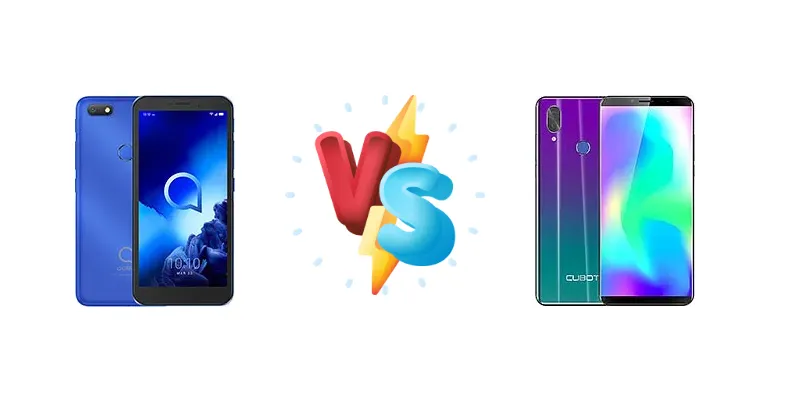
The Alcatel 1v (2019) and Cubot X19S represent the extreme end of the smartphone price spectrum. Both aim to deliver basic smartphone functionality at an incredibly low cost, but they achieve this with significantly different hardware. This comparison dissects their core components to determine which offers the better user experience for those on a tight budget.
🏆 Quick Verdict
For the average user prioritizing responsiveness and a slightly more modern chipset, the Cubot X19S emerges as the better choice. Its Mediatek Helio P23, built on a 16nm process, offers a noticeable performance advantage over the Alcatel 1v’s older Unisoc SC9863A, despite the Alcatel's more efficient core configuration.
| Network |
|---|
| 2G bands | GSM 850 / 900 / 1800 / 1900 | GSM 850 / 900 / 1800 / 1900 |
| 3G bands | HSDPA 800 / 850 / 900 / 1900 / 2100 - 5001D/5001U/5001T | HSDPA 900 / 2100 |
| 4G bands | 1, 3, 7, 8, 20, 28 - 5001D | 1, 3, 7, 8, 20 |
| Speed | HSPA 21.1/5.76 Mbps, LTE Cat4 150/50 Mbps | HSPA, LTE |
| Technology | GSM / HSPA / LTE | GSM / HSPA / LTE |
| | 1, 3, 5, 7, 8, 20, 28, 38, 40 - 5001T | - |
| Launch |
|---|
| Announced | 2019, September. Released 2019, Q4 | 2020. Released 2020 |
| Status | Discontinued | Discontinued |
| Body |
|---|
| Dimensions | 149.1 x 72.2 x 8.9 mm (5.87 x 2.84 x 0.35 in) | 155 x 74.7 x 9.6 mm (6.10 x 2.94 x 0.38 in) |
| SIM | · Nano-SIM· Nano-SIM + Nano-SIM | Nano-SIM + Nano-SIM |
| Weight | 153.2 g (5.40 oz) | 178.9 g (6.31 oz) |
| Display |
|---|
| Resolution | 480 x 960 pixels, 18:9 ratio (~195 ppi density) | 1080 x 2160 pixels, 18:9 ratio (~407 ppi density) |
| Size | 5.5 inches, 78.1 cm2 (~72.5% screen-to-body ratio) | 5.93 inches, 90.7 cm2 (~78.4% screen-to-body ratio) |
| Type | IPS LCD | IPS LCD |
| Platform |
|---|
| CPU | Octa-core (4x1.6 GHz Cortex-A55 & 4x1.2 GHz Cortex-A55) | Octa-core 2.5 GHz Cortex-A53 |
| Chipset | Unisoc SC9863A (28 nm) | Mediatek MT6763 Helio P23 (16 nm) |
| GPU | IMG8322 | Mali-G71 MP2 |
| OS | Android 9.0 Pie (Go edition) | Android 9.0 (Pie) |
| Memory |
|---|
| Card slot | microSDXC | microSDXC (uses shared SIM slot) |
| Internal | 16GB 1GB RAM, 16GB 2GB RAM, 16GB 3GB RAM | 32GB 4GB RAM |
| Main Camera |
|---|
| Dual | - | 16 MP, f/2.0, (wide), PDAF
2 MP |
| Features | LED flash, HDR, panorama | LED flash |
| Single | 5 MP, f/2.2, 28mm (wide), 1/5.0", 1.12µm
or
8 MP, f/2.2, 28mm (wide), 1/4.0", 1.12µm | - |
| Video | 1080p@30fps | Yes |
| Selfie camera |
|---|
| Features | LED flash | - |
| Single | 5 MP, f/2.2, 28mm (wide), 1/5.0", 1.12µm | 8 MP |
| Video | 1080p@30fps | Yes |
| Sound |
|---|
| 3.5mm jack | Yes | - |
| 35mm jack | Yes | Unspecified |
| Loudspeaker | Yes | Yes |
| Comms |
|---|
| Bluetooth | 4.2, A2DP, LE | 4.2, A2DP |
| NFC | No | No |
| Positioning | GPS | GPS |
| Radio | FM radio | Unspecified |
| USB | microUSB 2.0 | microUSB, OTG |
| WLAN | Wi-Fi 802.11 b/g/n, Wi-Fi Direct | Wi-Fi 802.11 a/b/g/n |
| Features |
|---|
| Sensors | Fingerprint (under display, optical) - market dependant, accelerometer, proximity | Fingerprint (rear-mounted), accelerometer, gyro, proximity, compass |
| Battery |
|---|
| Type | Li-Ion 2460 mAh, removable | 4000 mAh |
| Misc |
|---|
| Colors | Anthracite Black, Metallic Blue, Metallic Gold, Metallic Rose | Gradient, Black |
| Models | 5001D, 5001A, 5001U, 5001T, 5001J, 5001D_EEA | - |
| Price | About 80 EUR | - |
alcatel 1v (2019)
- Potentially better battery efficiency due to 28nm process.
- May run Android Go Edition for smoother performance on limited hardware.
- Lower price point (potentially).
- Significantly slower processor compared to the Cubot X19S.
- Older chipset architecture.
- Limited performance for multitasking or demanding apps.
Cubot X19S
- Faster processor (Helio P23) for smoother performance.
- More responsive user experience.
- More capable of handling social media and browsing.
- Potentially shorter battery life due to higher power consumption.
- May struggle with demanding games.
- Software optimization may be less refined.
Display Comparison
Neither device boasts a standout display. Details regarding panel type, resolution, and brightness are scarce for both. However, the focus here isn't display quality, but rather the underlying processing power needed to drive it. Both likely utilize low-cost LCD panels, and the difference in display performance will be minimal, dictated more by software optimization than hardware capabilities.
Camera Comparison
Camera performance on both devices will be limited. Specific sensor details are unavailable, but given the price point, expect basic image quality. The focus should not be on photographic capabilities, as both will struggle in low-light conditions. Any marketing around 'macro' lenses should be viewed with skepticism, as a 2MP sensor will offer minimal detail. The Helio P23’s ISP (Image Signal Processor) *may* offer slightly better image processing capabilities, but the overall experience will be heavily dependent on software optimization.
Performance
The core difference lies in the chipsets. The Cubot X19S’s Mediatek Helio P23 (16nm) features eight Cortex-A53 cores clocked at 2.5 GHz. This contrasts with the Alcatel 1v’s Unisoc SC9863A (28nm) which uses a combination of Cortex-A55 cores – four at 1.6 GHz and four at 1.2 GHz. While the Alcatel has more cores, the Helio P23’s higher clock speed and more advanced (though still older) architecture provide a tangible performance boost. The 16nm process node of the Helio P23 also contributes to better power efficiency compared to the 28nm Unisoc chip, though this advantage is partially offset by the higher clock speeds. The Alcatel 1v is likely running Android Go Edition to compensate for its limited processing power.
Battery Life
Battery capacity details are missing for both devices. However, the Unisoc SC9863A’s 28nm process is inherently more power-efficient than the Helio P23’s 16nm process *at the same clock speed*. However, the Helio P23’s higher performance means it will complete tasks faster, potentially reducing overall energy consumption. Charging wattage is also unknown, making it difficult to assess real-world charging times. The Alcatel 1v may offer slightly longer screen-on time for basic tasks, while the Cubot X19S will likely charge faster.
Buying Guide
Buy the Alcatel 1v (2019) if you need a phone primarily for basic communication – calls, texts, and light app usage – and value a potentially longer battery life due to the more efficient chipset. Buy the Cubot X19S if you prefer a more responsive experience for social media, browsing, and occasional gaming, and are willing to trade some potential battery life for increased processing power.
Frequently Asked Questions
❓ Will the Cubot X19S be able to run popular social media apps like Facebook and Instagram smoothly?
The Mediatek Helio P23 in the Cubot X19S is capable of running these apps, though expect some occasional lag or slowdowns, especially with multiple apps open. It's a significant improvement over the Alcatel 1v's Unisoc chip for these types of tasks.
❓ Is the Alcatel 1v (2019) a good choice for someone who primarily uses their phone for calls and texts?
Yes, the Alcatel 1v is well-suited for basic communication. Its more power-efficient chipset may provide longer battery life for calls and texts, and the less demanding processor is sufficient for these core functions.
❓ Can either of these phones handle basic mobile games like Candy Crush or Subway Surfers?
Both phones can run these types of games, but the Cubot X19S will provide a smoother and more enjoyable experience due to its faster processor. Expect lower graphics settings and potential frame rate drops on both devices.
❓ What version of Android do these phones run, and will they receive updates?
The Alcatel 1v (2019) likely runs Android Go Edition, a lightweight version of Android designed for low-end hardware. The Cubot X19S likely runs a full version of Android, but updates are unlikely for either device given their price point and target market.