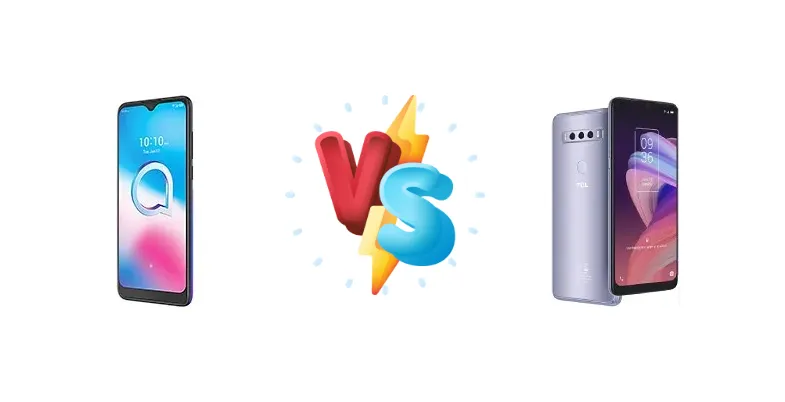
The alcatel 1S (2020) and TCL 10 SE represent the lower end of the smartphone market, targeting users prioritizing affordability. Both devices utilize the Mediatek Helio P22 chipset, but subtle differences in CPU clock speed and features like charging capability create a distinct separation in real-world performance and usability. This comparison dissects these nuances to help you choose the best option for your needs.
🏆 Quick Verdict
For the average user, the TCL 10 SE is the superior choice. While both phones share the same Mediatek Helio P22 chipset, the TCL 10 SE’s slightly faster 2.0 GHz CPU and 15W charging offer a noticeable improvement in responsiveness and convenience, justifying the potential price difference.
| Network |
|---|
| 2G bands | GSM 850 / 900 / 1800 / 1900 | GSM 850 / 900 / 1800 / 1900 |
| 3G bands | HSDPA 850 / 900 / 1900 / 2100 | HSDPA 850 / 900 / 1700(AWS) / 1900 / 2100 |
| 4G bands | 1, 3, 5, 7, 8, 20, 28, 38, 40 | 1, 2, 3, 5, 7, 8, 20, 28, 38, 40, 41 |
| Speed | HSPA 42.2/5.76 Mbps, LTE Cat4 150/50 Mbps | HSPA 42.2/5.76 Mbps, LTE (2CA) Cat13 400/75 Mbps |
| Technology | GSM / HSPA / LTE | GSM / HSPA / LTE |
| | - | HSDPA 800 / 850 / 900 / 2100 |
| Launch |
|---|
| Announced | 2020, January. Released 2020, May | 2020, July 09. Released 2020, July 21 |
| Status | Discontinued | Discontinued |
| Body |
|---|
| Build | Glass front, plastic back, plastic frame | - |
| Dimensions | 158.7 x 74.6 x 8.5 mm (6.25 x 2.94 x 0.33 in) | 164.9 x 74.7 x 8.4 mm (6.49 x 2.94 x 0.33 in) |
| SIM | Nano-SIM + Nano-SIM | · Nano-SIM· Nano-SIM + Nano-SIM |
| Weight | 165 g (5.82 oz) | 166 g (5.86 oz) |
| Display |
|---|
| Resolution | 720 x 1520 pixels, 19:9 ratio (~270 ppi density) | 720 x 1600 pixels, 20:9 ratio (~269 ppi density) |
| Size | 6.22 inches, 96.6 cm2 (~81.6% screen-to-body ratio) | 6.52 inches, 102.6 cm2 (~83.3% screen-to-body ratio) |
| Type | IPS LCD | LCD |
| Platform |
|---|
| CPU | Octa-core 1.8 GHz Cortex-A53 | Octa-core 2.0 GHz Cortex-A53 |
| Chipset | Mediatek MT6762D Helio P22 (12 nm) | Mediatek MT6762 Helio P22 (12 nm) |
| GPU | PowerVR GE8320 | PowerVR GE8320 |
| OS | Android 10 | Android 10, TCL UI |
| Memory |
|---|
| Card slot | microSDXC (uses shared SIM slot) | microSDXC (uses shared SIM slot) |
| Internal | 32GB 3GB RAM | 128GB 4GB RAM |
| | eMMC 5.1 | - |
| Main Camera |
|---|
| Features | LED flash, HDR, panorama | Dual-LED flash, HDR, panorama |
| Triple | 13 MP, f/1.8, (wide), 1/3.1", 1.12µm, AF
5 MP, f/2.2, (ultrawide/depth sensor), 1/5.0", 1.12µm
2 MP (macro) | 48 MP, f/1.8, 26mm (wide), 1/2.0", 0.8µm, PDAF
5 MP, f/2.2, 115˚ (ultrawide), 1.12µm
Auxiliary lens |
| Video | 1080p@30fps | 1080p@30fps |
| Selfie camera |
|---|
| Single | 5 MP, f/2.2, (wide), 1/5.0", 1.12µm | 8 MP, f/2.0, 26mm (wide), 1/4.0", 1.12µm
or
13 MP, f/2.2, 26mm (wide), 1/3.1", 1.12µm |
| Video | 1080p@30fps | 1080p@30fps |
| Sound |
|---|
| 3.5mm jack | Yes | Yes |
| 35mm jack | Yes | Yes |
| Loudspeaker | Yes | Yes |
| Comms |
|---|
| Bluetooth | 5.0, A2DP, LE | 5.0, A2DP, LE, aptX |
| NFC | No | Yes |
| Positioning | GPS | GPS, GLONASS, GALILEO, BDS |
| Radio | FM radio | FM radio |
| USB | microUSB 2.0 | USB Type-C 2.0, OTG |
| WLAN | Wi-Fi 802.11 b/g/n, Wi-Fi Direct | Wi-Fi 802.11 a/b/g/n/ac, dual-band, Wi-Fi Direct |
| Features |
|---|
| Sensors | Fingerprint (rear-mounted), accelerometer, proximity, compass | Fingerprint (rear-mounted), accelerometer, gyro, proximity, compass |
| Battery |
|---|
| Charging | - | 15W wired |
| Type | Li-Po 4000 mAh | Li-Po 4000 mAh |
| Misc |
|---|
| Colors | Agate Green, Power Grey | Black, Violet |
| Models | 5028Y, 5028D, 5028D_EEA, 5028Y_EEA, 5028A | T766H_EEA, T766U, T766H, T766A, T766J |
| Price | About 100 EUR | - |
alcatel 1S (2020)
- Potentially lower price point.
- Compact and lightweight design (likely).
- Reliable Mediatek Helio P22 chipset.
- Slower CPU clock speed (1.8 GHz).
- Slower charging speeds.
- Likely less responsive user interface.
TCL 10 SE
- Faster CPU clock speed (2.0 GHz).
- 15W fast charging support.
- Slightly more responsive user experience.
- Potentially higher price.
- May not offer significant camera improvements.
- Still limited by the Helio P22 chipset.
Display Comparison
Neither device boasts a standout display. Both likely utilize LCD panels, common in this price bracket. Specifics like resolution and brightness are not provided, but we can assume they are similar – likely 720p+ and adequate for basic use. The absence of features like high refresh rates or HDR support is expected. Bezels are likely substantial on both, maximizing screen real estate within a budget.
Camera Comparison
Camera performance is likely to be similar on both devices, with neither excelling in image quality. Details regarding sensor size and aperture are unavailable, but both likely feature a primary camera paired with auxiliary sensors of limited utility. The focus should be on adequate performance in good lighting conditions, with image quality degrading significantly in low light. Expect basic image processing and limited dynamic range. The absence of Optical Image Stabilization (OIS) is expected.
Performance
Both the alcatel 1S (2020) and TCL 10 SE are powered by the Mediatek MT6762 Helio P22 (12 nm) chipset, featuring an octa-core CPU. However, the TCL 10 SE’s CPU is clocked at 2.0 GHz, a 0.2 GHz increase over the alcatel 1S’s 1.8 GHz. While seemingly minor, this clock speed difference translates to slightly faster application loading times and a more responsive user interface on the TCL 10 SE. Both rely on Cortex-A53 cores, which are efficient but not designed for demanding tasks. Gaming performance will be limited to less intensive titles at lower settings. RAM configurations are not specified, but both likely feature 2-3GB, which is sufficient for basic multitasking but can lead to app reloading.
Battery Life
Battery capacity is not specified for either device, but both likely feature batteries in the 3000-4000 mAh range, typical for this segment. The TCL 10 SE gains a significant advantage with its 15W wired charging support. The alcatel 1S likely relies on slower 10W or 5W charging, resulting in considerably longer charge times. This means the TCL 10 SE can be topped up more quickly, reducing downtime and improving usability for users who rely heavily on their phones throughout the day.
Buying Guide
Buy the alcatel 1S (2020) if you absolutely need the lowest possible price and are willing to compromise on charging speed and potentially overall responsiveness. Buy the TCL 10 SE if you prioritize a slightly smoother user experience, faster charging, and a more modern feature set, even if it means spending a bit more upfront.
Frequently Asked Questions
❓ Will the TCL 10 SE's faster charging significantly reduce my charging time compared to the alcatel 1S?
Yes, the TCL 10 SE's 15W charging will noticeably reduce charging time. While exact figures depend on the battery capacity (which isn't specified), you can expect a 0-100% charge to be considerably faster than the alcatel 1S, which likely supports only 5W or 10W charging.
❓ Can I expect to play demanding games like PUBG Mobile on either of these phones?
While both phones can technically run PUBG Mobile, you'll need to lower the graphics settings to the minimum and accept lower frame rates. The Mediatek Helio P22 is not a gaming-focused chipset, and the limited RAM will further constrain performance. Expect occasional stuttering and lag.
❓ Is the difference in CPU clock speed (1.8 GHz vs 2.0 GHz) really noticeable in everyday use?
The 0.2 GHz difference isn't massive, but it contributes to a slightly snappier experience on the TCL 10 SE. You'll notice it in app loading times and general UI responsiveness, especially when multitasking. It's a subtle but tangible improvement.