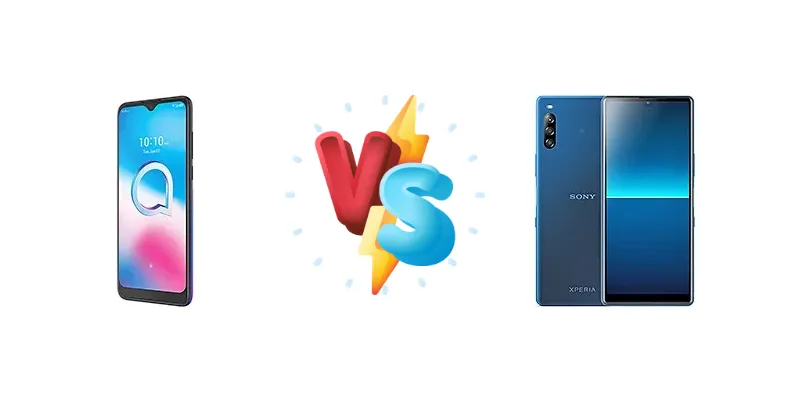
Both the Sony Xperia L4 and the Alcatel 1S (2020) occupy the ultra-budget smartphone segment, aiming to deliver essential functionality at the lowest possible price. However, despite sharing the same Mediatek Helio P22 chipset, subtle differences in CPU clock speed and feature sets create a noticeable disparity in real-world performance and user experience. This comparison dissects these nuances to determine which device offers the best value.
🏆 Quick Verdict
For the average user prioritizing responsiveness and future-proofing, the Sony Xperia L4 is the better choice. While both phones share the same chipset architecture, the Xperia L4’s 2.0 GHz CPU clock speed provides a tangible performance boost over the Alcatel 1S’s 1.8 GHz, coupled with the added benefit of USB Power Delivery for faster charging.
| Network |
|---|
| 2G bands | GSM 850 / 900 / 1800 / 1900 | GSM 850 / 900 / 1800 / 1900 |
| 3G bands | HSDPA 850 / 900 / 1900 / 2100 | HSDPA 850 / 900 / 1900 / 2100 |
| 4G bands | 1, 3, 5, 7, 8, 20, 28, 38, 40 | 1, 2, 3, 5, 7, 8, 20, 40 |
| Speed | HSPA 42.2/5.76 Mbps, LTE Cat4 150/50 Mbps | HSPA 42.2/5.76 Mbps, LTE (2CA) Cat6 300/50 Mbps |
| Technology | GSM / HSPA / LTE | GSM / HSPA / LTE |
| Launch |
|---|
| Announced | 2020, January. Released 2020, May | 2020, February 20. Released 2020, April 28 |
| Status | Discontinued | Discontinued |
| Body |
|---|
| Build | Glass front, plastic back, plastic frame | Glass front, plastic back, plastic frame |
| Dimensions | 158.7 x 74.6 x 8.5 mm (6.25 x 2.94 x 0.33 in) | 159 x 71 x 8.7 mm (6.26 x 2.80 x 0.34 in) |
| SIM | Nano-SIM + Nano-SIM | · Nano-SIM· Nano-SIM + Nano-SIM |
| Weight | 165 g (5.82 oz) | 178 g (6.28 oz) |
| Display |
|---|
| Resolution | 720 x 1520 pixels, 19:9 ratio (~270 ppi density) | 720 x 1680 pixels, 21:9 ratio (~295 ppi density) |
| Size | 6.22 inches, 96.6 cm2 (~81.6% screen-to-body ratio) | 6.2 inches, 89.8 cm2 (~79.5% screen-to-body ratio) |
| Type | IPS LCD | IPS LCD |
| Platform |
|---|
| CPU | Octa-core 1.8 GHz Cortex-A53 | Octa-core 2.0 GHz Cortex-A53 |
| Chipset | Mediatek MT6762D Helio P22 (12 nm) | Mediatek MT6762 Helio P22 (12 nm) |
| GPU | PowerVR GE8320 | PowerVR GE8320 |
| OS | Android 10 | Android 9.0 (Pie) |
| Memory |
|---|
| Card slot | microSDXC (uses shared SIM slot) | microSDXC (uses shared SIM slot) |
| Internal | 32GB 3GB RAM | 64GB 3GB RAM |
| | eMMC 5.1 | eMMC 5.1 |
| Main Camera |
|---|
| Features | LED flash, HDR, panorama | LED flash, HDR, panorama |
| Triple | 13 MP, f/1.8, (wide), 1/3.1", 1.12µm, AF
5 MP, f/2.2, (ultrawide/depth sensor), 1/5.0", 1.12µm
2 MP (macro) | 13 MP, f/2.0, 26mm (wide), 1/3.0", PDAF
5 MP, f/2.2, 17mm (ultrawide), 1/5.0", 1.12µm
Auxiliary lens |
| Video | 1080p@30fps | 1080p@30fps |
| Selfie camera |
|---|
| Single | 5 MP, f/2.2, (wide), 1/5.0", 1.12µm | 8 MP, f/2.0, 27mm (wide), 1/4.0", 1.12µm |
| Video | 1080p@30fps | 1080p@30fps |
| Sound |
|---|
| 3.5mm jack | Yes | Yes |
| 35mm jack | Yes | Yes |
| Loudspeaker | Yes | Yes |
| Comms |
|---|
| Bluetooth | 5.0, A2DP, LE | 5.0, A2DP, LE |
| NFC | No | Yes |
| Positioning | GPS | GPS, GLONASS |
| Radio | FM radio | FM radio |
| USB | microUSB 2.0 | USB Type-C 2.0 |
| WLAN | Wi-Fi 802.11 b/g/n, Wi-Fi Direct | Wi-Fi 802.11 a/b/g/n, dual-band, Wi-Fi Direct |
| Features |
|---|
| Sensors | Fingerprint (rear-mounted), accelerometer, proximity, compass | Fingerprint (side-mounted), accelerometer, proximity, compass |
| Battery |
|---|
| Charging | - | USB Power Delivery |
| Type | Li-Po 4000 mAh | Li-Ion 3580 mAh |
| Misc |
|---|
| Colors | Agate Green, Power Grey | Black, Blue |
| Models | 5028Y, 5028D, 5028D_EEA, 5028Y_EEA, 5028A | XQ-AD52, XQ-AD51 |
| Price | About 100 EUR | About 200 EUR |
alcatel 1S (2020)
- Extremely affordable price point
- Functional for basic smartphone tasks
- Compact and lightweight design
- Slower CPU clock speed (1.8 GHz)
- Likely slower charging speeds
- Limited performance for demanding apps
Sony Xperia L4
- Faster CPU clock speed (2.0 GHz) for improved performance
- USB Power Delivery for faster charging
- Sony brand recognition
- Slightly higher price compared to the Alcatel 1S
- Still limited by the Helio P22 chipset
- Likely similar camera performance
Display Comparison
Neither Sony nor Alcatel provide detailed display specifications beyond resolution. Both likely utilize LCD panels, common in this price bracket. The absence of data on brightness nits, color gamut coverage, or refresh rates suggests a focus on cost reduction. Bezels are expected to be substantial on both devices, impacting the overall screen-to-body ratio. Color accuracy is likely to be standard for the price point, prioritizing power efficiency over fidelity.
Camera Comparison
Camera performance is likely to be similar on both devices, relying heavily on software processing to enhance image quality. Both are expected to feature a primary camera alongside depth and potentially macro sensors, though details are scarce. The absence of Optical Image Stabilization (OIS) on either device means low-light photography will be challenging. While megapixel counts may differ, the image sensor size is the critical factor, and without that data, it’s difficult to definitively assess camera quality. The 2MP macro sensors commonly found in this segment offer limited practical benefit due to their low resolution and lack of detail.
Performance
Both the Alcatel 1S (2020) and the Sony Xperia L4 are powered by the Mediatek MT6762 Helio P22 (12 nm). However, the Xperia L4 boasts a CPU clock speed of 2.0 GHz, a 11.1% increase over the Alcatel 1S’s 1.8 GHz. This seemingly small difference translates to faster app loading times and smoother multitasking. Both utilize an Octa-core Cortex-A53 configuration, meaning the performance gains are primarily due to the higher clock speed. While neither phone is a gaming powerhouse, the Xperia L4 will handle less demanding titles with slightly better frame rates. The lack of information on RAM speed (likely LPDDR3) suggests a shared limitation in memory bandwidth, potentially bottlenecking performance in more intensive tasks.
Battery Life
Battery capacity is not specified for either device, but both likely feature batteries in the 3000-4000 mAh range, typical for this class. The key differentiator is the Sony Xperia L4’s support for USB Power Delivery. This allows for faster charging speeds compared to the Alcatel 1S, which likely relies on standard 5W charging. While 0-100% charge times are unavailable, the Xperia L4 will significantly reduce downtime, making it more convenient for users who need to quickly top up their battery.
Buying Guide
Buy the Alcatel 1S (2020) if you need a functional, extremely affordable smartphone for basic tasks like calls, texts, and light social media use, and are willing to compromise on performance. Buy the Sony Xperia L4 if you prefer a slightly more responsive experience, faster charging capabilities via USB Power Delivery, and the brand recognition of Sony, even within the budget segment.
Frequently Asked Questions
❓ Will the Sony Xperia L4 handle popular games like PUBG Mobile?
While the Xperia L4 can *run* PUBG Mobile, expect to play at low settings and potentially experience frame rate drops. The Helio P22 chipset is not designed for demanding gaming, and the phone may heat up during extended play sessions. It's suitable for casual gaming, but not for competitive or graphically intensive titles.
❓ How much faster is the charging on the Sony Xperia L4 compared to the Alcatel 1S?
The Alcatel 1S likely supports standard 5W charging, resulting in a slow charge time. The Xperia L4’s USB Power Delivery support allows for significantly faster charging, potentially reaching 10W or higher depending on the charger used. This translates to a noticeable reduction in charging time, allowing you to quickly top up your battery when needed.
❓ Is the difference in CPU clock speed (1.8 GHz vs 2.0 GHz) really noticeable in everyday use?
Yes, the 2.0 GHz CPU in the Xperia L4 provides a tangible improvement in responsiveness. You'll notice faster app loading times, smoother scrolling, and a more fluid multitasking experience compared to the Alcatel 1S. While not a massive leap, it's a significant advantage within the ultra-budget segment.