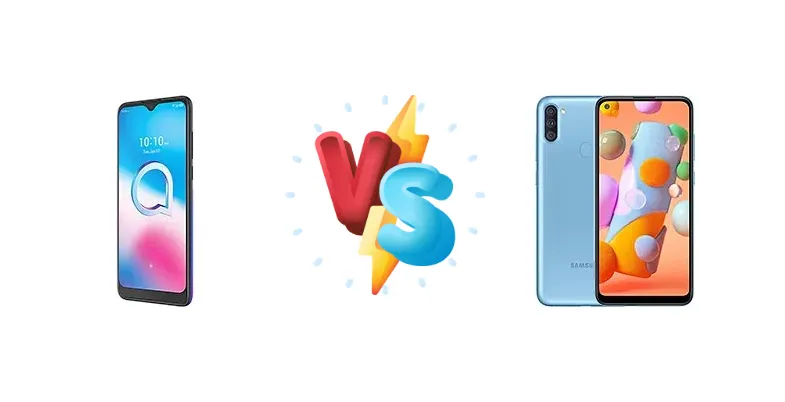
The Alcatel 1S (2020) and Samsung Galaxy A11 represent the lower end of the smartphone spectrum, targeting users prioritizing affordability. While both offer essential smartphone functionality, they diverge in their core hardware choices, specifically the chipset. This comparison dissects those differences to determine which device delivers the best value for budget-conscious consumers.
🏆 Quick Verdict
For the average user, the Samsung Galaxy A11 edges out the Alcatel 1S (2020) due to its 15W charging capability. While both phones utilize an octa-core Cortex-A53 CPU, the A11’s faster charging mitigates the slightly less efficient Snapdragon 450 chipset, offering a more convenient user experience.
| Network |
|---|
| 2G bands | GSM 850 / 900 / 1800 / 1900 | GSM 850 / 900 / 1800 / 1900 |
| 3G bands | HSDPA 850 / 900 / 1900 / 2100 | HSDPA 850 / 900 / 1900 / 2100 |
| 4G bands | 1, 3, 5, 7, 8, 20, 28, 38, 40 | 1, 2, 3, 5, 7, 8, 20, 28, 38, 40, 41 |
| Speed | HSPA 42.2/5.76 Mbps, LTE Cat4 150/50 Mbps | HSPA 42.2/5.76 Mbps, LTE Cat4 150/50 Mbps |
| Technology | GSM / HSPA / LTE | GSM / HSPA / LTE |
| | - | 1, 2, 3, 4, 5, 7, 8, 12, 13, 17, 20, 25, 26, 28, 38, 39, 40, 41, 66, 71 - SM-A115U |
| Launch |
|---|
| Announced | 2020, January. Released 2020, May | 2020, March 13. Released 2020, May 01 |
| Status | Discontinued | Discontinued |
| Body |
|---|
| Build | Glass front, plastic back, plastic frame | Glass front, plastic back, plastic frame |
| Dimensions | 158.7 x 74.6 x 8.5 mm (6.25 x 2.94 x 0.33 in) | 161.4 x 76.3 x 8 mm (6.35 x 3.00 x 0.31 in) |
| SIM | Nano-SIM + Nano-SIM | · Nano-SIM· Nano-SIM + Nano-SIM |
| Weight | 165 g (5.82 oz) | 177 g (6.24 oz) |
| Display |
|---|
| Resolution | 720 x 1520 pixels, 19:9 ratio (~270 ppi density) | 720 x 1560 pixels, 19.5:9 ratio (~268 ppi density) |
| Size | 6.22 inches, 96.6 cm2 (~81.6% screen-to-body ratio) | 6.4 inches, 100.5 cm2 (~81.6% screen-to-body ratio) |
| Type | IPS LCD | PLS LCD |
| Platform |
|---|
| CPU | Octa-core 1.8 GHz Cortex-A53 | Octa-core 1.8 GHz Cortex-A53 |
| Chipset | Mediatek MT6762D Helio P22 (12 nm) | Qualcomm SDM450 Snapdragon 450 (14 nm) |
| GPU | PowerVR GE8320 | Adreno 506 |
| OS | Android 10 | Android 10, upgradable to Android 12, One UI Core 4.1 |
| Memory |
|---|
| Card slot | microSDXC (uses shared SIM slot) | microSDXC (dedicated slot) |
| Internal | 32GB 3GB RAM | 32GB 2GB RAM, 32GB 3GB RAM, 64GB 3GB RAM, 64GB 4GB RAM |
| | eMMC 5.1 | eMMC 5.1 |
| Main Camera |
|---|
| Features | LED flash, HDR, panorama | LED flash, panorama, HDR |
| Triple | 13 MP, f/1.8, (wide), 1/3.1", 1.12µm, AF
5 MP, f/2.2, (ultrawide/depth sensor), 1/5.0", 1.12µm
2 MP (macro) | 13 MP, f/1.8, 27mm (wide), AF
5 MP, f/2.2, 115˚ (ultrawide)
Auxiliary lens |
| Video | 1080p@30fps | 1080p@30fps |
| Selfie camera |
|---|
| Single | 5 MP, f/2.2, (wide), 1/5.0", 1.12µm | 8 MP, f/2.0 |
| Video | 1080p@30fps | 1080p@30fps |
| Sound |
|---|
| 3.5mm jack | Yes | Yes |
| 35mm jack | Yes | Yes |
| Loudspeaker | Yes | Yes |
| Comms |
|---|
| Bluetooth | 5.0, A2DP, LE | 4.2, A2DP, LE |
| NFC | No | No |
| Positioning | GPS | GPS, GLONASS, GALILEO, BDS |
| Radio | FM radio | FM radio |
| USB | microUSB 2.0 | USB Type-C 2.0 |
| WLAN | Wi-Fi 802.11 b/g/n, Wi-Fi Direct | Wi-Fi 802.11 b/g/n, Wi-Fi Direct |
| Features |
|---|
| Sensors | Fingerprint (rear-mounted), accelerometer, proximity, compass | Fingerprint (rear-mounted), accelerometer, proximity |
| Battery |
|---|
| Charging | - | 15W wired |
| Type | Li-Po 4000 mAh | Li-Po 4000 mAh |
| Misc |
|---|
| Colors | Agate Green, Power Grey | Black, White, Blue, Red |
| Models | 5028Y, 5028D, 5028D_EEA, 5028Y_EEA, 5028A | SM-A115F/DS, SM-A115F, SM-A115M, SM-A115M/DS, SM-A115U, SM-A115A, SM-A115AZ, SM-A115U1, SM-A115W, SM-A115AP, SM-S115DL |
| Price | About 100 EUR | About 160 EUR |
| SAR EU | - | 0.52 W/kg (head) 0.99 W/kg (body) |
alcatel 1S (2020)
- Potentially better power efficiency due to 12nm Helio P22.
- Lower price point (likely).
- Simple, straightforward Android experience.
- Significantly slower charging speeds.
- Less brand recognition than Samsung.
Samsung Galaxy A11
- 15W fast charging for quicker top-ups.
- Samsung’s established brand and software support.
- Potentially better camera image processing.
- Less power-efficient 14nm Snapdragon 450.
- May be slightly more expensive than the Alcatel 1S.
Display Comparison
Neither device is expected to deliver a premium display experience. Details regarding panel type, resolution, and brightness are not provided, but given the price point, both likely utilize LCD panels. The focus here is on the internal hardware, not display fidelity. Bezels are likely substantial on both devices, typical for this segment.
Camera Comparison
Camera performance is unlikely to be a key differentiator. Without specific sensor details, it’s safe to assume both phones feature basic camera setups geared towards casual photography. The presence of a 2MP macro lens on the Galaxy A11 is likely more of a marketing feature than a substantial improvement in image quality. Image processing will likely favor Samsung’s typically vibrant style, while the Alcatel 1S may offer a more natural look. The lack of OIS on either device means low-light performance will be limited.
Performance
The core difference lies in the chipsets: the Alcatel 1S (2020) uses the Mediatek MT6762D Helio P22 (12nm), while the Samsung Galaxy A11 features the Qualcomm Snapdragon 450 (14nm). Both employ an octa-core 1.8 GHz Cortex-A53 CPU, meaning raw CPU performance will be comparable for everyday tasks like browsing and social media. However, the Helio P22’s 12nm process *should* result in slightly better power efficiency, potentially leading to longer battery life under similar usage. The Snapdragon 450’s 14nm process is less efficient, but Qualcomm’s optimizations may partially offset this. Neither chipset is designed for demanding gaming or multitasking.
Battery Life
Battery capacity isn’t specified, but both phones likely house batteries in the 4000-5000 mAh range. The critical difference is charging speed: the Samsung Galaxy A11 supports 15W wired charging, while the Alcatel 1S (2020) likely supports a standard 5W or 10W charging rate. This translates to significantly faster charging times for the Galaxy A11, a major convenience factor. While the Alcatel 1S’s more efficient chipset *could* extend battery life, the convenience of quickly topping up the Galaxy A11 is a significant advantage.
Buying Guide
Buy the Alcatel 1S (2020) if you prioritize a potentially longer battery life due to the more efficient 12nm manufacturing process of the Helio P22, and are comfortable with slower charging speeds. Buy the Samsung Galaxy A11 if you value faster charging and are willing to accept potentially slightly shorter battery life, and prefer the Samsung brand ecosystem.
Frequently Asked Questions
❓ Will the Snapdragon 450 in the Galaxy A11 struggle with multitasking compared to the Helio P22?
While both chipsets utilize the same Cortex-A53 CPU architecture, the Snapdragon 450’s GPU and memory controller may offer slightly better performance in multitasking scenarios. However, the difference will likely be minimal and only noticeable with a moderate number of apps open.
❓ How long will it take to fully charge the Samsung Galaxy A11 with the 15W charger?
Estimating a full charge time is difficult without knowing the battery capacity. However, with a 15W charger, expect a full charge to take between 2 to 3 hours, significantly faster than the Alcatel 1S which could take 4+ hours with a standard charger.
❓ Is the camera on either phone good enough for casual social media posting?
Yes, both phones are adequate for casual social media photography in good lighting conditions. Don't expect exceptional detail or low-light performance, but they will suffice for everyday snapshots.
❓ Does the Alcatel 1S (2020) support software updates for security patches?
Alcatel’s software update track record is less consistent than Samsung’s. While the 1S (2020) likely launched with Android 10, long-term security updates are not guaranteed and may be infrequent.