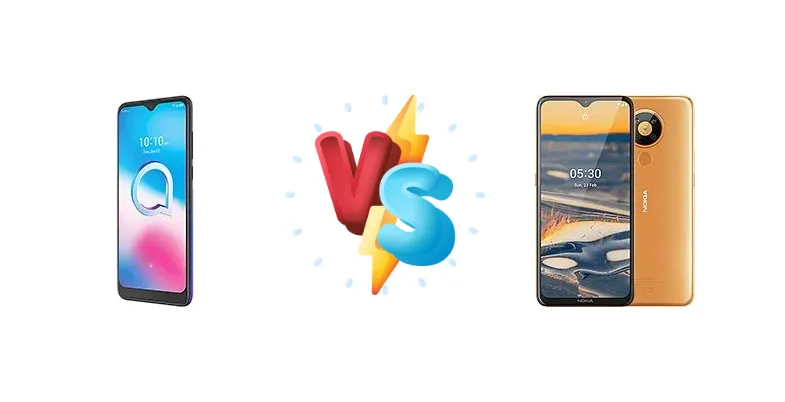
The Alcatel 1S (2020) and Nokia 5.3 represent two distinct approaches to the ultra-budget smartphone market. The Alcatel prioritizes affordability, while the Nokia 5.3 aims for a slightly more refined experience with a more modern chipset. This comparison dissects their core components to determine which device delivers the best value for users seeking a functional and reliable smartphone without breaking the bank.
🏆 Quick Verdict
For the average user prioritizing responsiveness and future-proofing, the Nokia 5.3 is the clear winner. Its Snapdragon 665 chipset, built on an 11nm process, offers a significant performance advantage over the Alcatel 1S’s Helio P22, translating to smoother multitasking and a better overall user experience. However, the Alcatel 1S remains a viable option for those on the tightest of budgets.
| Network |
|---|
| 2G bands | GSM 850 / 900 / 1800 / 1900 | GSM 850 / 900 / 1800 / 1900 |
| 3G bands | HSDPA 850 / 900 / 1900 / 2100 | HSDPA 850 / 900 / 1900 / 2100 - Global |
| 4G bands | 1, 3, 5, 7, 8, 20, 28, 38, 40 | 1, 3, 5, 7, 8, 20, 28, 38, 40, 41 - Global |
| Speed | HSPA 42.2/5.76 Mbps, LTE Cat4 150/50 Mbps | HSPA 42.2/5.76 Mbps, LTE Cat4 150/50 Mbps |
| Technology | GSM / HSPA / LTE | GSM / HSPA / LTE |
| | - | 1, 3, 5, 8, 40, 41 - India |
| Launch |
|---|
| Announced | 2020, January. Released 2020, May | 2020, March 19. Released 2020, April 02 |
| Status | Discontinued | Discontinued |
| Body |
|---|
| Build | Glass front, plastic back, plastic frame | Glass front (Gorilla Glass 3), plastic back, plastic frame |
| Dimensions | 158.7 x 74.6 x 8.5 mm (6.25 x 2.94 x 0.33 in) | 164.3 x 76.6 x 8.5 mm (6.47 x 3.02 x 0.33 in) |
| SIM | Nano-SIM + Nano-SIM | · Nano-SIM· Nano-SIM + Nano-SIM |
| Weight | 165 g (5.82 oz) | 185 g (6.53 oz) |
| Display |
|---|
| Protection | - | Corning Gorilla Glass 3 |
| Resolution | 720 x 1520 pixels, 19:9 ratio (~270 ppi density) | 720 x 1600 pixels, 20:9 ratio (~268 ppi density) |
| Size | 6.22 inches, 96.6 cm2 (~81.6% screen-to-body ratio) | 6.55 inches, 103.6 cm2 (~82.3% screen-to-body ratio) |
| Type | IPS LCD | IPS LCD, 450 nits (typ) |
| Platform |
|---|
| CPU | Octa-core 1.8 GHz Cortex-A53 | Octa-core (4x2.0 GHz Kryo 260 Gold & 4x1.8 GHz Kryo 260 Silver) |
| Chipset | Mediatek MT6762D Helio P22 (12 nm) | Qualcomm SM6125 Snapdragon 665 (11 nm) |
| GPU | PowerVR GE8320 | Adreno 610 |
| OS | Android 10 | Android 10, upgradable to Android 11, Android One |
| Memory |
|---|
| Card slot | microSDXC (uses shared SIM slot) | microSDXC (dedicated slot) |
| Internal | 32GB 3GB RAM | 64GB 3GB RAM, 64GB 4GB RAM, 64GB 6GB RAM, 128GB 4GB RAM |
| | eMMC 5.1 | eMMC 5.1 |
| Main Camera |
|---|
| Features | LED flash, HDR, panorama | LED flash, HDR, panorama |
| Quad | - | 13 MP, f/1.8, (wide), PDAF
5 MP, 13mm (ultrawide)
2 MP (macro)
Auxiliary lens |
| Triple | 13 MP, f/1.8, (wide), 1/3.1", 1.12µm, AF
5 MP, f/2.2, (ultrawide/depth sensor), 1/5.0", 1.12µm
2 MP (macro) | - |
| Video | 1080p@30fps | 4K@30fps, 1080p@30fps |
| Selfie camera |
|---|
| Single | 5 MP, f/2.2, (wide), 1/5.0", 1.12µm | 8 MP, f/2.0, (wide) |
| Video | 1080p@30fps | 1080p@30fps |
| Sound |
|---|
| 3.5mm jack | Yes | Yes |
| 35mm jack | Yes | Yes |
| Loudspeaker | Yes | Yes |
| Comms |
|---|
| Bluetooth | 5.0, A2DP, LE | 4.2, A2DP, LE, aptX |
| NFC | No | Yes |
| Positioning | GPS | GPS, GLONASS, BDS |
| Radio | FM radio | FM radio |
| USB | microUSB 2.0 | USB Type-C 2.0, OTG |
| WLAN | Wi-Fi 802.11 b/g/n, Wi-Fi Direct | Wi-Fi 802.11 b/g/n/ac, Wi-Fi Direct |
| Features |
|---|
| Sensors | Fingerprint (rear-mounted), accelerometer, proximity, compass | Fingerprint (rear-mounted), accelerometer, proximity |
| Battery |
|---|
| Charging | - | 10W wired |
| Type | Li-Po 4000 mAh | Li-Po 4000 mAh |
| Misc |
|---|
| Colors | Agate Green, Power Grey | Cyan, Sand, Charcoal |
| Models | 5028Y, 5028D, 5028D_EEA, 5028Y_EEA, 5028A | TA-1234, TA-1223, TA-1227, TA-1229 |
| Price | About 100 EUR | About 290 EUR |
| SAR | - | 1.03 W/kg (head) 0.95 W/kg (body) |
| SAR EU | - | 0.70 W/kg (head) 1.39 W/kg (body) |
alcatel 1S (2020)
- Likely the most affordable option.
- Functional for basic smartphone tasks.
- May offer slightly longer battery life due to potentially larger capacity (spec unknown).
- Significantly slower performance than the Nokia 5.3.
- Less efficient chipset leading to potential throttling.
- Limited software support and updates.
Nokia 5.3
- Faster and more responsive performance thanks to the Snapdragon 665.
- More efficient chipset for better battery life and less heat.
- Likely to receive more software updates and security patches.
- Slightly higher price point.
- Slow 10W charging.
- Camera performance is still limited by budget components.
Display Comparison
Neither device boasts a standout display. Both likely utilize LCD panels, common in this price bracket. The key difference lies under the hood: processing power impacts UI smoothness. While neither spec sheet details resolution or brightness, the Nokia 5.3’s superior chipset will contribute to a more fluid scrolling experience, even if the panel itself is similar. Bezels are expected to be substantial on both devices, reflecting their budget positioning.
Camera Comparison
Camera performance is likely to be similar in real-world usage, given the typical limitations of budget smartphone cameras. Both devices likely feature a primary sensor paired with auxiliary lenses of limited utility. Without specific sensor size or aperture information, it’s difficult to definitively declare a winner. However, the Snapdragon 665’s image signal processor (ISP) is generally more capable than the Helio P22’s, potentially resulting in slightly better image processing and dynamic range on the Nokia 5.3. Expect both to struggle in low-light conditions.
Performance
The Nokia 5.3’s Qualcomm Snapdragon 665 (11nm) is the clear performance champion. The 11nm fabrication process is more efficient than the Alcatel 1S’s Mediatek Helio P22 (12nm), leading to lower power consumption and potentially less thermal throttling. The Snapdragon 665’s CPU configuration – a combination of 4x2.0 GHz Kryo 260 Gold and 4x1.8 GHz Kryo 260 Silver cores – provides a more balanced and powerful processing experience compared to the Alcatel 1S’s uniform Octa-core 1.8 GHz Cortex-A53 setup. This translates to faster app loading times and smoother multitasking on the Nokia 5.3.
Battery Life
While the Alcatel 1S’s battery capacity is unknown, the Nokia 5.3’s efficiency gains from the 11nm Snapdragon 665 will likely translate to comparable or even better battery life, despite the Nokia 5.3 only supporting 10W wired charging. The more efficient chipset means less power is consumed during everyday tasks, offsetting any potential capacity difference. The 10W charging on the Nokia 5.3 is slow by modern standards, but adequate for overnight charging.
Buying Guide
Buy the Alcatel 1S (2020) if you need a functional smartphone for basic tasks like calls, texts, and light social media use, and your budget is extremely limited. Buy the Nokia 5.3 if you prefer a more responsive device capable of handling moderate multitasking, occasional gaming, and benefit from a more efficient chipset that should offer better longevity and software support.
Frequently Asked Questions
❓ Will the Nokia 5.3 be able to handle popular social media apps like TikTok and Instagram without significant lag?
Yes, the Snapdragon 665 in the Nokia 5.3 is sufficiently powerful to run social media apps like TikTok and Instagram smoothly. While it won't offer a flagship-level experience, it will provide a much more responsive and enjoyable experience compared to the Alcatel 1S's Helio P22, which may struggle with these apps, especially when multitasking.
❓ Is the 10W charging on the Nokia 5.3 a major drawback?
While 10W charging is slow compared to modern fast charging standards, it's acceptable for a budget device like the Nokia 5.3. It's best suited for overnight charging. The Snapdragon 665's efficiency means you won't be topping up the battery as frequently, mitigating the impact of the slow charging speed.
❓ Can I expect to play demanding games like PUBG Mobile on either of these phones?
Playing PUBG Mobile on either device will require significant compromises. The Alcatel 1S's Helio P22 will likely struggle to maintain a playable framerate even on the lowest settings. The Nokia 5.3 might be able to run PUBG Mobile at low settings with reduced graphics, but expect noticeable lag and frame drops. These phones are not designed for demanding gaming.