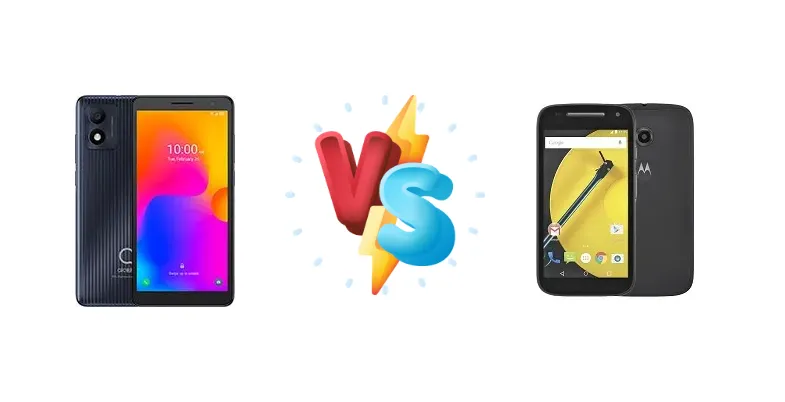
Looking for an affordable smartphone that won't break the bank? The Alcatel 1B (2022) and the Motorola Moto E (2nd Gen) are both contenders in the budget phone arena. But which one offers the best bang for your buck? Let's dive into a detailed comparison.
🏆 Quick Verdict
The Motorola Moto E (2nd Gen) edges out the Alcatel 1B (2022) primarily due to its significantly better battery life and slightly more mature software experience. While the Alcatel boasts a newer chipset, the Moto E's endurance and overall reliability make it a stronger choice for most users.
| Network |
|---|
| 2G bands | GSM 850 / 900 / 1800 / 1900 | GSM 850 / 900 / 1800 / 1900 - all versions |
| 3G bands | HSDPA 850 / 900 / 1900 / 2100 | HSDPA 850 / 1700(AWS) / 1900 - XT1527, XT1511 |
| 4G bands | 1, 3, 5, 7, 8, 20, 28, 38, 40, 41 - 5031D, 5031G | 2, 4, 5, 7, 17 - XT1527 |
| Speed | HSPA 42.2/11.1 Mbps, LTE Cat4 150/50 Mbps | HSPA, LTE |
| Technology | GSM / HSPA / LTE | GSM / HSPA / LTE |
| | 2, 3, 4, 5, 7, 8, 12, 13, 17, 26, 28, 38, 40, 66 - 5031A, 5041J | 1, 3, 7, 20 - XT1524 |
| Launch |
|---|
| Announced | 2022, May 31 | 2015, February. Released 2015, February |
| Status | Available. Released 2022, May 31 | Discontinued |
| Body |
|---|
| Dimensions | 146.7 x 71.9 x 10 mm (5.78 x 2.83 x 0.39 in) | 129.9 x 66.8 x 12.3 mm (5.11 x 2.63 x 0.48 in) |
| SIM | · Nano-SIM· Nano-SIM + Nano-SIM | Micro-SIM |
| Weight | 172 g (6.07 oz) | 145 g (5.11 oz) |
| Display |
|---|
| Protection | - | Corning Gorilla Glass 3, oleophobic coating |
| Resolution | 720 x 1440 pixels, 18:9 ratio (~293 ppi density) | 540 x 960 pixels, 16:9 ratio (~245 ppi density) |
| Size | 5.5 inches, 78.1 cm2 (~74.0% screen-to-body ratio) | 4.5 inches, 55.8 cm2 (~64.3% screen-to-body ratio) |
| Type | TFT LCD | IPS LCD |
| Platform |
|---|
| CPU | Quad-core 2.0 GHz Cortex-A53 | Quad-core 1.2 GHz Cortex-A7 - 3G modelQuad-core 1.2 GHz Cortex-A53 - LTE model |
| Chipset | Mediatek MT6761 Helio A22 (12 nm) | Qualcomm Snapdragon 200 (28 nm) - 3G modelQualcomm Snapdragon 410 (28 nm) - LTE model |
| GPU | PowerVR GE8300 | Adreno 302 - 3G modelAdreno 306 - LTE model |
| OS | Android 11 (Go edition) | Android 5.0/5.1 (Lollipop) - only XT1527, upgradable to 6.0 (Marshmallow) |
| Memory |
|---|
| Card slot | microSDXC (dedicated slot) | microSDHC (dedicated slot) |
| Internal | 32GB 2GB RAM | 8GB 1GB RAM |
| | eMMC 5.1 | eMMC 4.5 |
| Main Camera |
|---|
| Features | LED flash, HDR, panorama | Panorama, HDR |
| Single | 8 MP, f/2.0, 25 mm (wide), 1/4.0", 1.12µm, AF | 5 MP, f/2.2, AF |
| Video | 1080p@30fps | 720p@30fps |
| Selfie camera |
|---|
| Single | 5 MP, f/2.2, 24 mm (wide), 1/5.0", 1.12µm | VGA |
| Video | 1080p@30fps | - |
| Sound |
|---|
| 3.5mm jack | Yes | Yes |
| 35mm jack | Yes | Yes |
| Loudspeaker | Yes | Yes |
| Comms |
|---|
| Bluetooth | 5.0, A2DP | 4.0, LE, aptX |
| NFC | No | No |
| Positioning | GPS | GPS, GLONASS |
| Radio | FM radio | FM radio, RDS |
| USB | microUSB 2.0 | microUSB 2.0, OTG |
| WLAN | Wi-Fi 802.11 b/g/n, Wi-Fi Direct | Wi-Fi 802.11 b/g/n, Wi-Fi Direct, hotspot |
| Features |
|---|
| Sensors | Accelerometer | Accelerometer, proximity |
| Battery |
|---|
| Type | Li-Ion 3000 mAh battery, removable | Li-Ion 2390 mAh, non-removable |
| Misc |
|---|
| Colors | Prime Black, Atlantic Blue | Black, White |
| Models | 5031D, 5031G, 5031A, 5031J | XT1527, XT1511, XT1505, XT1524, XT1528, XT1526 |
| Price | About 100 EUR | About 130 EUR |
| SAR | - | 0.89 W/kg (head) 1.40 W/kg (body) |
| Tests |
|---|
| Battery life | - |
Endurance rating 82h
|
| Camera | - |
Photo / Video |
| Loudspeaker | - |
Voice 72dB / Noise 68dB / Ring 75dB
|
| Performance | - |
Basemark OS II 2.0: 546Basemark X: 1851 |
alcatel 1B (2022)
- Slightly newer chipset (Helio A22)
- Modern design
- Potentially more RAM (depending on variant)
- Shorter battery life
- Basic camera
- Limited performance
- Software support may be limited
Motorola Moto E (2nd gen)
- Exceptional battery life (82h endurance)
- Reliable software experience
- Durable build quality
- Generally more readily available parts/support
- Older chipset (Snapdragon 200/410)
- Basic display
- Limited storage
- Outdated design
Display Comparison
Both phones feature basic LCD displays, likely around 4.5-5 inches. Expect resolutions in the 854 x 480 range. The Moto E might have slightly better color accuracy due to Motorola's generally more refined display tuning, but both are adequate for everyday use. Viewing angles will be limited.
Camera Comparison
Camera quality on both phones is expected to be basic. Both likely feature a single rear camera around 5-8MP. Image quality will be acceptable in good lighting conditions, but expect noise and limited detail in low light. Video recording will likely be limited to 720p.
Performance
The Alcatel 1B (2022) has a slight advantage with its Mediatek Helio A22 chipset (12nm) compared to the Moto E's Snapdragon 200/410 (28nm). However, the Cortex-A53 cores in both phones are relatively low-powered. Expect basic performance for simple tasks like calling, texting, and light browsing. Don't expect to play demanding games on either device.
Battery Life
This is where the Moto E (2nd Gen) shines. Its endurance rating of 82 hours is exceptional for a phone of its era. The Alcatel 1B (2022) likely has a smaller battery and the less efficient 12nm process, resulting in significantly shorter battery life – likely around 24-36 hours with moderate use.
Buying Guide
The Alcatel 1B (2022) is ideal for users prioritizing a slightly newer processor and a more modern design, even if it means sacrificing battery life. The Motorola Moto E (2nd Gen) is perfect for those who need a phone that can last all day and offers a reliable, no-frills experience.
Frequently Asked Questions
❓ Which phone is better for gaming?
Neither phone is ideal for gaming. Both have limited processing power and graphics capabilities. Simple, less demanding games might be playable, but don't expect a smooth experience.
❓ How much storage do these phones have?
Both phones typically come with limited internal storage (around 8-16GB). It's highly recommended to use a microSD card for expanding storage.