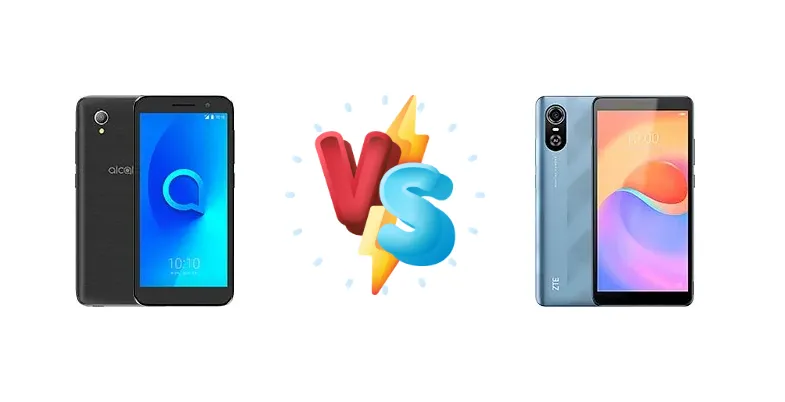
The Alcatel 1 and ZTE Blade A31 Plus represent the extreme end of the smartphone price spectrum. Both aim to deliver basic smartphone functionality at an incredibly low cost. This comparison dissects their key differences, focusing on how their internal hardware translates to real-world usability for those seeking the most affordable connected experience.
🏆 Quick Verdict
For the average user prioritizing multitasking and a smoother experience, the ZTE Blade A31 Plus is the better choice. Its octa-core Unisoc SC9863A processor offers a significant performance advantage over the Alcatel 1’s quad-core Mediatek MT6739, making it more capable for everyday tasks.
| Network |
|---|
| 2G bands | GSM 850 / 900 / 1800 / 1900 | GSM 850 / 900 / 1800 / 1900 |
| 3G bands | HSDPA 850 / 900 / 1900 / 2100 | HSDPA 850 / 900 / 2100 |
| 4G bands | 1, 3, 7, 8, 20 | 1, 2, 3, 5, 7, 8, 20, 28, 38, 40, 41 |
| Speed | HSPA 42.2/5.76 Mbps, LTE Cat4 150/50 Mbps | HSPA, LTE |
| Technology | GSM / HSPA / LTE | GSM / HSPA / LTE |
| Launch |
|---|
| Announced | 2018, July. Released 2018, July | 2021, October 31 |
| Status | Discontinued | Available. Released 2021, October 31 |
| Body |
|---|
| Dimensions | 137.6 x 65.7 x 9.8 mm (5.42 x 2.59 x 0.39 in) | 159.2 x 77.5 x 9.6 mm (6.27 x 3.05 x 0.38 in) |
| SIM | · Nano-SIM· Nano-SIM + Nano-SIM | Nano-SIM + Nano-SIM |
| Weight | 134 g (4.73 oz) | - |
| Display |
|---|
| Resolution | 480 x 960 pixels, 18:9 ratio (~215 ppi density) | 480 x 960 pixels, 18:9 ratio (~179 ppi density) |
| Size | 5.0 inches, 64.5 cm2 (~71.4% screen-to-body ratio) | 6.0 inches, 92.9 cm2 (~75.3% screen-to-body ratio) |
| Type | TFT LCD | IPS LCD |
| Platform |
|---|
| CPU | Quad-core 1.28 GHz Cortex-A53 | Octa-core (4x1.6 GHz Cortex-A55 & 4x1.2 GHz Cortex-A55) |
| Chipset | Mediatek MT6739 (28 nm) | Unisoc SC9863A (28 nm) |
| GPU | PowerVR GE8100 | IMG8322 |
| OS | Android 8.1 Oreo (Go edition) | Android 11 (Go edition) |
| Memory |
|---|
| Card slot | microSDHC (dedicated slot) | microSDXC |
| Internal | 8GB 1GB RAM, 16GB 1GB RAM | 32GB 1GB RAM |
| | eMMC 5.1 | eMMC 5.1 |
| Main Camera |
|---|
| Features | LED flash | LED flash, HDR |
| Single | 5 MP, f/2.4, 1/5.0", 1.12µm | 5 MP (up-scaled to 8 MP) |
| Video | 720p@30fps | 720p@30fps |
| Selfie camera |
|---|
| Single | 2 MP, f/2.8 | 2 MP (up-scaled to 5 MP) |
| Video | 720p@30fps | - |
| Sound |
|---|
| 3.5mm jack | Yes | Yes |
| 35mm jack | Yes | Yes |
| Loudspeaker | Yes | Yes |
| Comms |
|---|
| Bluetooth | 4.2, A2DP, LE | 4.2, A2DP, LE |
| NFC | No | Yes |
| Positioning | GPS | GPS, GLONASS |
| Radio | FM radio | FM radio |
| USB | microUSB 2.0 | microUSB 2.0 |
| WLAN | Wi-Fi 802.11 b/g/n, Wi-Fi Direct | Wi-Fi 802.11 b/g/n |
| Features |
|---|
| Sensors | Accelerometer, proximity | Accelerometer |
| Battery |
|---|
| Type | Li-Ion 2000 mAh | Li-Ion 3000 mAh |
| Misc |
|---|
| Colors | Black, Blue, Gold, Pink | Blue, Gray |
| Models | 5033X, 5033J, 5033T, 5033D, 5033G, 5033M, 5033X_EEA, 5033F, 5033E, 5033D_EEA, 5033Q, 5033O, 5033G_EEA, 5033EP, 5033XR, 5033F_EEA, 5033S, 5033D_RU | - |
| Price | About 60 EUR | - |
alcatel 1
- Extremely affordable
- Simple and easy to use
- Compact size
- Slow performance
- Outdated processor architecture
- Limited multitasking capabilities
ZTE Blade A31 Plus
- Faster octa-core processor
- More efficient processor architecture
- Better multitasking performance
- Still a budget device with limitations
- Camera quality likely basic
- May have bloatware
Display Comparison
Neither device boasts a standout display. Both utilize 28nm chipsets, suggesting a focus on cost reduction over display quality. Specific display specs (resolution, panel type) are not provided, but given the price point, expect basic LCD panels. The lack of information prevents a detailed comparison of brightness or color accuracy. However, the A31 Plus’s more powerful processor *could* potentially handle more efficient display rendering, leading to slightly smoother scrolling, even on a similar panel.
Camera Comparison
Camera details are sparse for both devices. Given the target market, image quality is unlikely to be a priority. It’s safe to assume both feature basic camera sensors. Without specific megapixel counts or aperture information, a direct comparison is impossible. However, the A31 Plus’s more capable processor *could* potentially offer slightly better image processing capabilities, resulting in marginally improved photos, but expectations should remain low.
Performance
The core difference lies in the processors. The Alcatel 1’s Mediatek MT6739 is a quad-core processor based on the Cortex-A53 architecture. The ZTE Blade A31 Plus, however, features the Unisoc SC9863A, an octa-core chip utilizing Cortex-A55 cores. While both are built on a 28nm process, the A55 architecture is more efficient and offers improved performance per clock cycle compared to the older A53. The A31 Plus’s configuration of 4x1.6 GHz and 4x1.2 GHz cores suggests a big.LITTLE architecture, allowing it to balance performance and power consumption. This translates to a noticeably snappier experience for the A31 Plus, especially when multitasking or running more demanding apps.
Battery Life
Battery capacity isn’t specified for either device. However, the Unisoc SC9863A’s more efficient architecture in the ZTE Blade A31 Plus likely contributes to better battery life, even if the battery capacity is similar to the Alcatel 1. The A31 Plus’s ability to handle tasks more efficiently means less power draw, extending usage time between charges. Charging wattage is also unknown, but both will likely support slow charging speeds.
Buying Guide
Buy the Alcatel 1 if you need a truly minimal smartphone for basic communication – calls, texts, and light app usage – and are constrained by the absolute lowest budget. Buy the ZTE Blade A31 Plus if you prefer a more responsive experience, even for simple tasks, and anticipate using multiple apps or needing slightly faster performance for social media or web browsing. The A31 Plus offers a better balance of usability for a small price increase.
Frequently Asked Questions
❓ Will the ZTE Blade A31 Plus handle basic social media apps like Facebook and WhatsApp smoothly?
Yes, the ZTE Blade A31 Plus’s octa-core processor and Cortex-A55 architecture are significantly better equipped to handle the demands of social media apps compared to the Alcatel 1. While it won’t offer a flagship-level experience, it should provide a reasonably smooth and responsive experience for these common tasks.
❓ Is the Alcatel 1 suitable for a first-time smartphone user or someone who primarily makes calls and sends texts?
Absolutely. The Alcatel 1’s simplicity and low cost make it an ideal choice for users with very basic needs. If you primarily need a device for calls, texts, and occasional light app usage, the Alcatel 1 will suffice, but be prepared for slow performance.
❓ Can either of these phones run popular mobile games?
Neither phone is well-suited for gaming. The processors lack the graphical power to run demanding games at playable frame rates. Simple, older games might be playable at low settings, but don’t expect a good gaming experience on either device.