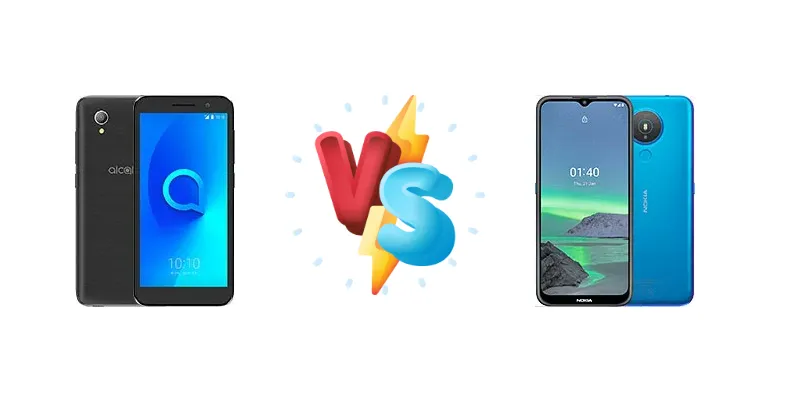
The Alcatel 1 and Nokia 1.4 represent the absolute bottom end of the smartphone market, targeting users prioritizing affordability above all else. Both devices run Android Go Edition, optimized for low-RAM devices. However, beneath the surface, a key difference lies in their chipsets – the Mediatek MT6739 in the Alcatel 1 and the Qualcomm Snapdragon 215 in the Nokia 1.4 – and this dictates the overall user experience.
🏆 Quick Verdict
For the average user, the Nokia 1.4 offers a slightly more refined experience thanks to the Qualcomm Snapdragon 215. While the performance difference isn't massive, the Snapdragon 215 generally provides smoother multitasking and app loading times. The Alcatel 1 remains a viable option for extremely budget-conscious buyers.
| Network |
|---|
| 2G bands | GSM 850 / 900 / 1800 / 1900 | GSM 850 / 900 / 1800 / 1900 |
| 3G bands | HSDPA 850 / 900 / 1900 / 2100 | HSDPA 850 / 900 / 2100 - International |
| 4G bands | 1, 3, 7, 8, 20 | 1, 3, 5, 7, 8, 20, 28, 38, 40, 41 - International |
| Speed | HSPA 42.2/5.76 Mbps, LTE Cat4 150/50 Mbps | HSPA 42.2/5.76 Mbps, LTE Cat4 150/50 Mbps |
| Technology | GSM / HSPA / LTE | GSM / HSPA / LTE |
| | - | 1, 2, 3, 4, 5, 7, 12, 17, 28, 66 - LATAM, USA |
| Launch |
|---|
| Announced | 2018, July. Released 2018, July | 2021, February 03 |
| Status | Discontinued | Available. Released 2021, February 03 |
| Body |
|---|
| Build | - | Glass front, plastic back, plastic frame |
| Dimensions | 137.6 x 65.7 x 9.8 mm (5.42 x 2.59 x 0.39 in) | 166.4 x 76.7 x 8.7 mm (6.55 x 3.02 x 0.34 in) |
| SIM | · Nano-SIM· Nano-SIM + Nano-SIM | · Nano-SIM· Nano-SIM + Nano-SIM |
| Weight | 134 g (4.73 oz) | 178 g (6.28 oz) |
| Display |
|---|
| Resolution | 480 x 960 pixels, 18:9 ratio (~215 ppi density) | 720 x 1600 pixels, 20:9 ratio (~269 ppi density) |
| Size | 5.0 inches, 64.5 cm2 (~71.4% screen-to-body ratio) | 6.52 inches, 102.6 cm2 (~80.4% screen-to-body ratio) |
| Type | TFT LCD | IPS LCD |
| Platform |
|---|
| CPU | Quad-core 1.28 GHz Cortex-A53 | Quad-core 1.3 GHz Cortex-A53 |
| Chipset | Mediatek MT6739 (28 nm) | Qualcomm QM215 Snapdragon 215 (28 nm) |
| GPU | PowerVR GE8100 | Adreno 308 |
| OS | Android 8.1 Oreo (Go edition) | Android 10 (Go edition), planned upgrade to Android 11 (Go edition) |
| Memory |
|---|
| Card slot | microSDHC (dedicated slot) | microSDXC |
| Internal | 8GB 1GB RAM, 16GB 1GB RAM | 16GB 1GB RAM, 32GB 2GB RAM, 64GB 3GB RAM |
| | eMMC 5.1 | eMMC 5.1 |
| Main Camera |
|---|
| Dual | - | 8 MP, (wide), AF
2 MP (macro) |
| Features | LED flash | LED flash, HDR |
| Single | 5 MP, f/2.4, 1/5.0", 1.12µm | - |
| Video | 720p@30fps | 720p@30fps |
| Selfie camera |
|---|
| Single | 2 MP, f/2.8 | 5 MP |
| Video | 720p@30fps | 720p@30fps |
| Sound |
|---|
| 3.5mm jack | Yes | Yes |
| 35mm jack | Yes | Yes |
| Loudspeaker | Yes | Yes |
| Comms |
|---|
| Bluetooth | 4.2, A2DP, LE | 4.2, A2DP, LE |
| NFC | No | No |
| Positioning | GPS | GPS |
| Radio | FM radio | FM radio |
| USB | microUSB 2.0 | microUSB 2.0 |
| WLAN | Wi-Fi 802.11 b/g/n, Wi-Fi Direct | Wi-Fi 802.11 b/g/n |
| Features |
|---|
| Sensors | Accelerometer, proximity | Fingerprint (rear-mounted), accelerometer, proximity |
| Battery |
|---|
| Type | Li-Ion 2000 mAh | Li-Po 4000 mAh |
| Misc |
|---|
| Colors | Black, Blue, Gold, Pink | Fjord, Charcoal, Dusk |
| Models | 5033X, 5033J, 5033T, 5033D, 5033G, 5033M, 5033X_EEA, 5033F, 5033E, 5033D_EEA, 5033Q, 5033O, 5033G_EEA, 5033EP, 5033XR, 5033F_EEA, 5033S, 5033D_RU | TA-1322 |
| Price | About 60 EUR | About 90 EUR |
alcatel 1
- Potentially lower price point
- Android Go Edition for optimized performance
- Functional for basic communication
- Slower processor compared to Nokia 1.4
- Likely lower build quality
- Less responsive user experience
Nokia 1.4
- Slightly faster Snapdragon 215 processor
- Potentially better software optimization
- More responsive multitasking
- May be slightly more expensive
- Still limited by low-end hardware
- Android Go Edition limitations
Display Comparison
Neither the Alcatel 1 nor the Nokia 1.4 boast impressive displays. Both are likely to feature low-resolution panels, and specific details like brightness and color accuracy are not provided. However, given the price point, expect limited viewing angles and washed-out colors on both. The focus here is purely functional, prioritizing visibility over visual fidelity.
Camera Comparison
Camera performance on both devices is expected to be extremely limited. Details regarding sensor size and lens apertures are unavailable, but given the target market, both likely feature low-resolution sensors. Image quality will suffer in low-light conditions, and detail will be minimal. Any marketing around camera capabilities should be viewed with extreme skepticism. Focusing on the primary sensor is key, as any additional sensors (often 2MP macro lenses) will offer negligible improvements.
Performance
The core difference lies in the chipsets. The Nokia 1.4’s Qualcomm Snapdragon 215, clocked at 1.3 GHz, offers a marginal performance advantage over the Alcatel 1’s Mediatek MT6739 (1.28 GHz). Both utilize a quad-core Cortex-A53 architecture, but Qualcomm’s optimizations generally result in better sustained performance and power efficiency. While both are capable of handling basic Android Go Edition tasks, the Snapdragon 215 will exhibit less lag when switching between apps or loading moderately demanding websites. The 28nm fabrication process is identical for both, meaning thermal throttling isn't a major concern given the low power draw.
Battery Life
Battery life will largely depend on usage patterns. Neither device specifies battery capacity, but given their low-power chipsets and basic displays, both should be able to last a full day with moderate use. Charging speeds are also unknown, but likely to be slow due to the use of standard micro-USB charging ports. The Snapdragon 215’s slightly better power efficiency might translate to a small advantage in battery longevity for the Nokia 1.4.
Buying Guide
Buy the Alcatel 1 if you absolutely need the lowest possible price and are willing to accept occasional performance hiccups. It's suitable for basic tasks like calls, texts, and light social media. Buy the Nokia 1.4 if you prioritize a slightly smoother, more responsive experience, even if it means spending a little more. It's better suited for users who occasionally browse the web or use multiple apps simultaneously.
Frequently Asked Questions
❓ Will the Nokia 1.4 handle popular social media apps like Facebook and WhatsApp smoothly?
Yes, the Qualcomm Snapdragon 215 in the Nokia 1.4 should provide a reasonably smooth experience with basic social media apps like Facebook and WhatsApp. However, expect some lag when loading images or videos, and avoid running multiple apps simultaneously.
❓ Is the Mediatek MT6739 in the Alcatel 1 capable of playing basic games?
The Mediatek MT6739 can handle very simple 2D games, but it will struggle with more demanding titles. Expect low frame rates and significant lag in most modern games. It's best suited for casual gaming or older, less graphically intensive games.
❓ How does Android Go Edition affect the user experience on both phones?
Android Go Edition is a lightweight version of Android designed for devices with limited RAM and storage. It uses less storage space, data, and processing power, resulting in a smoother experience on these low-end devices. However, it also means some features found in the standard Android version are missing.
❓ Which phone is better for someone who primarily uses their phone for calls and texts?
Both phones are perfectly adequate for basic calls and texts. The Alcatel 1's lower price makes it a compelling option if this is your primary use case, as the performance difference won't be noticeable for these tasks.