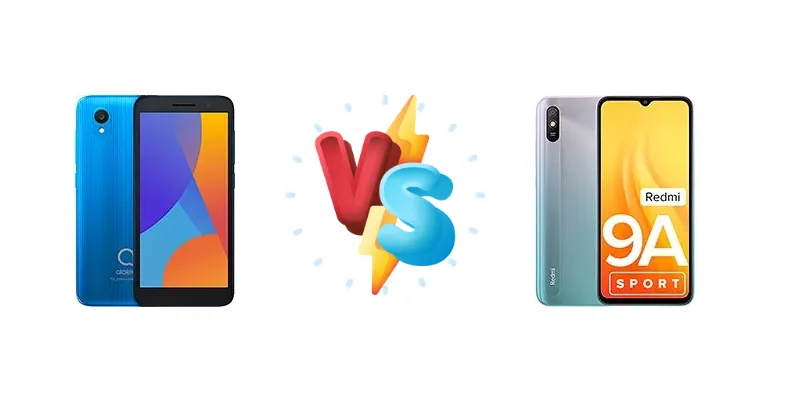
Both the Alcatel 1 (2021) and the Xiaomi Redmi 9A Sport occupy the ultra-budget smartphone segment, targeting first-time smartphone buyers or those needing a reliable secondary device. However, a significant difference in chipset architecture separates these two, impacting real-world performance and user experience. This comparison will dissect those differences to determine which device offers the best value.
🏆 Quick Verdict
For the average user, the Xiaomi Redmi 9A Sport is the clear winner. Its Helio G25 chipset, built on a more efficient 12nm process and featuring an octa-core CPU, delivers substantially better performance than the Alcatel 1 (2021)'s aging Mediatek MT6739. While both phones are basic, the Redmi 9A Sport offers a smoother, more responsive experience.
| Network |
|---|
| 2G bands | GSM 850 / 900 / 1800 / 1900 | GSM 850 / 900 / 1800 / 1900 |
| 3G bands | HSDPA 850 / 900 / 1900 / 2100 | HSDPA 850 / 900 / 2100 |
| 4G bands | 1, 3, 7, 8, 20 | 1, 3, 5, 8, 40, 41 |
| Speed | HSPA 42.2/11.5 Mbps, LTE Cat4 150/50 Mbps | HSPA, LTE |
| Technology | GSM / HSPA / LTE | GSM / HSPA / LTE |
| Launch |
|---|
| Announced | 2021, June 25 | 2021, September 28 |
| Status | Available. Released 2021, October 22 | Available. Released 2021, September 28 |
| Body |
|---|
| Dimensions | 137.6 x 65.7 x 9.8 mm (5.42 x 2.59 x 0.39 in) | 164.9 x 77.1 x 9 mm (6.49 x 3.04 x 0.35 in) |
| SIM | · Nano-SIM· Nano-SIM + Nano-SIM | Nano-SIM + Nano-SIM |
| Weight | 134 g (4.73 oz) | 194 g (6.84 oz) |
| | - | Water-repellent coating |
| Display |
|---|
| Protection | Asahi Glass | - |
| Resolution | 480 x 960 pixels, 18:9 ratio (~215 ppi density) | 720 x 1600 pixels, 20:9 ratio (~269 ppi density) |
| Size | 5.0 inches, 64.5 cm2 (~71.4% screen-to-body ratio) | 6.53 inches, 102.9 cm2 (~81.0% screen-to-body ratio) |
| Type | TFT LCD | IPS LCD, 400 nits (typ) |
| Platform |
|---|
| CPU | Quad-core 1.28 GHz Cortex-A53 | Octa-core (4x2.0 GHz Cortex-A53 & 4x1.5 GHz Cortex-A53) |
| Chipset | Mediatek MT6739 (28 nm) | Mediatek MT6762G Helio G25 (12 nm) |
| GPU | PowerVR GE8100 | PowerVR GE8320 |
| OS | Android 11 (Go edition) | Android 10, MIUI 12 |
| Memory |
|---|
| Card slot | microSDHC (dedicated slot) | microSDXC (dedicated slot) |
| Internal | 8GB 1GB RAM, 16GB 1GB RAM | 32GB 2GB RAM, 32GB 3GB RAM |
| | eMMC 5.1 | eMMC 5.1 |
| Main Camera |
|---|
| Features | LED flash | LED flash, HDR |
| Single | 5 MP, f/2.4, 1/5.0", 1.12µm | 13 MP, f/2.2, 28mm (wide), 1.0µm, PDAF |
| Video | 720p@30fps | 1080p@30/60fps |
| Selfie camera |
|---|
| Features | - | HDR |
| Single | 2 MP, f/2.8 | 5 MP, f/2.2, (wide), 1.12µm |
| Video | 720p@30fps | 1080p@30fps |
| Sound |
|---|
| 3.5mm jack | Yes | Yes |
| 35mm jack | Yes | Yes |
| Loudspeaker | Yes | Yes |
| Comms |
|---|
| Bluetooth | 4.2, A2DP, LE | 5.0, A2DP, LE |
| NFC | No | No |
| Positioning | GPS | GPS, GLONASS, BDS |
| Radio | FM radio | FM radio |
| USB | microUSB 2.0 | microUSB 2.0, OTG |
| WLAN | Wi-Fi 802.11 b/g/n, Wi-Fi Direct | Wi-Fi 802.11 a/b/g/n, Wi-Fi Direct |
| Features |
|---|
| Sensors | Accelerometer, proximity | Accelerometer, proximity |
| Battery |
|---|
| Charging | - | 10W wired |
| Type | Li-Ion 2000 mAh | Li-Po 5000 mAh |
| Misc |
|---|
| Colors | Volcano Black, AI Aqua | Carbon Black, Coral Green, Metallic Blue |
| Price | About 60 EUR | About 100 EUR |
alcatel 1 (2021)
- Potentially lower price point.
- Simple and straightforward user interface.
- May be more readily available in certain regions.
- Significantly weaker processor performance.
- Less efficient chipset architecture.
- Likely slower app loading times and multitasking.
Xiaomi Redmi 9A Sport
- Faster and more efficient processor (Helio G25).
- Octa-core CPU for improved multitasking.
- 10W wired charging support.
- Better thermal management.
- May be slightly more expensive.
- Still a basic smartphone with limited features.
- Camera performance likely remains limited.
Display Comparison
Neither device is expected to boast a high-quality display. Given the price point, both likely utilize LCD panels with modest resolutions (720p is probable for both). The lack of detailed display specifications necessitates focusing on the chipset's ability to drive the UI smoothly. The Redmi 9A Sport’s more powerful GPU, integrated within the Helio G25, will likely handle UI animations and basic video playback with fewer stutters than the Alcatel 1 (2021).
Camera Comparison
Both phones are likely to feature basic camera setups. Without specific sensor details, it’s safe to assume both will rely on low-resolution primary sensors. The Redmi 9A Sport *may* have a slight advantage due to the Helio G25’s image signal processor (ISP), which could offer marginally better image processing capabilities. However, expect limited low-light performance and detail from both devices. The presence of a 2MP macro camera on either device is largely a marketing gimmick and unlikely to deliver meaningful results.
Performance
The core difference lies in the chipsets. The Alcatel 1 (2021) uses the Mediatek MT6739, a quad-core processor built on a 28nm process. This older architecture is significantly less efficient and powerful than the Xiaomi Redmi 9A Sport’s Mediatek MT6762G Helio G25. The Helio G25 features an octa-core configuration (4x2.0 GHz Cortex-A53 & 4x1.5 GHz Cortex-A53), providing a substantial boost in multi-core performance. This translates to faster app loading times, smoother multitasking, and a more responsive overall experience. The 12nm process node of the Helio G25 also contributes to better thermal management, reducing the likelihood of performance throttling under sustained load.
Battery Life
Battery capacity is not specified for either device, but both likely feature batteries in the 4000-5000 mAh range, typical for this price segment. The Redmi 9A Sport includes 10W wired charging, which, while slow by modern standards, is a standard offering in this category. The Alcatel 1 (2021)'s charging speed is unknown, but likely similar. The Helio G25’s improved power efficiency could translate to slightly longer battery life on the Redmi 9A Sport, even with a similar battery capacity, due to reduced power draw during typical usage.
Buying Guide
Buy the Alcatel 1 (2021) if you absolutely need the lowest possible price and your usage is limited to very basic tasks like calls, texts, and light social media. Buy the Xiaomi Redmi 9A Sport if you prioritize a more fluid user experience, occasional gaming, or multitasking, even within the constraints of a budget device. The Redmi 9A Sport’s processor provides a noticeable improvement in responsiveness.
Frequently Asked Questions
❓ Will the Redmi 9A Sport be able to handle popular social media apps like Facebook and Instagram without significant lag?
Yes, the Redmi 9A Sport’s Helio G25 chipset is significantly more capable than the Alcatel 1 (2021)’s MT6739. It should handle Facebook, Instagram, and similar apps with a much smoother experience, reducing lag and stuttering during scrolling and content loading.
❓ Is the Redmi 9A Sport suitable for playing mobile games like PUBG Mobile or Call of Duty Mobile?
While the Redmi 9A Sport can *run* these games, don’t expect a high-fidelity experience. The Helio G25 is an entry-level gaming chip. You’ll likely need to play at the lowest graphics settings and may still experience frame drops during intense action. The Alcatel 1 (2021) would struggle even more.
❓ How much faster is the Redmi 9A Sport's processor compared to the Alcatel 1 (2021)?
The Redmi 9A Sport’s Helio G25 is substantially faster. The move from a quad-core processor to an octa-core processor, combined with the more efficient 12nm process, results in a significant performance improvement – likely 50-75% faster in CPU-intensive tasks and a noticeable improvement in GPU performance.