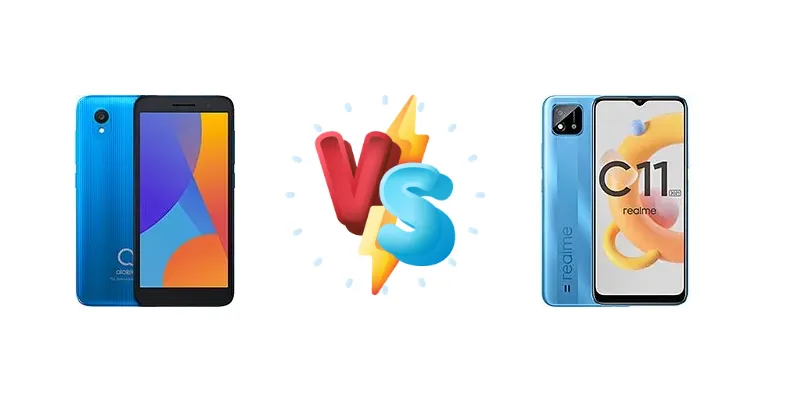
The Alcatel 1 (2021) and Realme C11 (2021) represent the absolute bottom end of the smartphone market, targeting users with minimal needs and extremely tight budgets. While both devices aim for affordability, they take different approaches to achieving it. The Realme C11 attempts to offer a more modern experience with an octa-core processor, while the Alcatel 1 prioritizes simplicity and a lower price point with a quad-core chipset. This comparison will dissect their key differences to help you determine which best suits your needs.
🏆 Quick Verdict
For the vast majority of users, the Realme C11 (2021) is the superior choice. Its Unisoc SC9863A octa-core processor provides a noticeably smoother and more responsive experience than the Alcatel 1’s Mediatek MT6739 quad-core. While neither phone excels, the C11 offers better value for a minimal price increase.
| Network |
|---|
| 2G bands | GSM 850 / 900 / 1800 / 1900 | GSM 850 / 900 / 1800 / 1900 |
| 3G bands | HSDPA 850 / 900 / 1900 / 2100 | HSDPA 850 / 900 / 1900 / 2100 |
| 4G bands | 1, 3, 7, 8, 20 | 1, 3, 5, 8, 38, 40, 41 |
| Speed | HSPA 42.2/11.5 Mbps, LTE Cat4 150/50 Mbps | HSPA, LTE |
| Technology | GSM / HSPA / LTE | GSM / HSPA / LTE |
| Launch |
|---|
| Announced | 2021, June 25 | 2021, June 28 |
| Status | Available. Released 2021, October 22 | Available. Released 2021, June 28 |
| Body |
|---|
| Build | - | Glass front, plastic frame, plastic back |
| Dimensions | 137.6 x 65.7 x 9.8 mm (5.42 x 2.59 x 0.39 in) | 165.2 x 76.4 x 8.9 mm (6.50 x 3.01 x 0.35 in) |
| SIM | · Nano-SIM· Nano-SIM + Nano-SIM | Nano-SIM + Nano-SIM |
| Weight | 134 g (4.73 oz) | 190 g (6.70 oz) |
| | - | Splash resistant design |
| Display |
|---|
| Protection | Asahi Glass | - |
| Resolution | 480 x 960 pixels, 18:9 ratio (~215 ppi density) | 720 x 1600 pixels, 20:9 ratio (~269 ppi density) |
| Size | 5.0 inches, 64.5 cm2 (~71.4% screen-to-body ratio) | 6.52 inches, 102.6 cm2 (~81.3% screen-to-body ratio) |
| Type | TFT LCD | IPS LCD, 400 nits (typ) |
| Platform |
|---|
| CPU | Quad-core 1.28 GHz Cortex-A53 | Octa-core (4x1.6 GHz Cortex-A55 & 4x1.2 GHz Cortex-A55) |
| Chipset | Mediatek MT6739 (28 nm) | Unisoc SC9863A (28 nm) |
| GPU | PowerVR GE8100 | IMG8322 |
| OS | Android 11 (Go edition) | Android 11, Realme Go UI |
| Memory |
|---|
| Card slot | microSDHC (dedicated slot) | microSDXC (dedicated slot) |
| Internal | 8GB 1GB RAM, 16GB 1GB RAM | 32GB 2GB RAM, 64GB 4GB RAM |
| | eMMC 5.1 | eMMC 5.1 |
| Main Camera |
|---|
| Features | LED flash | LED flash, HDR, panorama |
| Single | 5 MP, f/2.4, 1/5.0", 1.12µm | 8 MP, f/2.0, (wide), AF |
| Video | 720p@30fps | 1080p@30fps |
| Selfie camera |
|---|
| Features | - | HDR, panorama |
| Single | 2 MP, f/2.8 | 5 MP, f/2.2, (wide) |
| Video | 720p@30fps | 1080p@30fps |
| Sound |
|---|
| 3.5mm jack | Yes | Yes |
| 35mm jack | Yes | Yes |
| Loudspeaker | Yes | Yes |
| Comms |
|---|
| Bluetooth | 4.2, A2DP, LE | 4.2, A2DP |
| NFC | No | No |
| Positioning | GPS | GPS, GLONASS, GALILEO, BDS |
| Radio | FM radio | Unspecified |
| USB | microUSB 2.0 | microUSB 2.0, OTG |
| WLAN | Wi-Fi 802.11 b/g/n, Wi-Fi Direct | Wi-Fi 802.11 b/g/n |
| Features |
|---|
| Sensors | Accelerometer, proximity | Accelerometer, gyro, proximity, compass |
| Battery |
|---|
| Charging | - | 10W wired
Reverse wired |
| Type | Li-Ion 2000 mAh | 5000 mAh |
| Misc |
|---|
| Colors | Volcano Black, AI Aqua | Cool Blue, Cool Grey |
| Models | - | RMX3231 |
| Price | About 60 EUR | About 80 EUR |
alcatel 1 (2021)
- Potentially lower price point
- Extremely basic and easy to use
- Compact form factor
- Significantly slower performance
- Outdated processor architecture
- Likely limited software support
Realme C11 (2021)
- Faster octa-core processor
- More modern processor architecture
- 10W charging with reverse charging
- Likely better battery life
- May be slightly more expensive
- Still a budget device with limitations
- Camera quality will be basic
Display Comparison
Neither Alcatel nor Realme provide display specifications beyond resolution. Given their price points, both likely utilize LCD panels with basic color reproduction. The absence of detailed specs suggests neither prioritizes display quality. Bezels are expected to be substantial on both devices, maximizing screen real estate within a compact form factor. Without further data, a direct comparison is impossible, but the Realme C11’s slightly larger form factor *could* indicate a marginally larger display.
Camera Comparison
Both devices are likely to feature basic camera setups. Given the market segment, detailed camera specs are scarce. It’s safe to assume both will include a primary camera and potentially a secondary depth sensor. Image quality will be heavily reliant on software processing and will likely be subpar in low-light conditions. The absence of OIS (Optical Image Stabilization) on either device means shaky hands will result in blurry photos. Focusing on megapixel counts would be misleading; the image signal processor (ISP) within the chipset is the more critical factor, and the Unisoc SC9863A likely offers a more capable ISP than the Mediatek MT6739.
Performance
The core difference lies in the chipset: the Realme C11 boasts a Unisoc SC9863A octa-core processor (4x1.6 GHz Cortex-A55 & 4x1.2 GHz Cortex-A55), while the Alcatel 1 is equipped with a Mediatek MT6739 quad-core 1.28 GHz Cortex-A53. The Unisoc chip’s octa-core configuration, utilizing Cortex-A55 cores, represents a significant architectural improvement over the older Cortex-A53 cores in the Mediatek chip. This translates to better multi-tasking capabilities and a more fluid user experience on the Realme C11. The MT6739 will struggle with even moderately demanding apps, while the C11 can handle basic tasks with relative ease. Both are built on a 28nm process, meaning thermal efficiency will be similar, but the C11 will simply *finish tasks faster* before heat becomes a factor.
Battery Life
Battery capacity is not specified for the Alcatel 1 (2021), but given its focus on simplicity, it’s likely a smaller capacity than the Realme C11’s. The Realme C11 includes 10W wired charging and even supports reverse wired charging, a feature rarely found in this price bracket. While 10W charging isn’t fast, it’s a welcome addition. The Alcatel 1 likely relies on slower charging speeds. The Realme C11’s larger battery (likely around 5000mAh) combined with the more efficient Unisoc chipset will result in longer battery life, allowing for a full day of light use.
Buying Guide
Buy the Alcatel 1 (2021) if you absolutely need the cheapest possible smartphone for basic tasks like calls and texts, and are willing to tolerate significant performance limitations. Buy the Realme C11 (2021) if you want a more usable smartphone experience, even for light social media browsing or occasional gaming, and appreciate the benefit of a more modern processor architecture.
Frequently Asked Questions
❓ Is the Realme C11's reverse charging feature useful for accessories like Bluetooth headphones?
Yes, the Realme C11's reverse wired charging can provide a slow trickle charge to accessories like Bluetooth headphones or earbuds. While not a fast charging solution, it's a convenient feature for topping up small devices when a power outlet isn't available.
❓ Will the Alcatel 1 (2021) struggle with popular apps like WhatsApp or Facebook?
Yes, the Alcatel 1's Mediatek MT6739 quad-core processor will likely struggle with apps like WhatsApp and Facebook, especially with multiple chats or heavy media usage. Expect noticeable lag and slow loading times. The Realme C11 will provide a much smoother experience with these apps.
❓ Can either of these phones handle basic mobile games like Candy Crush or Subway Surfers?
The Realme C11 can handle basic mobile games like Candy Crush or Subway Surfers at low settings. The Alcatel 1 may struggle even with these games, experiencing significant frame rate drops and lag. Neither phone is suitable for graphically demanding games.
❓ What kind of storage options are available on these devices, and can it be expanded?
Storage details are limited, but both devices likely come with 32GB of internal storage. Crucially, both support microSD card expansion, allowing you to add more storage for photos, videos, and apps. This is essential given the limited internal storage.