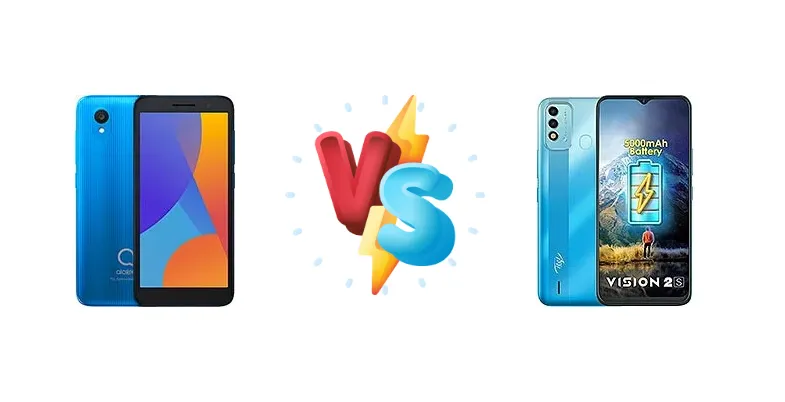
Both the alcatel 1 (2021) and the itel Vision 2S occupy the ultra-budget smartphone segment, targeting first-time smartphone buyers or those needing a reliable secondary device. However, a key difference in their core processing power – an octa-core Unisoc chip versus a quad-core Mediatek – suggests a potentially significant performance gap. This comparison will dissect those differences and determine which device delivers the best value.
🏆 Quick Verdict
For the average user prioritizing responsiveness and multitasking, the itel Vision 2S is the clear winner. Its Unisoc SC9863A chipset, featuring eight Cortex-A55 cores, provides a substantial performance advantage over the alcatel 1 (2021)'s aging Mediatek MT6739. While both phones are limited by their price point, the itel offers a smoother, more usable experience.
| Network |
|---|
| 2G bands | GSM 850 / 900 / 1800 / 1900 | GSM 850 / 900 / 1800 / 1900 |
| 3G bands | HSDPA 850 / 900 / 1900 / 2100 | HSDPA 850 / 900 / 2100 |
| 4G bands | 1, 3, 7, 8, 20 | LTE |
| Speed | HSPA 42.2/11.5 Mbps, LTE Cat4 150/50 Mbps | HSPA, LTE |
| Technology | GSM / HSPA / LTE | GSM / HSPA / LTE |
| Launch |
|---|
| Announced | 2021, June 25 | 2021 |
| Status | Available. Released 2021, October 22 | Available. Released 2021 |
| Body |
|---|
| Dimensions | 137.6 x 65.7 x 9.8 mm (5.42 x 2.59 x 0.39 in) | 166 x 76.3 x 8.9 mm (6.54 x 3.00 x 0.35 in) |
| SIM | · Nano-SIM· Nano-SIM + Nano-SIM | Dual SIM |
| Weight | 134 g (4.73 oz) | - |
| Display |
|---|
| Protection | Asahi Glass | - |
| Resolution | 480 x 960 pixels, 18:9 ratio (~215 ppi density) | 720 x 1600 pixels, 20:9 ratio (~269 ppi density) |
| Size | 5.0 inches, 64.5 cm2 (~71.4% screen-to-body ratio) | 6.52 inches, 102.6 cm2 (~81.0% screen-to-body ratio) |
| Type | TFT LCD | IPS LCD |
| Platform |
|---|
| CPU | Quad-core 1.28 GHz Cortex-A53 | Octa-core (4x1.6 GHz Cortex-A55 & 4x1.2 GHz Cortex-A55) |
| Chipset | Mediatek MT6739 (28 nm) | Unisoc SC9863A (28 nm) |
| GPU | PowerVR GE8100 | IMG8322 |
| OS | Android 11 (Go edition) | Android 11 (Go edition) |
| Memory |
|---|
| Card slot | microSDHC (dedicated slot) | microSDXC |
| Internal | 8GB 1GB RAM, 16GB 1GB RAM | 32GB 2GB RAM |
| | eMMC 5.1 | - |
| Main Camera |
|---|
| Dual | - | 8 MP
0.3 MP |
| Features | LED flash | LED flash |
| Single | 5 MP, f/2.4, 1/5.0", 1.12µm | - |
| Video | 720p@30fps | 1080p@30fps |
| Selfie camera |
|---|
| Single | 2 MP, f/2.8 | 5 MP |
| Video | 720p@30fps | Yes |
| Sound |
|---|
| 3.5mm jack | Yes | - |
| 35mm jack | Yes | Yes |
| Loudspeaker | Yes | Yes |
| Comms |
|---|
| Bluetooth | 4.2, A2DP, LE | Yes |
| NFC | No | No |
| Positioning | GPS | GPS |
| Radio | FM radio | Unspecified |
| USB | microUSB 2.0 | microUSB |
| WLAN | Wi-Fi 802.11 b/g/n, Wi-Fi Direct | Yes |
| Features |
|---|
| Sensors | Accelerometer, proximity | Fingerprint (rear-mounted), accelerometer |
| Battery |
|---|
| Charging | - | 18W wired |
| Type | Li-Ion 2000 mAh | 5000 mAh |
| Misc |
|---|
| Colors | Volcano Black, AI Aqua | Gradation Purple, Gradation Blue, Deep Blue |
| Price | About 60 EUR | - |
alcatel 1 (2021)
- Potentially the lowest price point in its class.
- Simple and straightforward Android Go experience.
- Reliable for basic communication tasks.
- Significantly slower performance compared to the itel Vision 2S.
- Outdated chipset architecture.
- Likely limited software support.
itel Vision 2S
- Faster octa-core processor for smoother performance.
- 18W fast charging for quicker top-ups.
- More responsive user experience.
- Potentially better image processing.
- May be slightly more expensive than the alcatel 1 (2021).
- Still limited by its ultra-budget price point.
- Camera quality will still be basic.
Display Comparison
Neither device boasts a standout display. Both utilize 28nm chipsets, suggesting similar power constraints impacting display capabilities. Specific display specs (resolution, brightness, panel type) are not provided, but given the price bracket, expect basic LCD panels. The alcatel 1 (2021) likely prioritizes cost savings, potentially resulting in lower peak brightness and narrower viewing angles compared to what the itel Vision 2S *could* achieve with its slightly more modern chipset allowing for potentially better display driver optimization.
Camera Comparison
Camera performance on both devices will be limited. Without specific sensor details, it's safe to assume both rely on basic sensors. The absence of Optical Image Stabilization (OIS) on either device means image quality will suffer in low-light conditions. Any mention of a 2MP macro camera on either phone should be viewed with skepticism; these sensors rarely deliver usable results. The itel Vision 2S *may* benefit from slightly better image processing capabilities due to its more modern chipset, but the difference will likely be marginal.
Performance
The performance disparity is the most significant factor in this comparison. The alcatel 1 (2021)'s Mediatek MT6739, with its quad-core Cortex-A53 CPU, is a relatively old architecture. The itel Vision 2S, however, features the Unisoc SC9863A, an octa-core processor utilizing four Cortex-A55 cores clocked at 1.6 GHz and another four at 1.2 GHz. Cortex-A55 cores are more efficient and offer improved performance per clock cycle compared to the A53. This translates to faster app loading times, smoother multitasking, and a more responsive user interface on the itel Vision 2S. While both are 28nm, the core count and architecture give the itel a clear edge.
Battery Life
Battery capacity is not specified for either device. However, the itel Vision 2S includes 18W wired charging, a significant advantage over the alcatel 1 (2021), which likely supports only standard 5W or 10W charging. This faster charging capability means the itel can be topped up much more quickly, reducing downtime and improving usability for users who frequently need to recharge their phones. Even with a similar battery capacity, the itel’s more efficient chipset could translate to slightly longer battery life.
Buying Guide
Buy the alcatel 1 (2021) if you absolutely need the lowest possible price and your usage is limited to basic tasks like calls, texts, and light web browsing. Buy the itel Vision 2S if you prefer a more responsive device capable of handling multiple apps, social media, and occasional gaming without significant lag. The itel’s faster charging is also a significant benefit for those who need to quickly top up their battery.
Frequently Asked Questions
❓ Will the itel Vision 2S handle popular social media apps like Facebook and Instagram smoothly?
Yes, the itel Vision 2S's octa-core processor and more efficient Cortex-A55 cores are significantly better equipped to handle the demands of social media apps compared to the alcatel 1 (2021). You should experience smoother scrolling, faster loading times, and fewer instances of lag.
❓ Is the Unisoc SC9863A chipset reliable and well-supported?
Unisoc has been steadily improving its chipset offerings. While not as widely recognized as MediaTek or Qualcomm, the SC9863A is a capable processor for entry-level smartphones. Software support will depend on itel's commitment to updates, but it's generally comparable to other brands in this price segment.
❓ Can the itel Vision 2S run multiple apps simultaneously without slowing down?
The itel Vision 2S is better at multitasking than the alcatel 1 (2021) due to its octa-core processor and increased RAM (assuming both have similar RAM configurations, which is likely in this segment). While it won't match the performance of higher-end devices, it should be able to handle a few apps running in the background without significant slowdown.