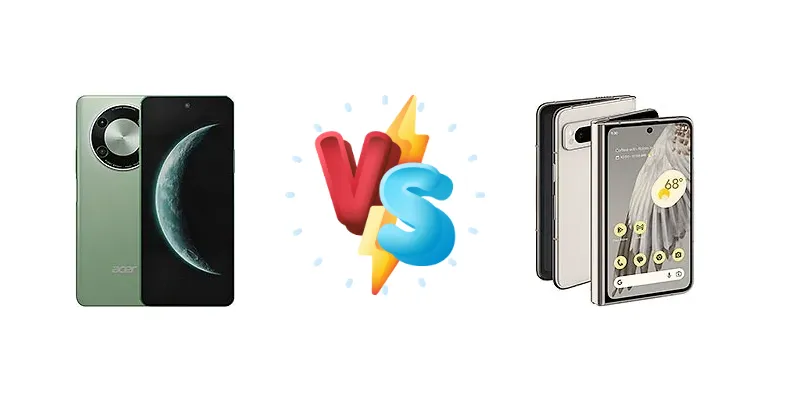
The foldable phone market is heating up, with Google entering the fray with the premium Pixel Fold. However, Acer aims to disrupt with the Super ZX, offering a potentially more accessible entry point. This comparison dissects the core differences between these two devices, focusing on performance, camera capabilities, and overall value.
🏆 Quick Verdict
For the average user prioritizing a polished software experience and advanced camera features, the Google Pixel Fold is the clear winner. However, the Acer Super ZX presents a compelling alternative for budget-conscious consumers who prioritize raw performance and don't need the foldable form factor's premium features.
| Network |
|---|
| 2G bands | GSM 850 / 900 / 1800 / 1900 | GSM 850 / 900 / 1800 / 1900 |
| 3G bands | HSDPA 850 / 900 / 2100 | HSDPA 800 / 850 / 900 / 1700(AWS) / 1900 / 2100 |
| 4G bands | LTE | 1, 2, 3, 4, 5, 7, 8, 12, 13, 14, 17, 18, 19, 20, 21, 25, 26, 28, 29, 30, 32, 38, 39, 40, 41, 42, 46, 48, 66, 71 |
| 5G bands | SA/NSA | 1, 2, 3, 5, 7, 8, 12, 14, 20, 25, 28, 30, 38, 40, 41, 48, 66, 71, 75, 76, 77, 78, 79, 257, 258, 260, 261 SA/NSA/Sub6/mmWave |
| Speed | HSPA, LTE, 5G | HSPA, LTE, 5G |
| Technology | GSM / HSPA / LTE / 5G | GSM / CDMA / HSPA / EVDO / LTE / 5G |
| | - | CDMA2000 1xEV-DO |
| Launch |
|---|
| Announced | 2025, May 26 | 2023, May 10 |
| Status | Available. Released 2025, May 26 | Available. Released 2023, June 27 |
| Body |
|---|
| Build | - | Glass front (Gorilla Glass Victus) (folded), plastic front (unfolded), glass back (Gorilla Glass Victus), aluminum frame |
| Dimensions | 8.6 mm thickness | Unfolded: 139.7 x 158.7 x 5.8 mmFolded: 139.7 x 79.5 x 12.1 mm |
| SIM | Nano-SIM + Nano-SIM | Nano-SIM + eSIM |
| Weight | 200 g (7.05 oz) | 283 g (9.98 oz) |
| | - | IPX8 water resistant |
| Display |
|---|
| Resolution | 1080 x 2400 pixels, 20:9 ratio (~388 ppi density) | 1840 x 2208 pixels (~378 ppi density) |
| Size | 6.78 inches, 111.0 cm2 (~85.3% screen-to-body ratio) | 7.6 inches, 183.3 cm2 (~82.7% screen-to-body ratio) |
| Type | IPS LCD, 120Hz | Foldable OLED, 120Hz, HDR10+, 1000 nits (HBM), 1450 nits (peak) |
| | - | Cover display:
OLED, 120Hz, HDR, Corning Gorilla Glass Victus
5.8 inches, 1080 x 2092 pixels, 17.4:9 ratio, 408 ppi
1200 nits (HBM), 1550 nits (peak) |
| Platform |
|---|
| CPU | Octa-core (2x2.4 GHz Cortex-A76 & 6x2.0 GHz Cortex-A55) | Octa-core (2x2.85 GHz Cortex-X1 & 2x2.35 GHz Cortex-A78 & 4x1.80 GHz Cortex-A55) |
| Chipset | Mediatek Dimensity 6300 (6 nm) | Google Tensor G2 (5 nm) |
| GPU | Mali-G57 MC2 | Mali-G710 MP7 |
| OS | Android 15 | Android 13, upgradable to Android 15, up to 5 major Android upgrades |
| Memory |
|---|
| Card slot | Unspecified | No |
| Internal | 128GB 4GB RAM, 128GB 6GB RAM, 128GB 8GB RAM | 256GB 12GB RAM, 512GB 12GB RAM |
| | - | UFS 3.1 |
| Main Camera |
|---|
| Features | LED flash, HDR, panorama | Laser AF, Dual-LED flash, HDR, panorama |
| Triple | 64 MP, f/1.8, (wide), 1/1.73", 0.8µm, PDAF
2 MP (macro)
Auxiliary lens | 48 MP, f/1.7, 25mm (wide), 1/2.0", 0.8µm, dual pixel PDAF, OIS
10.8 MP, f/3.1, 112mm (telephoto), 1/3.1", 1.22µm, dual pixel PDAF, OIS, 5x optical zoom
10.8 MP, f/2.2, 121˚, (ultrawide), 1/3.0", 1.25µm |
| Video | Yes | 4K@30/60fps, 1080p@30/60/120/240fps, 10-bit HDR |
| Selfie camera |
|---|
| Features | - | HDR, panorama |
| Single | Yes | 8 MP, f/2.0, 24mm (wide), 1/4.0", 1.12µm
Cover camera:
9.5 MP, f/2.2, 24mm (wide), 1.22µm, dual pixel PDAF |
| Video | Yes | 4K@30/60fps, 1080p@30/60fps |
| Sound |
|---|
| 3.5mm jack | - | No |
| 35mm jack | Yes | No |
| Loudspeaker | Yes | Yes, with stereo speakers |
| Comms |
|---|
| Bluetooth | Yes | 5.2, A2DP, LE, aptX HD |
| NFC | Unspecified | Yes |
| Positioning | GPS, GLONASS, GALILEO, BDS | GPS, GLONASS, GALILEO, BDS |
| Radio | Unspecified | No |
| USB | USB Type-C 2.0 | USB Type-C 3.2, OTG |
| WLAN | Yes | Wi-Fi 802.11 a/b/g/n/ac/6e, tri-band, Wi-Fi Direct |
| Features |
|---|
| Sensors | Fingerprint (side-mounted), accelerometer, proximity, compass | Fingerprint (side-mounted), accelerometer, gyro, proximity, compass, barometer |
| | - | Ultra Wideband (UWB) support |
| Battery |
|---|
| Charging | 33W wired, 50% in 35 min | Wired, PD3.0
Wireless |
| Type | 5000 mAh | Li-Po 4821 mAh |
| Misc |
|---|
| Colors | Carbon Black, Cosmic Green, Lunar Blue | Porcelain, Obsidian |
| Models | - | G9FPL |
| Price | ₹ 8,999 | € 670.87 / $ 389.26 / £ 899.99 |
Acer Super ZX
- Strong performance for the price with Dimensity 6300
- Fast 33W wired charging
- Potentially more affordable than the Pixel Fold
- Lacks the premium features of a foldable phone
- Camera performance likely inferior to the Pixel Fold
- Software updates may be less frequent
Google Pixel Fold
- Innovative foldable design
- Google’s AI-powered features and software experience
- Superior camera system with advanced image processing
- Significantly higher price point
- Potential for crease visibility on the foldable display
- Battery life may be compromised by the foldable form factor
Display Comparison
While specific display details for the Acer Super ZX are unavailable, the Google Pixel Fold boasts an inner foldable display and a cover screen. The Pixel Fold’s use of OLED technology ensures vibrant colors and deep blacks. The Tensor G2 likely drives adaptive refresh rates, potentially utilizing LTPO technology for power efficiency. The Super ZX, given its price point, likely utilizes a standard AMOLED panel. The Pixel Fold’s foldable nature inherently introduces a crease, a trade-off for the larger screen real estate, while the Super ZX will have a more traditional, uninterrupted display.
Camera Comparison
The Google Pixel Fold is expected to leverage Google’s renowned computational photography prowess. While specific sensor details are unavailable for either device, the Pixel Fold’s Tensor G2 chip is specifically designed to accelerate image processing. The Pixel Fold will likely prioritize image quality and dynamic range through software algorithms. The Acer Super ZX, lacking the same level of software optimization, will rely more heavily on its hardware. Without detailed sensor information, it’s difficult to make a direct comparison, but the Pixel Fold’s camera system is expected to be more versatile and deliver superior image quality in challenging conditions.
Performance
The Google Pixel Fold’s Google Tensor G2 (5nm) chipset, with its Cortex-X1 prime core clocked at 2.85 GHz, offers a significant performance advantage over the Acer Super ZX’s Mediatek Dimensity 6300 (6nm). The Tensor G2’s architecture, including the Cortex-A78 performance cores, is designed for more demanding tasks like AI processing and complex computations. The Dimensity 6300, while capable, focuses on efficiency with its Cortex-A76 and A55 cores. The 5nm fabrication process of the Tensor G2 also contributes to better thermal efficiency, potentially reducing throttling during sustained workloads. The Pixel Fold’s likely LPDDR5X RAM further enhances performance, while the Super ZX’s RAM specification is unknown but likely LPDDR4X.
Battery Life
The Acer Super ZX’s 33W wired charging is relatively fast, promising a 50% charge in 35 minutes. The Google Pixel Fold supports both wired charging (PD3.0) and wireless charging, offering greater convenience. However, the actual battery capacity of both devices is unknown. The Tensor G2’s 5nm process *should* contribute to better power efficiency, potentially offsetting a smaller battery capacity. The Pixel Fold’s wireless charging capability is a significant advantage for users who prefer cable-free charging.
Buying Guide
Buy the Acer Super ZX if you need a strong performer for everyday tasks and light gaming, and value affordability above all else. Its Mediatek Dimensity 6300 chipset delivers solid performance without the flagship price tag. Buy the Google Pixel Fold if you demand a seamless foldable experience, Google’s AI-powered features, and a sophisticated camera system, and are willing to pay a premium for it.
Frequently Asked Questions
❓ Is the Mediatek Dimensity 6300 in the Acer Super ZX powerful enough for demanding games like Genshin Impact?
The Dimensity 6300 is a capable mid-range chipset. While it won't deliver the highest frame rates at maximum settings, it should be able to run Genshin Impact and similar titles at medium settings with acceptable performance. Expect some frame drops during intense scenes.
❓ How does the Google Tensor G2 handle heat during prolonged use, like video recording or extended gaming sessions?
The Tensor G2's 5nm fabrication process helps mitigate heat generation. However, Google has historically prioritized software features over aggressive thermal throttling. Expect some warming during extended use, but the Tensor G2 is designed to maintain performance for a reasonable duration before throttling becomes noticeable.
❓ Does the Acer Super ZX support 5G connectivity?
While not explicitly stated, the Mediatek Dimensity 6300 *does* support 5G connectivity. This means the Acer Super ZX should be capable of utilizing 5G networks where available, offering faster download and upload speeds.
❓ What are the long-term software support commitments for the Acer Super ZX?
Acer's software update track record is less consistent than Google's. Expect fewer major Android version updates and security patches compared to the Pixel Fold, which is guaranteed to receive several years of updates directly from Google.