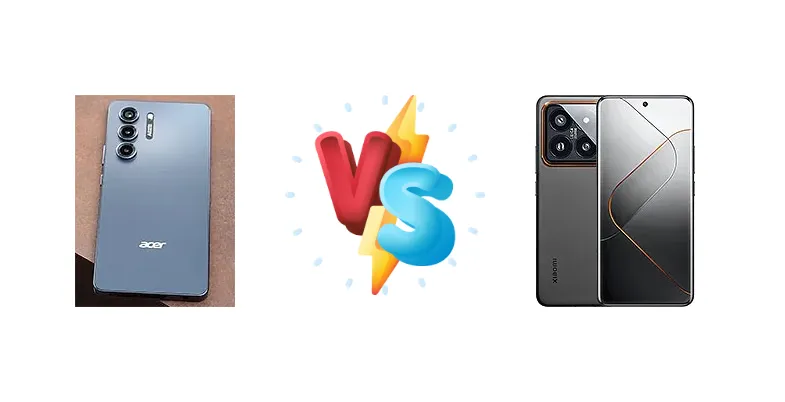
The Xiaomi 14 Pro arrives as a premium flagship, leveraging Qualcomm’s latest silicon and cutting-edge charging technology. The Acer Super ZX Pro, meanwhile, aims to deliver a strong experience at a potentially more accessible price point with Mediatek’s Dimensity 7400. This comparison dissects the core differences to help you determine which device best suits your needs.
🏆 Quick Verdict
For users prioritizing raw performance and the fastest charging speeds, the Xiaomi 14 Pro is the clear winner. However, the Acer Super ZX Pro presents a compelling alternative for those seeking a balanced experience without the top-tier price tag, offering respectable performance and adequate charging.
| Network |
|---|
| 2G bands | GSM 850 / 900 / 1800 / 1900 | GSM 850 / 900 / 1800 / 1900 |
| 3G bands | HSDPA 850 / 900 / 2100 | HSDPA 800 / 850 / 900 / 1700(AWS) / 1900 / 2100 |
| 4G bands | LTE | 1, 3, 4, 5, 7, 8, 18, 19, 26, 28, 34, 38, 39, 40, 41, 42, 48, 66 |
| 5G bands | SA/NSA | 1, 3, 5, 7, 8, 28, 38, 40, 41, 48, 66, 77, 78, 79 SA/NSA |
| Speed | HSPA, LTE, 5G | HSPA, LTE, 5G |
| Technology | GSM / HSPA / LTE / 5G | GSM / CDMA / HSPA / CDMA2000 / LTE / 5G |
| Launch |
|---|
| Announced | 2025, May 26 | 2023, October 26 |
| Status | Cancelled | Available. Released 2023, November 01 |
| Body |
|---|
| Build | Glass front, glass back, plastic frame | Glass front, aluminum frame or titanium frame, glass back |
| Dimensions | - | 161.4 x 75.3 x 8.5 mm |
| SIM | Nano-SIM + Nano-SIM | Nano-SIM + Nano-SIM |
| Weight | 182 g (6.42 oz) | 223 g or 230 g (7.87 oz) |
| Display |
|---|
| Protection | - | Shatterproof glass |
| Resolution | 1080 x 2400 pixels, 20:9 ratio (~395 ppi density) | 1440 x 3200 pixels, 20:9 ratio (~522 ppi density) |
| Size | 6.67 inches, 107.4 cm2 | 6.73 inches, 108.9 cm2 (~89.6% screen-to-body ratio) |
| Type | AMOLED, 120Hz, 1000 nits (HBM) | LTPO AMOLED, 68B colors, 120Hz, Dolby Vision, HDR10+, 3000 nits (peak) |
| Platform |
|---|
| CPU | Octa-core (4x2.6 GHz Cortex-A78 & 4x2.0 GHz Cortex-A55) | Octa-core (1x3.3 GHz Cortex-X4 & 3x3.2 GHz Cortex-A720 & 2x3.0 GHz Cortex-A720 & 2x2.3 GHz Cortex-A520) |
| Chipset | Mediatek Dimensity 7400 (4 nm) | Qualcomm SM8650-AB Snapdragon 8 Gen 3 (4 nm) |
| GPU | Mali-G615 MC2 | Adreno 750 |
| OS | Android 15 | Android 14, HyperOS |
| Memory |
|---|
| Card slot | Unspecified | No |
| Internal | 128GB 6GB RAM, 128GB 8GB RAM, 256GB 8GB RAM, 512GB 8GB RAM, 512GB 12GB RAM | 256GB 12GB RAM, 512GB 16GB RAM, 1TB 16GB RAM |
| Main Camera |
|---|
| Features | LED flash, HDR, panorama | Laser AF, color spectrum sensor, Leica lens, Dual-LED dual-tone flash, HDR, panorama |
| Triple | 64 MP, f/1.8, (wide), 1/1.73", 0.8µm, PDAF, OIS
5 MP, (ultrawide)
Auxiliary lens | 50 MP, f/1.4-f/4.0, 23mm (wide), 1/1.31", 1.2µm, dual pixel PDAF, OIS
50 MP, f/2.0, 75mm (telephoto), PDAF (10cm - ∞), OIS, 3.2x optical zoom
50 MP, f/2.2, 14mm, 115˚ (ultrawide), AF |
| Video | 1440p@30fps, 1080p@30fps | 8K@24fps (HDR), 4K@24/30/60fps (HDR10+, 10-bit Dolby Vision HDR, 10-bit LOG), 1080p@30/60/120/240/960fps, 720p@1920fps, gyro-EIS |
| Selfie camera |
|---|
| Features | HDR | HDR, panorama |
| Single | 13 MP | 32 MP, f/2.0, 22mm (wide), 0.7µm |
| Video | 1440p@30fps, 1080p@30fps | 4K@30/60fps, 1080p@30/60fps, gyro-EIS |
| Sound |
|---|
| 35mm jack | Unspecified | No |
| Loudspeaker | Yes, with stereo speakers (with Dolby Atmos) | Yes, with stereo speakers |
| Comms |
|---|
| Bluetooth | 5.4, A2DP, LE | 5.4, A2DP, LE, aptX HD, aptX Adaptive |
| Infrared port | - | Yes |
| NFC | Unspecified | Yes |
| Positioning | GPS, GLONASS, GALILEO, BDS | GPS (L1+L5), GLONASS (G1), BDS (B1I+B1c+B2a), GALILEO (E1+E5a), QZSS (L1+L5), NavIC (L5) |
| Radio | Unspecified | No |
| USB | USB Type-C 2.0 | USB Type-C 3.2 Gen 2, OTG |
| WLAN | Wi-Fi 802.11 a/b/g/n/ac/6, dual-band | Wi-Fi 802.11 a/b/g/n/ac/6e/7, dual-band, Wi-Fi Direct |
| Features |
|---|
| Sensors | Fingerprint (under display, optical), accelerometer, proximity, compass | Fingerprint (under display, optical), accelerometer, proximity, gyro, compass, barometer |
| Battery |
|---|
| Charging | 33W wired | 120W wired, PD3.0, QC4, 100% in 18 min
50W wireless, 100% in 40 min
10W reverse wireless |
| Type | 5000 mAh | Li-Po 4880 mAh |
| Misc |
|---|
| Colors | Black; other colors | Black, Silver, Titanium, Green |
| Models | - | 23116PN5BC |
| Price | About 190 EUR | About 650 EUR |
Acer Super ZX Pro
- Potentially more affordable price point
- Respectable performance for everyday tasks
- Mediatek Dimensity 7400 offers good efficiency
- Significantly slower charging speed
- Less powerful chipset compared to Snapdragon 8 Gen 3
- Limited information available on camera and display
Xiaomi 14 Pro
- Blazing-fast Snapdragon 8 Gen 3 performance
- Ultra-fast 120W wired and 50W wireless charging
- Advanced camera system with superior image processing
- Higher price tag
- Potential for thermal throttling under sustained load
- May be overkill for basic users
Display Comparison
While display specifications are absent for the Acer Super ZX Pro, the Xiaomi 14 Pro is expected to feature a high-resolution AMOLED panel. The Snapdragon 8 Gen 3’s integrated display engine supports advanced features like variable refresh rates, potentially utilizing LTPO technology for improved power efficiency. The Xiaomi 14 Pro’s display will likely prioritize color accuracy and peak brightness, crucial for HDR content consumption. The Acer, lacking these details, is assumed to offer a standard, though likely still good, AMOLED experience.
Camera Comparison
Camera details for the Acer Super ZX Pro are unavailable, making a direct comparison difficult. However, the Xiaomi 14 Pro is expected to feature a flagship-grade camera system, potentially including a large main sensor with optical image stabilization (OIS). The Snapdragon 8 Gen 3’s ISP (Image Signal Processor) offers advanced computational photography capabilities, enabling features like improved low-light performance and enhanced dynamic range. Without knowing the Acer’s sensor sizes and lens apertures, it’s safe to assume the Xiaomi 14 Pro will deliver superior image quality and versatility.
Performance
The core difference lies in the chipsets. The Xiaomi 14 Pro’s Snapdragon 8 Gen 3 (4nm) boasts a prime Cortex-X4 core clocked at 3.3 GHz, alongside three Cortex-A720 cores at 3.2 GHz and two Cortex-A720 cores at 3.0 GHz, plus two efficiency cores. This configuration provides a significant performance advantage over the Acer’s Mediatek Dimensity 7400 (4nm), which utilizes four Cortex-A78 cores at 2.6 GHz and four Cortex-A55 cores at 2.0 GHz. The Snapdragon’s newer architecture and higher clock speeds translate to faster app loading, smoother multitasking, and superior gaming performance. The Xiaomi 14 Pro will also benefit from faster LPDDR5x RAM, further enhancing responsiveness. Thermal management will be critical for the Snapdragon, but Qualcomm’s optimizations typically mitigate throttling effectively.
Battery Life
The Xiaomi 14 Pro’s charging capabilities are a standout feature, offering 120W wired charging, capable of a full charge in just 18 minutes. It also supports 50W wireless charging (40 minutes to full) and 10W reverse wireless charging. The Acer Super ZX Pro is limited to 33W wired charging, resulting in a significantly longer charging time. While battery capacity isn’t specified for either device, the Xiaomi’s faster charging mitigates the impact of a potentially smaller battery, providing more convenient top-ups throughout the day.
Buying Guide
Buy the Acer Super ZX Pro if you need a reliable daily driver with good performance for everyday tasks and moderate gaming, and value affordability. Buy the Xiaomi 14 Pro if you demand the absolute best in processing power for demanding games and applications, require the convenience of ultra-fast 120W charging, and are willing to pay a premium for it.
Frequently Asked Questions
❓ Will the Dimensity 7400 in the Acer Super ZX Pro struggle with graphically intensive games like Genshin Impact?
While the Dimensity 7400 is a capable chipset, it won't match the Snapdragon 8 Gen 3's performance in demanding titles. Expect to potentially lower graphics settings for a smooth experience in Genshin Impact, whereas the Xiaomi 14 Pro should handle it at maximum settings.
❓ How much faster is the 120W charging on the Xiaomi 14 Pro compared to the 33W charging on the Acer Super ZX Pro in real-world use?
The Xiaomi 14 Pro can go from 0-100% in approximately 18 minutes, while the Acer Super ZX Pro will likely take over an hour. This means you can quickly top up the Xiaomi 14 Pro during short breaks, whereas the Acer requires a more substantial charging period.
❓ Does the Xiaomi 14 Pro get excessively hot during prolonged gaming sessions?
The Snapdragon 8 Gen 3 is a powerful chip and can generate heat. However, Xiaomi typically implements effective thermal management solutions, including vapor chamber cooling, to mitigate throttling. While some warmth is expected, it shouldn't become uncomfortably hot during typical gaming sessions.
❓ Is the lack of detailed camera specifications for the Acer Super ZX Pro a major concern?
Yes, it is. In the flagship space, camera performance is a key differentiator. Without knowing the sensor size, aperture, and image processing capabilities, it's difficult to assess the Acer's camera quality, and it's likely to be outmatched by the Xiaomi 14 Pro.