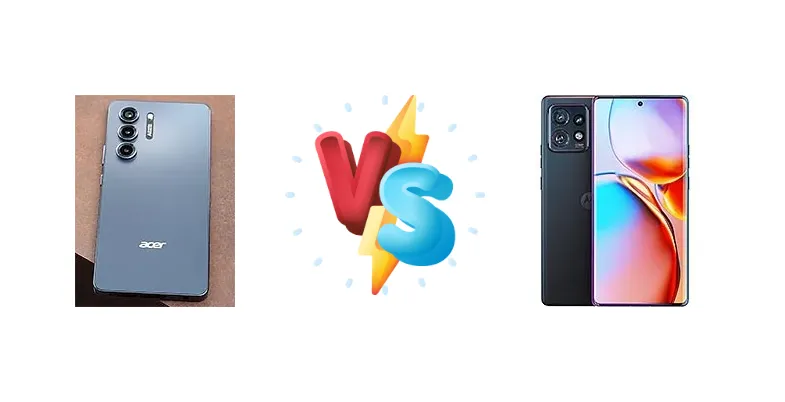
The Acer Super ZX Pro aims to deliver a compelling mid-range experience, while the Motorola Edge+ (2023) represents a flagship offering. This comparison dissects their core components – from chipsets to charging speeds – to determine which device best suits your priorities and budget. We'll focus on how the architectural differences translate into real-world performance and usability.
🏆 Quick Verdict
For the average user prioritizing raw performance and future-proofing, the Motorola Edge+ (2023) is the clear winner. Its Snapdragon 8 Gen 2 chipset provides a significant performance leap over the Dimensity 7400, coupled with substantially faster wired and wireless charging. However, the Super ZX Pro offers a potentially more affordable entry point.
| Network |
|---|
| 2G bands | GSM 850 / 900 / 1800 / 1900 | GSM 850 / 900 / 1800 / 1900 |
| 3G bands | HSDPA 850 / 900 / 2100 | HSDPA 850 / 900 / 1700(AWS) / 1900 / 2100 |
| 4G bands | LTE | 1, 2, 3, 4, 5, 7, 8, 12, 13, 14, 17, 18, 20, 25, 26, 28, 29, 30, 38, 39, 40, 41, 41, 46, 48, 66, 71 |
| 5G bands | SA/NSA | 1, 2, 3, 5, 7, 12, 14, 20, 25, 26, 28, 29, 30, 38, 41, 41, 48, 66, 70, 71, 77, 78 SA/NSA/Sub6/mmWave |
| Speed | HSPA, LTE, 5G | HSPA, LTE, 5G |
| Technology | GSM / HSPA / LTE / 5G | GSM / HSPA / LTE / 5G |
| Launch |
|---|
| Announced | 2025, May 26 | 2023, May 02 |
| Status | Cancelled | Available. Released 2023, May 19 |
| Body |
|---|
| Build | Glass front, glass back, plastic frame | Glass front (Gorilla Glass Victus), glass back (Gorilla Glass Victus), aluminum frame |
| Dimensions | - | 161.2 x 74 x 8.6 mm (6.35 x 2.91 x 0.34 in) |
| SIM | Nano-SIM + Nano-SIM | Nano-SIM + eSIM |
| Weight | 182 g (6.42 oz) | 203 g (7.16 oz) |
| | - | IP68 dust/water resistant (up to 1.5m for 30 min) |
| Display |
|---|
| Protection | - | Corning Gorilla Glass Victus |
| Resolution | 1080 x 2400 pixels, 20:9 ratio (~395 ppi density) | 1080 x 2400 pixels, 20:9 ratio (~395 ppi density) |
| Size | 6.67 inches, 107.4 cm2 | 6.67 inches, 107.4 cm2 (~90.0% screen-to-body ratio) |
| Type | AMOLED, 120Hz, 1000 nits (HBM) | OLED, 1B colors, 165Hz, HDR10+, Dolby Vision, 1300 nits (peak) |
| Platform |
|---|
| CPU | Octa-core (4x2.6 GHz Cortex-A78 & 4x2.0 GHz Cortex-A55) | Octa-core (1x3.2 GHz Cortex-X3 & 2x2.8 GHz Cortex-A715 & 2x2.8 GHz Cortex-A710 & 3x2.0 GHz Cortex-A510) |
| Chipset | Mediatek Dimensity 7400 (4 nm) | Qualcomm SM8550-AB Snapdragon 8 Gen 2 (4 nm) |
| GPU | Mali-G615 MC2 | Adreno 740 |
| OS | Android 15 | Android 13, upgradable to Android 14 |
| Memory |
|---|
| Card slot | Unspecified | No |
| Internal | 128GB 6GB RAM, 128GB 8GB RAM, 256GB 8GB RAM, 512GB 8GB RAM, 512GB 12GB RAM | 512GB 8GB RAM |
| | - | UFS 4.0 |
| Main Camera |
|---|
| Features | LED flash, HDR, panorama | Dual-LED flash, panorama, HDR |
| Triple | 64 MP, f/1.8, (wide), 1/1.73", 0.8µm, PDAF, OIS
5 MP, (ultrawide)
Auxiliary lens | 50 MP, f/1.8, (wide), 1/1.55", 1.0µm, multi-directional PDAF, OIS
12 MP, f/1.6, (telephoto), 1/2.93", 1.22µm, PDAF, 2x optical zoom
50 MP, f/2.2, 114˚ (ultrawide), 1/2.76", 0.64µm, AF |
| Video | 1440p@30fps, 1080p@30fps | 8K@30fps, 4K@30/60fps, 1080p@30/60/120/240/960fps, 10-bit HDR10+, gyro-EIS |
| Selfie camera |
|---|
| Features | HDR | HDR |
| Single | 13 MP | 60 MP, f/2.2, (wide), 1/2.8", 0.61µm |
| Video | 1440p@30fps, 1080p@30fps | 4K@30/60fps, 1080p@30/60/120/240fps |
| Sound |
|---|
| 3.5mm jack | - | No |
| 35mm jack | Unspecified | No |
| Loudspeaker | Yes, with stereo speakers (with Dolby Atmos) | Yes, with stereo speakers |
| Comms |
|---|
| Bluetooth | 5.4, A2DP, LE | 5.3, A2DP, LE, aptX HD, aptX Adaptive |
| NFC | Unspecified | Yes |
| Positioning | GPS, GLONASS, GALILEO, BDS | GPS, GLONASS, GALILEO, BDS |
| Radio | Unspecified | No |
| USB | USB Type-C 2.0 | USB Type-C 3.2, OTG, DisplayPort 1.4 |
| WLAN | Wi-Fi 802.11 a/b/g/n/ac/6, dual-band | Wi-Fi 802.11 a/b/g/n/ac/6e/7, tri-band, Wi-Fi Direct |
| Features |
|---|
| Sensors | Fingerprint (under display, optical), accelerometer, proximity, compass | Fingerprint (under display, optical), accelerometer, gyro, proximity, compass, barometer |
| | - | Ready For 3.5 support |
| Battery |
|---|
| Charging | 33W wired | 68W wired
15W wireless
5W reverse wired
5W reverse wireless |
| Type | 5000 mAh | Li-Po 5100 mAh |
| Misc |
|---|
| Colors | Black; other colors | Interstellar Black |
| Price | About 190 EUR | $ 298.99 |
Acer Super ZX Pro
- Potentially more affordable price point
- Efficient Mediatek Dimensity 7400 chipset for everyday tasks
- Sufficient performance for casual gaming
- Significantly slower charging speeds
- Less powerful chipset compared to the Snapdragon 8 Gen 2
- Likely inferior camera performance
Motorola Edge+ (2023)
- Top-tier performance with Snapdragon 8 Gen 2
- Ultra-fast 68W wired and 15W wireless charging
- Superior camera system with advanced ISP
- Higher price tag
- Potential for more heat generation under extreme load (though mitigated by the chip's efficiency)
- Larger size and weight compared to some mid-range options
Display Comparison
While display specs aren't provided, the Motorola Edge+ (2023), as a flagship, likely features a higher-resolution panel with potentially LTPO technology for adaptive refresh rates, contributing to better battery life. The Acer Super ZX Pro, positioned in the mid-range, may utilize a standard AMOLED panel. Bezels are expected to be slimmer on the Motorola, and color accuracy, while dependent on calibration, is typically more refined on flagship devices. The absence of display details for the Acer makes a direct comparison difficult, but the Motorola's flagship status suggests a superior visual experience.
Camera Comparison
Without specific camera sensor details, we can infer that the Motorola Edge+ (2023) likely features a larger main sensor with Optical Image Stabilization (OIS), enabling better low-light performance and sharper images. The Snapdragon 8 Gen 2’s ISP (Image Signal Processor) is also more advanced, offering superior image processing capabilities. The Acer Super ZX Pro will likely rely on software processing to compensate for a potentially smaller sensor. The inclusion of a 2MP macro camera on either device is largely a marketing tactic, offering minimal practical benefit. The Motorola’s camera system is expected to deliver more consistent and higher-quality results across various shooting conditions.
Performance
The core difference lies in the chipsets. The Motorola Edge+ (2023) boasts the Qualcomm Snapdragon 8 Gen 2 (4nm), featuring a prime Cortex-X3 core clocked at 3.2 GHz. This architecture is designed for peak performance and efficiency. Conversely, the Acer Super ZX Pro utilizes the Mediatek Dimensity 7400 (4nm) with a Cortex-A78 based core configuration. While both are 4nm chips, the Snapdragon 8 Gen 2’s newer architecture and higher clock speeds translate to significantly faster CPU and GPU performance. The Snapdragon’s Adreno GPU will outperform the Mali GPU in the Dimensity 7400, especially in graphically intensive games. The Motorola also benefits from faster RAM (likely LPDDR5x) compared to the Acer, further enhancing multitasking capabilities. Thermal management will be crucial; the Snapdragon 8 Gen 2, despite its power, is known for its improved thermal efficiency, minimizing throttling under sustained load.
Battery Life
The Motorola Edge+ (2023) significantly outpaces the Acer Super ZX Pro in charging speed with 68W wired charging, allowing for a full charge in approximately 30-40 minutes. The Acer’s 33W charging will take considerably longer. Furthermore, the Motorola adds 15W wireless charging and both 5W reverse wired/wireless charging, offering added convenience. While battery capacity isn't specified, the faster charging of the Motorola effectively mitigates any potential capacity disadvantage. The Snapdragon 8 Gen 2’s efficiency also contributes to better battery life during typical usage.
Buying Guide
Buy the Acer Super ZX Pro if you need a reliable daily driver for everyday tasks, social media, and light gaming, and are seeking a more budget-friendly option. You'll appreciate its efficiency and adequate performance for common use cases. Buy the Motorola Edge+ (2023) if you demand top-tier performance for demanding games, content creation, and multitasking, and value the convenience of ultra-fast charging and wireless power transfer. This is the phone for power users.
Frequently Asked Questions
❓ Does the Mediatek Dimensity 7400 in the Acer Super ZX Pro struggle with demanding games like Genshin Impact?
While the Dimensity 7400 is capable, Genshin Impact and similar graphically intensive titles will likely require reduced graphics settings to maintain a stable frame rate. The Snapdragon 8 Gen 2 in the Motorola Edge+ (2023) will handle these games with ease at higher settings.
❓ How long does it realistically take to fully charge the Motorola Edge+ (2023) from 0% using the 68W charger?
Expect a full charge from 0% to 100% on the Motorola Edge+ (2023) to take approximately 35-40 minutes with the included 68W charger. This is a significant time saving compared to the Acer Super ZX Pro’s 33W charging.
❓ Is the reverse wireless charging on the Motorola Edge+ (2023) useful for topping up accessories like earbuds?
Yes, the 5W reverse wireless charging is convenient for providing a slow trickle charge to accessories like wireless earbuds or smartwatches. It's not a fast charging solution, but it can be helpful in a pinch.
❓ Will the Acer Super ZX Pro receive fewer software updates compared to the Motorola Edge+ (2023)?
Generally, Motorola provides a more consistent and longer software support commitment for its flagship Edge+ series compared to Acer's mid-range offerings. Expect the Edge+ (2023) to receive more Android version updates and security patches over its lifespan.