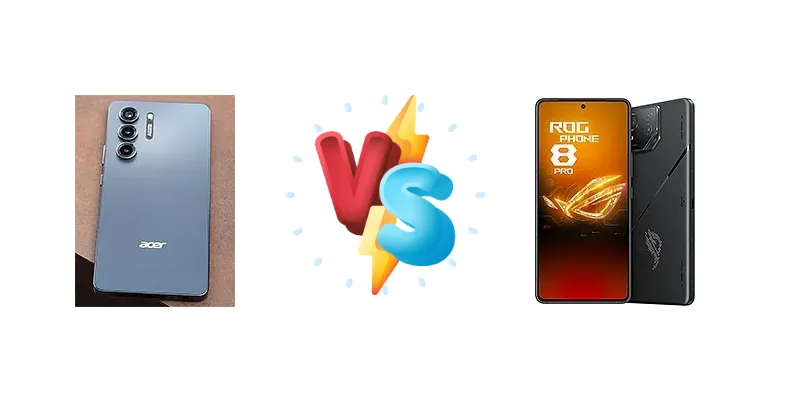
The Acer Super ZX Pro and Asus ROG Phone 8 Pro represent distinct approaches to the gaming smartphone market. The Super ZX Pro aims for a balance of performance and affordability, while the ROG Phone 8 Pro is a no-compromise flagship focused on delivering the ultimate gaming experience. This comparison dissects their key differences to help you determine which device best suits your needs.
🏆 Quick Verdict
For the average user prioritizing sustained performance and a premium experience, the Asus ROG Phone 8 Pro is the clear winner. Its Snapdragon 8 Gen 3 chipset, coupled with its exceptional 14:43 hour battery life and 65W charging, provides a significant advantage over the Acer Super ZX Pro's Dimensity 7400 and 33W charging.
| Network |
|---|
| 2G bands | GSM 850 / 900 / 1800 / 1900 | GSM 850 / 900 / 1800 / 1900 |
| 3G bands | HSDPA 850 / 900 / 2100 | HSDPA 850 / 900 / 1700(AWS) / 1800 / 1900 / 2100 - International |
| 4G bands | LTE | 1, 2, 3, 4, 5, 7, 8, 12, 17, 18, 19, 20, 25, 26, 28, 32, 34, 38, 39, 40, 41, 42, 43, 48, 66 - International |
| 5G bands | SA/NSA | 1, 2, 3, 5, 7, 8, 12, 18, 20, 25, 26, 28, 38, 40, 41, 48, 66, 77, 78, 79 SA/NSA/Sub6 - International |
| Speed | HSPA, LTE, 5G | HSPA, LTE (Up to 7CA), 5G |
| Technology | GSM / HSPA / LTE / 5G | GSM / CDMA / HSPA / LTE / 5G |
| Launch |
|---|
| Announced | 2025, May 26 | 2024, January 08 |
| Status | Cancelled | Available. Released 2024, January 18 |
| Body |
|---|
| Build | Glass front, glass back, plastic frame | Glass front (Gorilla Glass Victus 2), glass back (Gorilla Glass), aluminum frame |
| Dimensions | - | 163.8 x 76.8 x 8.9 mm (6.45 x 3.02 x 0.35 in) |
| SIM | Nano-SIM + Nano-SIM | Nano-SIM + Nano-SIM |
| Weight | 182 g (6.42 oz) | 225 g (7.94 oz) |
| Display |
|---|
| Protection | - | Corning Gorilla Glass Victus 2 |
| Resolution | 1080 x 2400 pixels, 20:9 ratio (~395 ppi density) | 1080 x 2400 pixels, 20:9 ratio (~388 ppi density) |
| Size | 6.67 inches, 107.4 cm2 | 6.78 inches, 111.0 cm2 (~88.2% screen-to-body ratio) |
| Type | AMOLED, 120Hz, 1000 nits (HBM) | LTPO AMOLED, 1B colors, 165Hz, HDR10, 1600 nits (HBM), 2500 nits (peak) |
| Platform |
|---|
| CPU | Octa-core (4x2.6 GHz Cortex-A78 & 4x2.0 GHz Cortex-A55) | Octa-core (1x3.3 GHz Cortex-X4 & 3x3.2 GHz Cortex-A720 & 2x3.0 GHz Cortex-A720 & 2x2.3 GHz Cortex-A520) |
| Chipset | Mediatek Dimensity 7400 (4 nm) | Qualcomm SM8650-AB Snapdragon 8 Gen 3 (4 nm) |
| GPU | Mali-G615 MC2 | Adreno 750 |
| OS | Android 15 | Android 14, up to 2 major Android upgrades |
| Memory |
|---|
| Card slot | Unspecified | No |
| Internal | 128GB 6GB RAM, 128GB 8GB RAM, 256GB 8GB RAM, 512GB 8GB RAM, 512GB 12GB RAM | 512GB 16GB RAM, 1TB 24GB RAM |
| Main Camera |
|---|
| Features | LED flash, HDR, panorama | LED flash, HDR, panorama |
| Triple | 64 MP, f/1.8, (wide), 1/1.73", 0.8µm, PDAF, OIS
5 MP, (ultrawide)
Auxiliary lens | 50 MP, f/1.9, 24mm (wide), 1/1.56", 1.0µm, PDAF, gimbal OIS
32 MP, f/2.4, (telephoto), 1/3.2", 0.7µm, PDAF, OIS, 3x optical zoom
13 MP, f/2.2, 13mm, 120˚ (ultrawide) |
| Video | 1440p@30fps, 1080p@30fps | 8K@24fps, 4K@30/60fps, 1080p@30/60/120/240fps, 720p@480fps; gyro-EIS, HDR10+ |
| Selfie camera |
|---|
| Features | HDR | Panorama, HDR |
| Single | 13 MP | 32 MP, f/2.5, 22mm (wide), 1/3.2", 0.7µm |
| Video | 1440p@30fps, 1080p@30fps | 1080p@30fps |
| Sound |
|---|
| 35mm jack | Unspecified | Yes |
| Loudspeaker | Yes, with stereo speakers (with Dolby Atmos) | Yes, with stereo speakers |
| Comms |
|---|
| Bluetooth | 5.4, A2DP, LE | 5.4, A2DP, LE, aptX HD, aptX Adaptive, aptX Lossless |
| NFC | Unspecified | Yes |
| Positioning | GPS, GLONASS, GALILEO, BDS | GPS (L1+L5), BDS (B1I+B1c+B2a), GALILEO (E1+E5a), QZSS (L1+L5), NavIC (L5), GLONASS |
| Radio | Unspecified | No |
| USB | USB Type-C 2.0 | USB Type-C (side), DisplayPort 1.4; USB Type-C (bottom), OTG |
| WLAN | Wi-Fi 802.11 a/b/g/n/ac/6, dual-band | Wi-Fi 802.11 a/b/g/n/ac/6e/7, tri-band, Wi-Fi Direct |
| Features |
|---|
| Sensors | Fingerprint (under display, optical), accelerometer, proximity, compass | Fingerprint (under display, optical), accelerometer, gyro, proximity, compass |
| Battery |
|---|
| Charging | 33W wired | 65W wired, PD3.0, PPS, QC5, 100% in 39 min - International
30W wired, PD3.0, PPS - India
15W wireless (Qi)
10W reverse wired |
| Type | 5000 mAh | 5500 mAh |
| Misc |
|---|
| Colors | Black; other colors | Phantom Black |
| Models | - | AI2401, AI2401_A, AI2401_D |
| Price | About 190 EUR | $ 1,157.98 / £ 1,693.75 / € 632.66 |
Acer Super ZX Pro
- Potentially more affordable price point
- 4nm Dimensity 7400 offers decent performance
- Compact form factor (assumed, based on market positioning)
- Significantly slower 33W charging
- Less powerful chipset compared to Snapdragon 8 Gen 3
- Limited camera information suggests a less capable system
Asus ROG Phone 8 Pro
- Exceptional performance with Snapdragon 8 Gen 3
- Long battery life (14:43h active use)
- Fast 65W charging (international) with multiple protocols
- Higher price tag
- Larger size and weight (typical for ROG Phones)
- Gaming-focused design may not appeal to all users
Display Comparison
The Asus ROG Phone 8 Pro boasts a significantly brighter display, reaching a measured peak of 1765 nits, ensuring excellent visibility even in direct sunlight. While the Super ZX Pro's display specifications are not provided, the ROG Phone 8 Pro's brightness advantage is substantial. The ROG Phone 8 Pro likely incorporates LTPO technology for adaptive refresh rates, further enhancing power efficiency and smoothness, a feature not confirmed for the Super ZX Pro. The ROG Phone 8 Pro's display is geared towards immersive gaming and media consumption, while the Super ZX Pro's display performance remains an unknown quantity.
Camera Comparison
The context data for the Acer Super ZX Pro lacks camera details, making a direct comparison difficult. However, the Asus ROG Phone 8 Pro’s camera system is designed for both photo and video capture, suggesting a more versatile setup. The ROG Phone 8 Pro likely features advanced image processing algorithms and potentially larger sensor sizes for improved low-light performance. Without specific details on the Super ZX Pro’s camera, it’s reasonable to assume the ROG Phone 8 Pro offers a more refined and capable photography experience.
Performance
The core difference lies in the chipsets: the Asus ROG Phone 8 Pro utilizes the Qualcomm Snapdragon 8 Gen 3 (4nm), featuring a powerful octa-core configuration with a prime Cortex-X4 core clocked at 3.3 GHz. This is a substantial leap over the Acer Super ZX Pro’s Mediatek Dimensity 7400 (4nm) with its Cortex-A78 cores peaking at 2.6 GHz. The Snapdragon 8 Gen 3’s architectural improvements and higher clock speeds translate to significantly faster processing and graphics performance, particularly in demanding games. While both are built on a 4nm process, the Snapdragon 8 Gen 3’s more advanced architecture offers superior thermal efficiency, minimizing throttling during prolonged gaming. The ROG Phone 8 Pro will deliver a smoother, more responsive gaming experience.
Battery Life
The Asus ROG Phone 8 Pro excels in battery life, achieving an impressive 14 hours and 43 minutes of active use. This is a significant advantage over what we would expect from a device with 33W charging. The ROG Phone 8 Pro also supports 65W wired charging (international markets), enabling a full charge in just 39 minutes, alongside PD3.0, PPS, and QC5 compatibility. India receives a slower 30W charging speed. The Super ZX Pro’s 33W charging is considerably slower, and while battery capacity isn’t specified, the ROG Phone 8 Pro’s combination of capacity and fast charging provides a clear advantage for users who prioritize minimizing downtime.
Buying Guide
Buy the Acer Super ZX Pro if you need a capable gaming phone on a tighter budget and don't require the absolute highest frame rates or longest battery life. It's a solid choice for casual gamers and everyday users. Buy the Asus ROG Phone 8 Pro if you demand uncompromising performance, extended gaming sessions, and the fastest possible charging speeds. This is the phone for competitive gamers and power users who want the best.
Frequently Asked Questions
❓ Does the Mediatek Dimensity 7400 in the Acer Super ZX Pro struggle with demanding titles like Genshin Impact?
While the Dimensity 7400 is a capable chip, it will likely require lower graphics settings and potentially experience more frame drops in graphically intensive games like Genshin Impact compared to the Snapdragon 8 Gen 3 in the ROG Phone 8 Pro. The Snapdragon 8 Gen 3's superior GPU and thermal management provide a smoother, more consistent gaming experience.
❓ How does the 65W charging on the Asus ROG Phone 8 Pro compare to the 33W charging on the Acer Super ZX Pro in real-world usage?
The 65W charging on the ROG Phone 8 Pro is significantly faster. Asus claims a 100% charge in 39 minutes (international markets). The Super ZX Pro’s 33W charging will take considerably longer, potentially over an hour and a half to fully charge, impacting convenience for users who need to quickly top up their battery.
❓ Is the ROG Phone 8 Pro's gaming-focused design (e.g., potential for accessories) a drawback for everyday use?
The ROG Phone 8 Pro's design is undeniably geared towards gaming, with a larger size and potentially more aggressive aesthetics. However, it's still a fully functional smartphone with all the necessary features for everyday tasks. The availability of accessories like external fans and controllers is a bonus for gamers but doesn't hinder its usability as a daily driver.