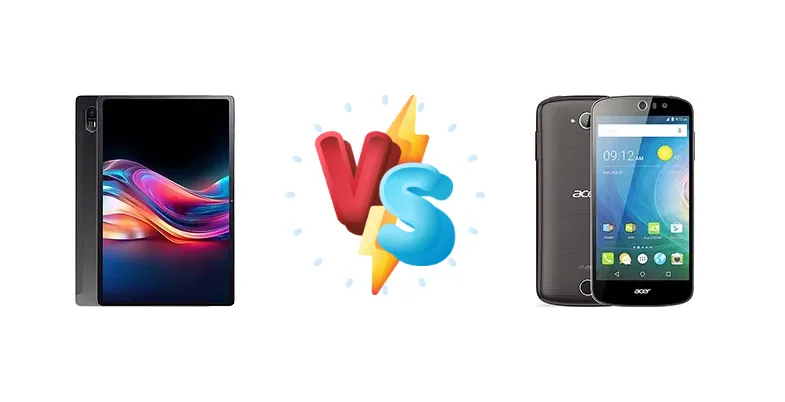
The Acer Iconia X12 and Liquid Z530S represent vastly different eras of mobile computing. The Z530S, released several years ago, targets the ultra-budget smartphone market, while the Iconia X12 is a more recent tablet designed for productivity and entertainment. This comparison dissects the core hardware differences to determine which device best suits your needs.
🏆 Quick Verdict
For the vast majority of users, the Acer Iconia X12 is the superior choice. Its modern Mediatek Helio G99 chipset provides a substantial performance boost and significantly improved battery endurance compared to the Liquid Z530S’s aging MT6753. While the Z530S may appeal to those on the absolute tightest budget, the X12 offers a far more future-proof and enjoyable experience.
| Network |
|---|
| 2G bands | N/A | GSM 850 / 900 / 1800 / 1900 - SIM 1 & SIM 2 (dual-SIM model only) |
| 3G bands | N/A | HSDPA |
| 4G bands | N/A | LTE |
| EDGE | No | Yes |
| GPRS | No | Yes |
| Speed | - | HSPA, LTE |
| Technology | No cellular connectivity | GSM / HSPA / LTE |
| Launch |
|---|
| Announced | 2025, September 03 | 2015, September. Released 2015, November |
| Status | Available. Released 2025, November | Discontinued |
| Body |
|---|
| Build | Glass front, aluminum alloy frame | - |
| Dimensions | 286.2 x 184.4 x 6.5 mm (11.27 x 7.26 x 0.26 in) | 144 x 70.3 x 8.9 mm (5.67 x 2.77 x 0.35 in) |
| SIM | No | Single SIM (Micro-SIM) or Dual SIM (Micro-SIM, dual stand-by) |
| Weight | 500 g (1.10 lb) | 145 g (5.11 oz) |
| Display |
|---|
| Protection | Mohs level 4 | - |
| Resolution | 1600 x 2560 pixels, 16:10 ratio (~240 ppi density) | 720 x 1280 pixels, 16:9 ratio (~294 ppi density) |
| Size | 12.6 inches, 460.3 cm2 (~87.2% screen-to-body ratio) | 5.0 inches, 68.9 cm2 (~68.1% screen-to-body ratio) |
| Type | AMOLED, 400 nits | IPS LCD |
| Platform |
|---|
| CPU | Octa-core (2x2.2 GHz Cortex-A76 & 6x2.0 GHz Cortex-A55) | Octa-core 1.3 GHz Cortex-A53 |
| Chipset | Mediatek Helio G99 (6 nm) | Mediatek MT6753 (28 nm) |
| GPU | Mali-G57 MC2 | Mali-T720MP3 |
| OS | Android 15 | Android 5.1 (Lollipop) |
| Memory |
|---|
| Call records | - | 30 dialed, 30 received, 30 missed calls |
| Card slot | microSDXC (dedicated slot) | microSDXC (dedicated slot) |
| Internal | 256GB 8GB RAM | 32GB 3GB RAM |
| Phonebook | - | Yes, Photo call |
| Main Camera |
|---|
| Features | LED flash | LED flash, HDR, panorama |
| Single | 13 MP, AF | 8 MP, AF |
| Video | 1080p@30fps | Yes |
| Selfie camera |
|---|
| Single | 5 MP | 8 MP |
| Video | Yes | - |
| Sound |
|---|
| 3.5mm jack | - | Yes |
| 35mm jack | Yes | Yes |
| Alert types | - | Vibration; Downloadable polyphonic, MP3 ringtones |
| Loudspeaker | Yes, with stereo speakers (4 speakers) | Yes |
| Comms |
|---|
| Bluetooth | 5.2, A2DP, LE | 4.0, A2DP |
| NFC | No | No |
| Positioning | GPS | GPS |
| Radio | No | FM radio |
| USB | USB Type-C 2.0, magnetic accessory connector | microUSB 2.0 |
| WLAN | Wi-Fi 802.11 a/b/g/n/ac, dual-band | Wi-Fi 802.11 b/g/n, hotspot |
| Features |
|---|
| Browser | - | WAP 2.0/xHTML, HTML (Opera v8.5) |
| Games | - | Yes |
| Java | - | Yes, MIDP 2.0 |
| Messaging | - | SMS, MMS, Email |
| Sensors | Accelerometer, proximity (accessories only) | Accelerometer, proximity |
| Battery |
|---|
| Charging | 20W wired | - |
| Stand-by | - | Up to 150 h |
| Talk time | - | Up to 4 h |
| Type | Li-Ion 8000 mAh | Li-Ion 2420 mAh, removable |
| Misc |
|---|
| Colors | Matte Black | Black, White |
| Models | A25014, X12-21M, X12-11-845L | - |
| Price | About 280 EUR | About 60 EUR |
| SAR | - | 1.41 W/kg (head) 0.25 W/kg (body) |
| EU LABEL |
|---|
| Battery | 80:31h endurance, 800 cycles | - |
| Energy | Class F | - |
| Free fall | Class E (2 falls) | - |
| Repairability | Class C | - |
Acer Iconia X12
- Significantly faster processor for smooth multitasking.
- Longer battery life and more charge cycles.
- Likely larger and higher-resolution display for better viewing.
- Tablet form factor may not be ideal for all users.
- Potentially higher price point than the Z530S.
Acer Liquid Z530S
- Ultra-affordable price point.
- Compact smartphone form factor for portability.
- Basic functionality for essential communication.
- Outdated processor struggles with modern apps.
- Limited battery life.
- Likely low-resolution display and camera.
Display Comparison
The context data doesn't provide display specifics, but given the Iconia X12 is a tablet, we can infer a larger screen size and potentially higher resolution than the Z530S. The Z530S, being an older smartphone, likely features a 720p or 1080p display. The Iconia X12, targeting a more modern user, likely has a higher brightness and color accuracy. The tablet form factor also allows for a more immersive viewing experience.
Camera Comparison
The context data lacks camera details for both devices. However, given the Z530S’s age and budget positioning, its camera system is likely basic, potentially featuring a low-resolution main sensor and limited features. The Iconia X12, while not marketed as a camera-centric device, likely benefits from a more modern image signal processor (ISP) within the Helio G99 chipset, resulting in better image quality and processing capabilities. We can expect the Iconia X12 to offer a more consistent and usable camera experience.
Performance
The performance gap between these devices is substantial. The Iconia X12’s Mediatek Helio G99 (6nm) utilizes Cortex-A76 and A55 cores clocked at 2.2 GHz and 2.0 GHz respectively, offering a significant leap in CPU performance over the Liquid Z530S’s MT6753 (28nm) with its 1.3 GHz Cortex-A53 cores. The 6nm process node of the Helio G99 also translates to improved power efficiency and reduced thermal throttling. This means the Iconia X12 will handle multitasking, demanding apps, and even light gaming with ease, while the Z530S will struggle with even moderate workloads.
Battery Life
The Iconia X12 boasts an impressive 80-hour endurance rating with 800 charge cycles, indicating a large battery capacity and robust battery health management. The Liquid Z530S’s battery life is not specified, but given its older chipset and smaller form factor, it will likely fall significantly short of the Iconia X12. The Iconia X12’s 20W wired charging is also a benefit, allowing for faster replenishment compared to the Z530S, which likely supports slower charging speeds.
Buying Guide
Buy the Acer Iconia X12 if you need a versatile tablet for work, streaming, and light gaming, prioritizing performance and battery life. Its larger screen and more powerful processor make it ideal for multitasking and demanding applications. Buy the Acer Liquid Z530S if you absolutely require a basic, ultra-affordable smartphone for essential communication and are willing to accept significant performance limitations and a shorter battery lifespan.
Frequently Asked Questions
❓ Is the Mediatek Helio G99 in the Iconia X12 capable of running demanding games like Genshin Impact?
While the Helio G99 isn't a flagship gaming chip, it's capable of running Genshin Impact at lower settings. Expect playable frame rates with reduced graphics quality. The Liquid Z530S’s MT6753 would struggle significantly, likely rendering the game unplayable.
❓ How does the 6nm process node of the Helio G99 impact the Iconia X12’s battery life compared to the 28nm MT6753?
The 6nm process node is significantly more power-efficient than the 28nm node. This means the Helio G99 consumes less power for the same level of performance, resulting in longer battery life and reduced heat generation. The Iconia X12’s 80-hour endurance is a direct result of this efficiency.
❓ Is the Acer Liquid Z530S still a viable option for basic smartphone use in 2024?
While functional for basic tasks like calls and texts, the Liquid Z530S’s outdated hardware will result in a sluggish and frustrating experience with modern apps and websites. It’s only recommended for users with extremely limited budgets and minimal smartphone needs.