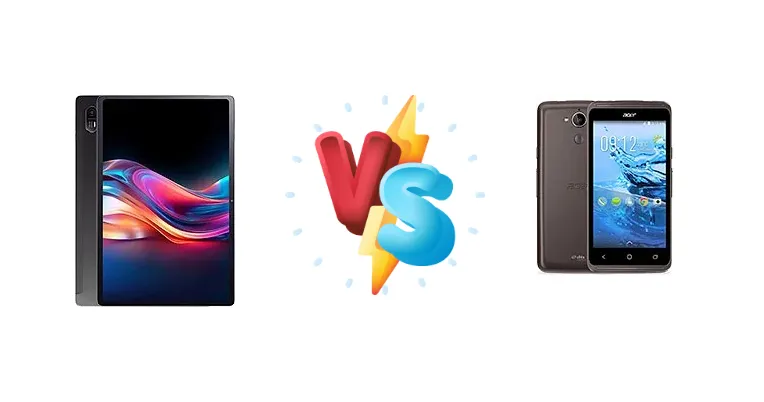
Acer's product lineup spans a wide range, from productivity-focused tablets like the Iconia X12 to ultra-affordable smartphones like the Liquid Z410. While both aim to deliver value, they cater to vastly different user needs. This comparison dissects the core differences, focusing on the architectural advantages of the Iconia X12's modern chipset versus the Liquid Z410's more basic offering.
🏆 Quick Verdict
For users prioritizing performance and longevity, the Acer Iconia X12 is the clear winner. Its Mediatek Helio G99 chipset provides a substantial leap in processing power and efficiency compared to the Liquid Z410’s MT6732M. However, the Liquid Z410 remains a viable option for those seeking the absolute lowest cost of entry for basic smartphone functionality.
| Network |
|---|
| 2G bands | N/A | GSM 850 / 900 / 1800 / 1900 - SIM 1 & SIM 2 (dual-SIM model only) |
| 3G bands | N/A | HSDPA 900 / 2100 |
| 4G bands | N/A | 1, 3, 7, 20 |
| EDGE | No | - |
| GPRS | No | - |
| Speed | - | HSPA, LTE Cat4 150/50 Mbps |
| Technology | No cellular connectivity | GSM / HSPA / LTE |
| | - | 2, 4, 7, 17 |
| Launch |
|---|
| Announced | 2025, September 03 | 2015, January. Released 2015, February |
| Status | Available. Released 2025, November | Discontinued |
| Body |
|---|
| Build | Glass front, aluminum alloy frame | - |
| Dimensions | 286.2 x 184.4 x 6.5 mm (11.27 x 7.26 x 0.26 in) | 136 x 66.7 x 9.9 mm (5.35 x 2.63 x 0.39 in) |
| SIM | No | Single SIM (Micro-SIM) or Dual SIM (Micro-SIM, dual stand-by) |
| Weight | 500 g (1.10 lb) | 145 g (5.11 oz) |
| Display |
|---|
| Protection | Mohs level 4 | - |
| Resolution | 1600 x 2560 pixels, 16:10 ratio (~240 ppi density) | 540 x 960 pixels, 16:9 ratio (~245 ppi density) |
| Size | 12.6 inches, 460.3 cm2 (~87.2% screen-to-body ratio) | 4.5 inches, 55.8 cm2 (~61.5% screen-to-body ratio) |
| Type | AMOLED, 400 nits | IPS LCD |
| Platform |
|---|
| CPU | Octa-core (2x2.2 GHz Cortex-A76 & 6x2.0 GHz Cortex-A55) | Quad-core 1.3 GHz Cortex-A53 |
| Chipset | Mediatek Helio G99 (6 nm) | Mediatek MT6732M (28 nm) |
| GPU | Mali-G57 MC2 | Mali-T760MP2 |
| OS | Android 15 | Android 4.4.4 (KitKat) |
| Memory |
|---|
| Card slot | microSDXC (dedicated slot) | microSDHC (dedicated slot) |
| Internal | 256GB 8GB RAM | 8GB 1GB RAM, 16GB 2GB RAM |
| Main Camera |
|---|
| Features | LED flash | LED flash |
| Single | 13 MP, AF | 5 MP, AF |
| Video | 1080p@30fps | Yes, dual shot |
| Selfie camera |
|---|
| Single | 5 MP | 2 MP |
| Video | Yes | - |
| Sound |
|---|
| 3.5mm jack | - | Yes |
| 35mm jack | Yes | Yes |
| Loudspeaker | Yes, with stereo speakers (4 speakers) | Yes, dual speakers |
| Comms |
|---|
| Bluetooth | 5.2, A2DP, LE | 4.0, A2DP |
| NFC | No | No |
| Positioning | GPS | GPS |
| Radio | No | FM radio |
| USB | USB Type-C 2.0, magnetic accessory connector | microUSB 2.0 |
| WLAN | Wi-Fi 802.11 a/b/g/n/ac, dual-band | Wi-Fi 802.11 b/g/n, hotspot |
| Features |
|---|
| Sensors | Accelerometer, proximity (accessories only) | Accelerometer, proximity |
| Battery |
|---|
| Charging | 20W wired | - |
| Type | Li-Ion 8000 mAh | Li-Po 2000 mAh, removable |
| Misc |
|---|
| Colors | Matte Black | Black |
| Models | A25014, X12-21M, X12-11-845L | - |
| Price | About 280 EUR | About 130 EUR |
| EU LABEL |
|---|
| Battery | 80:31h endurance, 800 cycles | - |
| Energy | Class F | - |
| Free fall | Class E (2 falls) | - |
| Repairability | Class C | - |
Acer Iconia X12
- Significantly faster processor for smooth multitasking.
- More efficient chipset for longer battery life.
- Likely superior camera performance.
- Higher price point.
- Larger form factor may not suit all users.
Acer Liquid Z410
- Extremely affordable.
- Compact and portable smartphone form factor.
- Acceptable for basic communication tasks.
- Slow processor struggles with demanding apps.
- Outdated chipset technology.
- Likely limited battery life and camera quality.
Display Comparison
The context data doesn't provide display specifics, but given the Iconia X12 is a tablet, we can infer a larger screen size optimized for media consumption and productivity. The Liquid Z410, being a smartphone, will have a smaller, more portable display. The Iconia X12’s larger form factor likely allows for a higher resolution panel. The difference in chipsets suggests the Iconia X12 could support higher refresh rates, resulting in smoother scrolling and animations, while the Liquid Z410 will likely be limited to a standard 60Hz refresh rate.
Camera Comparison
Without specific camera details, it’s safe to assume the Iconia X12, as a more modern device, will feature a superior camera system. The Liquid Z410 likely relies on basic sensors for functional, but not exceptional, image capture. The Iconia X12’s chipset likely supports more advanced image processing algorithms, resulting in better dynamic range, noise reduction, and overall image quality. The absence of details suggests the Liquid Z410 likely lacks features like Optical Image Stabilization (OIS).
Performance
The performance gap between these devices is substantial. The Acer Iconia X12’s Mediatek Helio G99, built on a 6nm process, features an octa-core configuration (2x2.2 GHz Cortex-A76 & 6x2.0 GHz Cortex-A55) offering significantly more processing power and efficiency than the Liquid Z410’s quad-core 1.3 GHz Cortex-A53 processor fabricated on a dated 28nm node. The 6nm process allows for higher transistor density and lower power consumption, translating to better sustained performance and reduced thermal throttling. This means the Iconia X12 will handle demanding applications and multitasking with ease, while the Liquid Z410 will struggle with even moderate workloads.
Battery Life
The Iconia X12 boasts an impressive 80-hour endurance rating with 800 charge cycles, indicating a focus on long-term battery health and usability. While the Liquid Z410’s battery capacity is unknown, its less powerful chipset and older manufacturing process likely result in lower energy consumption. However, the Iconia X12’s 20W wired charging offers a faster replenishment rate, potentially offsetting any capacity differences. The 800 cycle rating on the Iconia X12 suggests a battery designed to withstand years of regular use, a significant advantage over the likely lower-quality battery in the Z410.
Buying Guide
Buy the Acer Iconia X12 if you need a tablet capable of handling multitasking, streaming, and light gaming with a responsive user experience. It’s ideal for students, remote workers, or anyone who values a smooth and efficient digital experience. Buy the Acer Liquid Z410 if you prefer a minimal-cost smartphone for essential communication – calls, texts, and light web browsing – and are willing to accept compromises in performance and longevity.
Frequently Asked Questions
❓ Is the Mediatek Helio G99 in the Iconia X12 capable of running demanding games like Genshin Impact?
The Helio G99 is a capable mid-range chipset. While it won't deliver flagship-level performance, it should be able to run Genshin Impact at medium settings with acceptable frame rates. The larger screen of the Iconia X12 also enhances the gaming experience compared to the smaller display of the Liquid Z410.
❓ How does the older 28nm process of the Liquid Z410’s MT6732M affect its real-world performance?
The 28nm process is significantly less efficient than the 6nm process used in the Iconia X12’s Helio G99. This means the MT6732M consumes more power for the same level of performance, resulting in shorter battery life and increased heat generation. It also limits the chipset’s ability to sustain peak performance for extended periods due to thermal throttling.
❓ Given the price difference, is the Iconia X12 worth the extra cost for someone who primarily uses their device for web browsing and social media?
If your usage is limited to basic tasks like web browsing and social media, the Liquid Z410 will suffice. However, the Iconia X12’s smoother performance and longer battery life will provide a noticeably better user experience, even for these simple tasks. The investment in the Iconia X12 translates to a device that will remain usable and responsive for a longer period.