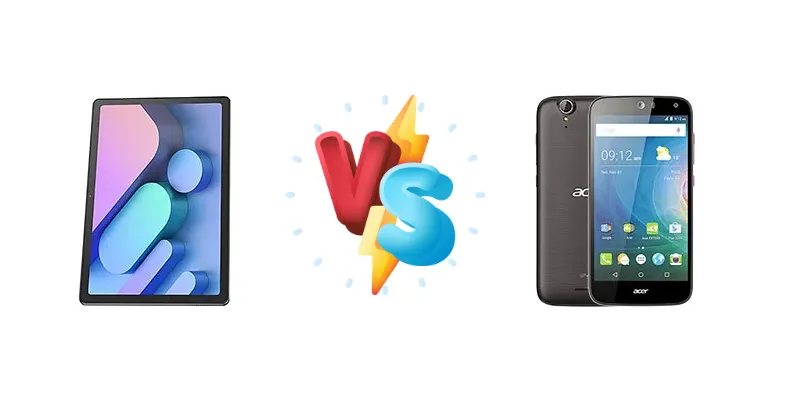
The Acer Iconia V12 and Liquid Z630 represent vastly different eras of mobile computing. The Z630, powered by the aging MT6735, targets the ultra-budget smartphone market, while the V12, with its Mediatek Helio G99, aims for a more versatile tablet experience. This comparison dissects the core differences, highlighting the significant performance gap between these two Acer devices.
🏆 Quick Verdict
For the average user needing a responsive and future-proof device, the Acer Iconia V12 is the clear winner. Its Helio G99 chipset delivers substantially better performance and efficiency than the Liquid Z630’s MT6735, making it suitable for multitasking, gaming, and demanding applications. The Z630 remains a viable option only for extremely basic use cases.
| Network |
|---|
| 2G bands | N/A | GSM 850 / 900 / 1800 / 1900 - SIM 1 & SIM 2 (dual-SIM model only) |
| 3G bands | N/A | HSDPA |
| 4G bands | N/A | LTE |
| EDGE | No | Yes |
| GPRS | No | Yes |
| Speed | - | HSPA, LTE |
| Technology | No cellular connectivity | GSM / HSPA / LTE |
| Launch |
|---|
| Announced | 2025, May 16 | 2015, September. Released 2015, September |
| Status | Available. Released 2025, July | Discontinued |
| Body |
|---|
| Build | Glass front, aluminum alloy frame | - |
| Dimensions | 7.9 mm thickness | 156.3 x 77.5 x 8.9 mm (6.15 x 3.05 x 0.35 in) |
| SIM | No | Single SIM (Micro-SIM) or Dual SIM (Micro-SIM, dual stand-by) |
| Weight | 595 g (1.31 lb) | 165 g (5.82 oz) |
| Display |
|---|
| Resolution | 1200 x 2000 pixels, 5:3 ratio (~195 ppi density) | 720 x 1280 pixels, 16:9 ratio (~267 ppi density) |
| Size | 11.97 inches, 407.8 cm2 | 5.5 inches, 83.4 cm2 (~68.8% screen-to-body ratio) |
| Type | IPS LCD, 90Hz | IPS LCD |
| Platform |
|---|
| CPU | Octa-core (2x2.2 GHz Cortex-A76 & 6x2.0 GHz Cortex-A55) | Quad-core 1.3 GHz Cortex-A53 |
| Chipset | Mediatek Helio G99 (6 nm) | Mediatek MT6735 (28 nm) |
| GPU | Mali-G57 MC2 | Mali-T720MP2 |
| OS | Android 15 | Android 5.1 (Lollipop) |
| Memory |
|---|
| Card slot | microSDXC (dedicated slot) | microSDXC (dedicated slot) |
| Internal | 256GB 8GB RAM | 8GB 1GB RAM, 16GB 2GB RAM |
| Main Camera |
|---|
| Features | LED flash | LED flash, HDR, panorama |
| Single | 8 MP, AF | 8 MP, AF |
| Video | 1080p@30fps | Yes |
| Selfie camera |
|---|
| Single | 5 MP | 8 MP |
| Video | Yes | - |
| Sound |
|---|
| 3.5mm jack | - | Yes |
| 35mm jack | Yes | Yes |
| Loudspeaker | Yes, with stereo speakers | Yes |
| Comms |
|---|
| Bluetooth | 5.2, A2DP, LE | 4.0, A2DP |
| NFC | No | No |
| Positioning | Unspecified | GPS |
| Radio | No | FM radio |
| USB | USB Type-C 2.0 | microUSB 2.0, OTG |
| WLAN | Wi-Fi 802.11 a/b/g/n/ac/6, dual-band | Wi-Fi 802.11 b/g/n, hotspot |
| Features |
|---|
| Sensors | Unspecified | Accelerometer, proximity, compass |
| Battery |
|---|
| Stand-by | - | Up to 1030 h |
| Talk time | - | Up to 22 h |
| Type | 8000 mAh | Li-Ion 4000 mAh, removable |
| Misc |
|---|
| Colors | Green | Black |
| Models | V12-11M | - |
| Price | About 290 EUR | About 200 EUR |
Acer Iconia V12
- Significantly faster processor for smooth multitasking.
- More power-efficient chipset for longer battery life.
- Better suited for demanding applications and gaming.
- Likely higher price point than the Z630.
- Tablet form factor may not be ideal for all users.
Acer Liquid Z630
- Extremely affordable price point.
- Compact smartphone form factor for portability.
- Sufficient for basic communication tasks.
- Outdated chipset with limited performance.
- Poor multitasking capabilities.
- Struggles with modern applications and games.
Display Comparison
Context data lacks display specifics for both devices. However, given the V12 is a tablet, it likely features a larger display with higher resolution than the Z630. The V12’s larger screen real estate is geared towards productivity, while the Z630’s display is likely optimized for cost. Without specific nit ratings, it’s difficult to assess brightness, but the V12’s intended use case suggests a brighter panel for outdoor visibility.
Camera Comparison
Context data provides no camera details. Given the Z630’s budget positioning, its camera system is likely basic. The V12, while not a camera-focused device, likely benefits from the increased processing power of the Helio G99 for image processing. Without sensor size or aperture information, a detailed comparison is impossible, but the V12’s chipset will enable better image quality and faster processing speeds.
Performance
The performance disparity is the most significant difference. The Iconia V12’s Mediatek Helio G99 (6nm) utilizes an octa-core CPU with two Cortex-A76 cores clocked at 2.2 GHz and six Cortex-A55 cores at 2.0 GHz. This architecture is a substantial upgrade over the Liquid Z630’s quad-core 1.3 GHz Cortex-A53 processor built on a 28nm process. The 6nm node of the Helio G99 offers significantly improved power efficiency and thermal performance, allowing for sustained performance under load. The Cortex-A76 cores in the V12 provide a much larger instruction set and higher IPC (Instructions Per Clock) than the A53 cores in the Z630, resulting in faster application launch times and smoother multitasking. The Z630’s older chipset will struggle with modern applications and multitasking.
Battery Life
Again, context data lacks battery capacity information. However, the Helio G99’s 6nm process contributes to better power efficiency, potentially offsetting a smaller battery capacity compared to the Z630. The Z630’s older chipset is inherently less efficient, meaning it will drain the battery faster under similar usage. Charging wattage is also unknown, but the V12’s more modern design may support faster charging technologies.
Buying Guide
Buy the Acer Iconia V12 if you need a tablet for productivity tasks like document editing, media consumption, or light gaming. Its modern chipset ensures a smooth experience and better longevity. Buy the Acer Liquid Z630 if you prioritize extreme affordability and only require a device for basic communication – calls, texts, and very light web browsing – and are willing to accept significant performance limitations.
Frequently Asked Questions
❓ Will the Acer Liquid Z630 struggle with popular social media apps like TikTok or Instagram?
Yes, the MT6735 chipset in the Z630 is likely to exhibit noticeable lag and slowdown when running demanding apps like TikTok or Instagram. The processor's limited processing power and older architecture will struggle to handle the complex algorithms and graphics rendering required by these applications.
❓ Can the Acer Iconia V12 handle light gaming, such as casual puzzle games or older titles?
Absolutely. The Helio G99 chipset in the Iconia V12 is capable of handling light gaming with ease. While it won't run the most demanding modern titles at maximum settings, it will provide a smooth and enjoyable experience for casual games and older, less graphically intensive titles.
❓ Is the Acer Liquid Z630 a good choice for someone who primarily uses their phone for calls and texts?
Yes, the Acer Liquid Z630 is a suitable option for users who primarily need a device for basic communication. Its low price point makes it an affordable choice for those who don't require advanced features or high performance.
❓ How much of a difference will the 6nm process of the Helio G99 make in real-world battery life compared to the 28nm process of the MT6735?
The 6nm process of the Helio G99 is significantly more power-efficient than the 28nm process of the MT6735. This translates to a noticeable improvement in battery life, especially during demanding tasks like gaming or video playback. You can expect the Iconia V12 to last considerably longer on a single charge than the Liquid Z630.