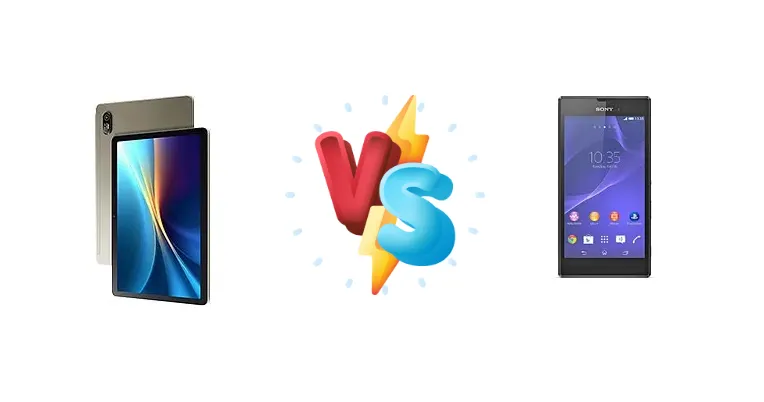
The Acer Iconia V11 and Sony Xperia T3 represent vastly different eras of Android device design. The Xperia T3, released in 2014, aimed for a sleek design with a mid-range processor, while the Iconia V11, a more recent offering, leverages a modern Mediatek Helio G99 chipset. This comparison dissects the core differences, revealing how much has changed in mobile processing and what each device offers in 2024.
🏆 Quick Verdict
For the vast majority of users, the Acer Iconia V11 is the clear winner. Its Mediatek Helio G99 chipset delivers significantly superior performance and efficiency compared to the Sony Xperia T3’s aging Snapdragon 400. While the Xperia T3 boasts a respectable 75-hour endurance rating, the Iconia V11’s modern architecture provides a better overall user experience.
| Network |
|---|
| 2G bands | GSM 850 / 900 / 1800 / 1900 - cellular model only | GSM 850 / 900 / 1800 / 1900 - all versions |
| 3G bands | HSDPA 900 / 2100 - cellular model only | HSDPA 900 / 2100 - D5103 |
| 4G bands | LTE - cellular model only | 1, 3, 7, 8, 20 - D5103 |
| Speed | HSPA, LTE - cellular model only | HSPA 42.2/21.1(D5102)/5.76 Mbps, LTE Cat4 150/50 Mbps |
| Technology | GSM / HSPA / LTE | GSM / HSPA / LTE |
| | - | 4, 7, 17 - D5106 |
| Launch |
|---|
| Announced | 2025, May 16 | 2014, June. Released 2014, July |
| Status | Available. Released 2025, August | Discontinued |
| Body |
|---|
| Build | Glass front, aluminum alloy frame | - |
| Dimensions | 7.9 mm thickness | 150.7 x 77 x 7 mm (5.93 x 3.03 x 0.28 in) |
| SIM | Nano-SIM | Micro-SIM |
| Weight | 500 g (1.10 lb) | 148 g (5.22 oz) |
| Display |
|---|
| Resolution | 1200 x 1920 pixels, 16:10 ratio (~207 ppi density) | 720 x 1280 pixels, 16:9 ratio (~277 ppi density) |
| Size | 10.92 inches, 345.8 cm2 | 5.3 inches, 77.4 cm2 (~66.7% screen-to-body ratio) |
| Type | IPS LCD, 90Hz | IPS LCD |
| | - | Triluminos display |
| Platform |
|---|
| CPU | Octa-core (2x2.2 GHz Cortex-A76 & 6x2.0 GHz Cortex-A55) | Quad-core 1.4 GHz Cortex-A7 |
| Chipset | Mediatek Helio G99 (6 nm) | Qualcomm MSM8928-2 Snapdragon 400 (28 nm) (D5103,D5106)/ Qualcomm MSM8228 (D5102) |
| GPU | Mali-G57 MC2 | Adreno 305 |
| OS | Android 15 | Android 4.4.2 (KitKat) |
| Memory |
|---|
| Card slot | microSDXC (dedicated slot) | microSDHC (dedicated slot) |
| Internal | 256GB 8GB RAM | 8GB 1GB RAM |
| | - | eMMC 4.5 |
| Main Camera |
|---|
| Features | LED flash | LED flash, HDR, panorama |
| Single | 8 MP, AF | 8 MP, f/2.4, AF |
| Video | 1080p@30fps | 1080p@30fps, HDR |
| Selfie camera |
|---|
| Single | 5 MP | 1.1 MP |
| Video | Yes | 720p@30fps |
| Sound |
|---|
| 3.5mm jack | - | Yes |
| 35mm jack | Yes | Yes |
| Loudspeaker | Yes, with stereo speakers | Yes |
| Comms |
|---|
| Bluetooth | 5.2, A2DP, LE | 4.0, A2DP, LE, aptX |
| NFC | No | Yes |
| Positioning | Unspecified | GPS, GLONASS |
| Radio | No | Stereo FM radio, RDS |
| USB | USB Type-C 2.0 | microUSB 2.0, OTG |
| WLAN | Wi-Fi 802.11 a/b/g/n/ac/6, dual-band | Wi-Fi 802.11 a/b/g/n, dual-band, Wi-Fi Direct, DLNA, hotspot |
| Features |
|---|
| Sensors | Unspecified | Accelerometer, gyro, proximity, compass |
| | - | ANT+ |
| Battery |
|---|
| Music play | - | Up to 63 h |
| Stand-by | - | Up to 639 h (2G) / Up to 688 h (3G) |
| Talk time | - | Up to 12 h 46 min (2G) / Up to 14 h 47 min (3G) |
| Type | 8000 mAh | Li-Ion 2500 mAh, non-removable |
| Misc |
|---|
| Colors | Gold | Black, White, Purple |
| Models | V11-21M, V11-22M | D5103, D5102 |
| Price | About 230 EUR | About 200 EUR |
| SAR | - | 0.48 W/kg (head) 0.97 W/kg (body) |
| SAR EU | - | 0.36 W/kg (head) |
| Tests |
|---|
| Audio quality | - |
Noise -89.1dB / Crosstalk -46.5dB |
| Battery life | - |
Endurance rating 75h
|
| Camera | - |
Photo / Video |
| Display | - |
Contrast ratio: 963 (nominal), 2.609 (sunlight) |
| Loudspeaker | - |
Voice 69dB / Noise 66dB / Ring 75dB
|
Acer Iconia V11
- Significantly faster processor and GPU
- More power-efficient chipset
- Likely better display quality
- Modern Android features and updates
- Battery capacity unknown
- May be more expensive than the Xperia T3
Sony Xperia T3
- Exceptional battery endurance (75h)
- Lower price point (likely)
- Compact and lightweight design
- Simple and easy to use
- Outdated processor and GPU
- Slow performance and lag
- Limited software support
- Poor camera quality (likely)
Display Comparison
Both devices share a contrast ratio of 963 (nominal) and 2.609 (sunlight), suggesting similar outdoor visibility. However, the Iconia V11 likely benefits from a more modern panel technology, potentially offering wider color gamut coverage and improved viewing angles. The Xperia T3’s display, while adequate for its time, will appear dated in comparison. Details regarding the Iconia V11’s resolution and panel type (IPS, TFT) are crucial for a full assessment, but the chipset alone suggests a more advanced display pipeline.
Camera Comparison
Both devices are listed as having 'Photo / Video' capabilities, but lack specific details. Given the Xperia T3’s age, its camera is likely limited in resolution and image quality. The Iconia V11, while not a camera-focused device, likely benefits from the Helio G99’s integrated image signal processor (ISP), enabling better noise reduction, dynamic range, and potentially more advanced features. Without sensor size or aperture information, a detailed camera comparison is impossible, but the Iconia V11’s modern ISP provides a clear advantage.
Performance
The performance gap between these devices is substantial. The Acer Iconia V11’s Mediatek Helio G99, built on a 6nm process, features an octa-core CPU (2x2.2 GHz Cortex-A76 & 6x2.0 GHz Cortex-A55) and a significantly more powerful GPU. This contrasts sharply with the Sony Xperia T3’s Qualcomm MSM8928-2 Snapdragon 400 (28nm) and quad-core 1.4 GHz Cortex-A7 CPU. The 28nm process of the Snapdragon 400 is notoriously inefficient, leading to higher power consumption and thermal throttling. The Helio G99’s 6nm node offers superior power efficiency, translating to longer battery life *despite* potentially higher performance. The architectural leap from Cortex-A7 to Cortex-A76 cores represents a massive improvement in instruction processing and overall responsiveness.
Battery Life
The Sony Xperia T3’s 75-hour endurance rating is impressive, but it’s a product of its low-power components and limited functionality. The Acer Iconia V11’s battery capacity is unknown, but the Helio G99’s 6nm process and power efficiency optimizations mean it can deliver comparable or even superior real-world battery life while offering significantly more performance. The Snapdragon 400’s inefficiency necessitates a larger battery to achieve the same endurance, and even then, performance is severely limited. Charging speeds are also a factor; the Iconia V11 likely supports faster charging technologies than the aging Xperia T3.
Buying Guide
Buy the Acer Iconia V11 if you need a tablet capable of handling modern apps, light gaming, and multitasking without significant lag. It’s ideal for students, casual users, and anyone seeking a responsive and future-proofed experience. Buy the Sony Xperia T3 if you prioritize extreme battery life above all else and only require basic functionality like calls, texts, and very light web browsing. It’s best suited for those needing a secondary device for emergencies or minimal use.
Frequently Asked Questions
❓ Is the Sony Xperia T3 still usable in 2024 for basic tasks like calling and texting?
Yes, the Xperia T3 can still handle basic tasks like calling, texting, and light web browsing. However, expect significant lag and slow performance with modern apps. It’s best suited as a secondary device for emergencies or minimal use.
❓ Can the Acer Iconia V11 handle modern mobile games like PUBG or Call of Duty?
The Mediatek Helio G99 in the Iconia V11 is capable of running many modern mobile games, but likely at medium settings. Demanding titles may require reduced graphics settings to maintain a smooth frame rate. It’s a significant improvement over the Xperia T3’s capabilities.
❓ What Android version does the Sony Xperia T3 currently support?
The Sony Xperia T3 originally launched with Android 4.4 KitKat and received updates up to Android 5.1 Lollipop. It no longer receives security updates, making it vulnerable to security threats.
❓ Does the Acer Iconia V11 support expandable storage via microSD card?
This information is not provided in the context data. However, many tablets in this price range do offer microSD card support, which would be a significant advantage for users needing more storage.