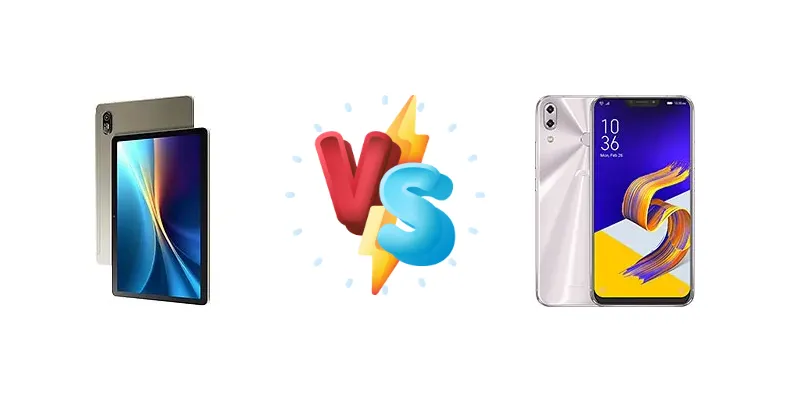
The Acer Iconia V11 and Asus Zenfone 5z represent very different eras of Android devices. The Zenfone 5z, released in 2018, was a compact flagship aiming for top-tier performance. The Iconia V11, a more recent offering, focuses on providing a solid tablet experience at a budget-friendly price point. This comparison dissects their core components to determine which device best suits your needs in today's market.
🏆 Quick Verdict
For the average user prioritizing battery life and a larger screen for media consumption, the Acer Iconia V11 is the better choice. While the Asus Zenfone 5z boasts a more powerful processor on paper, its age and smaller form factor limit its overall usability compared to the tablet's modern efficiency and larger display.
| Network |
|---|
| 2G bands | GSM 850 / 900 / 1800 / 1900 - cellular model only | GSM 850 / 900 / 1800 / 1900 |
| 3G bands | HSDPA 900 / 2100 - cellular model only | HSDPA 800 / 850 / 900 / 1700(AWS) / 1800 / 1900 / 2100 - B version, C version |
| 4G bands | LTE - cellular model only | 1, 2, 3, 4, 5, 7, 8, 12, 17, 18, 19, 20, 26, 28, 29, 30, 32, 34, 38, 39, 40, 41 - B version, C version |
| Speed | HSPA, LTE - cellular model only | HSPA 42.2/5.76 Mbps, LTE (5CA) Cat18 1200/150 Mbps |
| Technology | GSM / HSPA / LTE | GSM / CDMA / HSPA / LTE |
| | - | 1, 2, 3, 5, 7, 8, 18, 19, 20, 26, 28, 38, 39, 40, 41 - A version |
| Launch |
|---|
| Announced | 2025, May 16 | 2018, February. Released 2018, June |
| Status | Available. Released 2025, August | Discontinued |
| Body |
|---|
| Build | Glass front, aluminum alloy frame | Glass front (Gorilla Glass), aluminum back, aluminum frame |
| Dimensions | 7.9 mm thickness | 153 x 75.7 x 7.9 mm (6.02 x 2.98 x 0.31 in) |
| SIM | Nano-SIM | Nano-SIM + Nano-SIM |
| Weight | 500 g (1.10 lb) | 165 g (5.82 oz) |
| Display |
|---|
| Protection | - | Corning Gorilla Glass (unspecified version) |
| Resolution | 1200 x 1920 pixels, 16:10 ratio (~207 ppi density) | 1080 x 2246 pixels, 18.7:9 ratio (~402 ppi density) |
| Size | 10.92 inches, 345.8 cm2 | 6.2 inches, 96.9 cm2 (~83.6% screen-to-body ratio) |
| Type | IPS LCD, 90Hz | IPS LCD |
| Platform |
|---|
| CPU | Octa-core (2x2.2 GHz Cortex-A76 & 6x2.0 GHz Cortex-A55) | Octa-core (4x2.7 GHz Kryo 385 Gold & 4x1.7 GHz Kryo 385 Silver) |
| Chipset | Mediatek Helio G99 (6 nm) | Qualcomm SDM845 Snapdragon 845 (10 nm) |
| GPU | Mali-G57 MC2 | Adreno 630 |
| OS | Android 15 | Android 8.0 (Oreo), upgradable to Android 10 |
| Memory |
|---|
| Card slot | microSDXC (dedicated slot) | microSDXC (uses shared SIM slot) |
| Internal | 256GB 8GB RAM | 64GB 4GB RAM, 64GB 6GB RAM, 128GB 6GB RAM, 256GB 8GB RAM |
| Main Camera |
|---|
| Dual | - | 12 MP, f/1.8, 24mm (wide), 1/2.55", 1.4µm, PDAF, 4-axis OIS
8 MP, f/2.0, 12mm (ultrawide), 1/4.0", 1.12µm, no AF |
| Features | LED flash | Dual-LED dual-tone flash, HDR, panorama |
| Single | 8 MP, AF | - |
| Video | 1080p@30fps | 4K@30fps, 1080p@60/120fps, 1080p@30fps (gyro-EIS), 720p@240fps |
| Selfie camera |
|---|
| Features | - | HDR |
| Single | 5 MP | 8 MP, f/2.0, 24mm (wide), 1/4.0", 1.12µm |
| Video | Yes | 1080p@30fps (gyro-EIS) |
| Sound |
|---|
| 3.5mm jack | - | Yes |
| 35mm jack | Yes | Yes |
| Loudspeaker | Yes, with stereo speakers | Yes, with dual speakers |
| | - | 24-bit/192kHz audio |
| Comms |
|---|
| Bluetooth | 5.2, A2DP, LE | v5.0, A2DP, LE |
| NFC | No | Yes |
| Positioning | Unspecified | GPS, GLONASS, BDS |
| Radio | No | FM radio |
| USB | USB Type-C 2.0 | USB Type-C 2.0, OTG |
| WLAN | Wi-Fi 802.11 a/b/g/n/ac/6, dual-band | Wi-Fi 802.11 a/b/g/n/ac, Wi-Fi Direct |
| Features |
|---|
| Sensors | Unspecified | Fingerprint (rear-mounted), accelerometer, gyro, proximity, compass |
| Battery |
|---|
| Charging | - | 18W wired |
| Type | 8000 mAh | Li-Ion 3300 mAh, non-removable |
| Misc |
|---|
| Colors | Gold | Midnight Blue, Meteor Silver |
| Models | V11-21M, V11-22M | Z01RD |
| Price | About 230 EUR | About 500 EUR |
| Tests |
|---|
| Performance | - |
AnTuTu: 266590 (v7)
GeekBench: 9030 (v4.4)
GFXBench: 33fps (ES 3.1 onscreen) |
Acer Iconia V11
- Larger 10.95-inch display for immersive viewing
- More power-efficient Mediatek Helio G99 chipset
- Likely longer battery life due to larger battery and efficient processor
- Less powerful CPU compared to the Snapdragon 845 at peak clock speeds
- Camera likely less sophisticated than the Zenfone 5z
Asus Zenfone 5z ZS620KL
- Compact and pocketable form factor
- Snapdragon 845 was a flagship processor in 2018
- Potentially better camera system (depending on sensor details)
- Older chipset with less efficient architecture
- Smaller display size
- Limited software support and potential for battery degradation due to age
Display Comparison
The Asus Zenfone 5z, being a phone, features a smaller display, likely around 6.2 inches, while the Acer Iconia V11 boasts a larger 10.95-inch screen. While the Zenfone 5z's display resolution isn't specified, it likely targets a sharp image for its size. The Iconia V11's larger canvas is ideal for multitasking and video playback. Display technology details are missing for both, but the Iconia V11 benefits from the sheer size advantage for immersive viewing. Bezels are likely more pronounced on the older Zenfone 5z.
Camera Comparison
Camera details are sparse for both devices. The Zenfone 5z, as a flagship, likely featured a more sophisticated camera system with a larger primary sensor and optical image stabilization (OIS). However, without specific sensor sizes or aperture information, it's difficult to make a definitive comparison. The Iconia V11's camera is likely geared towards basic video conferencing and casual snapshots. The Zenfone 5z's image processing, while advanced for its time, will likely fall behind modern algorithms found in the Iconia V11, even with a potentially superior sensor.
Performance
The core difference lies in the chipsets. The Asus Zenfone 5z utilizes the Qualcomm Snapdragon 845 (10nm), featuring a Kryo 385 CPU with a peak clock speed of 2.7 GHz. This was a flagship processor in its time, offering strong performance. However, the Acer Iconia V11's Mediatek Helio G99 (6nm) benefits from a more modern fabrication process. While the G99's Cortex-A76 cores clock lower at 2.2 GHz, the 6nm process offers significantly improved power efficiency and thermal management. This means the Iconia V11 is likely to sustain performance for longer periods without throttling, despite the Zenfone 5z's higher peak CPU clock speeds. The Zenfone 5z's older architecture will also struggle with newer software optimizations.
Battery Life
The Asus Zenfone 5z supports 18W wired charging, a standard rate for its era. Battery capacity is unknown, but given its compact size, it's likely smaller than the Iconia V11's. The Iconia V11, with its larger form factor, likely houses a significantly larger battery. The Helio G99's superior power efficiency further extends the Iconia V11's battery life. While the Zenfone 5z's 18W charging is adequate, the Iconia V11's combination of larger battery and efficient chipset translates to longer usage between charges.
Buying Guide
Buy the Acer Iconia V11 if you need a large-screen device for media streaming, casual gaming, and productivity tasks, and value long battery life. Buy the Asus Zenfone 5z if you prioritize a compact form factor, still desire a relatively powerful processor for its size, and are comfortable with an older device that may have limited software support.
Frequently Asked Questions
❓ Is the Mediatek Helio G99 in the Acer Iconia V11 powerful enough for demanding games like Genshin Impact?
The Helio G99 is a capable processor for mid-range gaming. While it won't deliver the highest frame rates at maximum settings, it should provide a playable experience in Genshin Impact and similar titles, especially with optimized settings. The 6nm process helps mitigate thermal throttling during extended gaming sessions.
❓ Given the age of the Asus Zenfone 5z, what is the likelihood of receiving future software updates?
The Asus Zenfone 5z is no longer officially supported with software updates from Asus. While custom ROMs are available, relying on community support carries inherent risks and may not provide the same level of security or stability as official updates. This is a significant consideration for long-term usability.
❓ How does the Snapdragon 845's performance hold up against modern processors in everyday tasks like browsing and social media?
The Snapdragon 845 is still capable of handling everyday tasks smoothly. However, you may notice slightly slower app loading times and less responsiveness compared to devices with newer chipsets. The G99's efficiency gains will be more noticeable in sustained use.