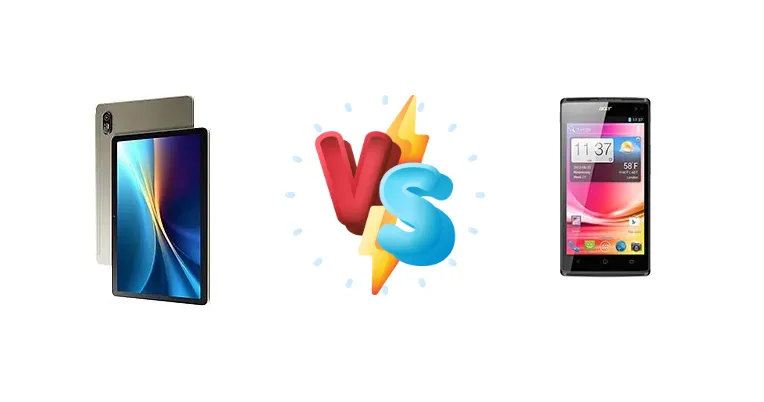
The Acer Iconia V11 and Liquid Z500 represent vastly different eras of mobile computing. The Liquid Z500, built around the aging Mediatek MT6582, targets ultra-budget users, while the Iconia V11, powered by the Helio G99, aims for a more capable, modern tablet experience. This comparison dissects the core differences and helps determine which device aligns with your priorities.
🏆 Quick Verdict
For the vast majority of users, the Acer Iconia V11 is the clear winner. Its Helio G99 chipset delivers significantly superior performance and efficiency compared to the Liquid Z500’s MT6582, making it suitable for gaming, multitasking, and future-proofing. The Z500 is only viable for extremely basic tasks and users on the tightest of budgets.
| Network |
|---|
| 2G bands | GSM 850 / 900 / 1800 / 1900 - cellular model only | GSM 850 / 900 / 1800 / 1900 - SIM 1 & SIM 2 (dual-SIM model only) |
| 3G bands | HSDPA 900 / 2100 - cellular model only | HSDPA 900 / 2100 |
| 4G bands | LTE - cellular model only | - |
| Speed | HSPA, LTE - cellular model only | HSPA |
| Technology | GSM / HSPA / LTE | GSM / HSPA |
| | - | HSDPA 850 / 900 / 1900 / 2100 |
| Launch |
|---|
| Announced | 2025, May 16 | 2014, September. Released 2014, Septeber |
| Status | Available. Released 2025, August | Discontinued |
| Body |
|---|
| Build | Glass front, aluminum alloy frame | - |
| Dimensions | 7.9 mm thickness | 145 x 73 x 8.8 mm (5.71 x 2.87 x 0.35 in) |
| SIM | Nano-SIM | Single SIM (Micro-SIM) or Dual SIM (Micro-SIM, dual stand-by) |
| Weight | 500 g (1.10 lb) | 150 g (5.29 oz) |
| Display |
|---|
| Protection | - | Corning Gorilla Glass 3 |
| Resolution | 1200 x 1920 pixels, 16:10 ratio (~207 ppi density) | 720 x 1280 pixels, 16:9 ratio (~294 ppi density) |
| Size | 10.92 inches, 345.8 cm2 | 5.0 inches, 68.9 cm2 (~65.1% screen-to-body ratio) |
| Type | IPS LCD, 90Hz | IPS LCD |
| Platform |
|---|
| CPU | Octa-core (2x2.2 GHz Cortex-A76 & 6x2.0 GHz Cortex-A55) | Quad-core 1.3 GHz Cortex-A7 |
| Chipset | Mediatek Helio G99 (6 nm) | Mediatek MT6582 (28 nm) |
| GPU | Mali-G57 MC2 | Mali-400MP2 |
| OS | Android 15 | Android 4.4.2 (KitKat) |
| Memory |
|---|
| Card slot | microSDXC (dedicated slot) | microSDHC (dedicated slot) |
| Internal | 256GB 8GB RAM | 4GB 1GB RAM, 16GB 2GB RAM |
| Main Camera |
|---|
| Features | LED flash | LED flash, HDR |
| Single | 8 MP, AF | 8 MP, AF |
| Video | 1080p@30fps | 1080p@30fps |
| Selfie camera |
|---|
| Single | 5 MP | 2 MP |
| Video | Yes | - |
| Sound |
|---|
| 3.5mm jack | - | Yes |
| 35mm jack | Yes | Yes |
| Loudspeaker | Yes, with stereo speakers | Yes, with stereo speakers |
| Comms |
|---|
| Bluetooth | 5.2, A2DP, LE | 4.0, A2DP, EDR |
| NFC | No | No |
| Positioning | Unspecified | GPS |
| Radio | No | FM radio |
| USB | USB Type-C 2.0 | microUSB 2.0 |
| WLAN | Wi-Fi 802.11 a/b/g/n/ac/6, dual-band | Wi-Fi 802.11 b/g/n, hotspot |
| Features |
|---|
| Sensors | Unspecified | Accelerometer, proximity |
| Battery |
|---|
| Type | 8000 mAh | Li-Ion 2000 mAh, non-removable |
| Misc |
|---|
| Colors | Gold | Aquamarine Green, Sandy Silver, Titanium Black |
| Models | V11-21M, V11-22M | - |
| Price | About 230 EUR | About 150 EUR |
| SAR EU | - | 0.62 W/kg (head) |
Acer Iconia V11
- Significantly faster processor and GPU
- More efficient power consumption
- Better multitasking capabilities
- Improved camera image processing
- Likely higher price point
- Larger form factor (tablet vs. phone)
Acer Liquid Z500
- Extremely low price
- Compact size (smartphone)
- Basic functionality for essential tasks
- Potentially longer standby time (due to lower power demands when idle)
- Very slow performance
- Poor multitasking capabilities
- Limited app compatibility
- Outdated technology
Display Comparison
While display specifications are not provided for the Liquid Z500, it's likely to feature a lower resolution and less color accurate panel typical of its price bracket. The Iconia V11, benefiting from its tablet form factor, likely has a larger display. The key difference, however, lies under the hood. The Helio G99’s integrated GPU is capable of driving higher resolution displays and refresh rates, offering a smoother visual experience. The older MT6582 would struggle with anything beyond basic UI elements.
Camera Comparison
Camera details are absent for both devices, but given the Liquid Z500’s positioning, it likely features a basic camera setup. The Iconia V11, while not a camera-focused device, benefits from the Helio G99’s image signal processor (ISP), which offers improved image processing capabilities compared to the MT6582’s ISP. This translates to better dynamic range, noise reduction, and overall image quality, even with similar sensor hardware. Expect the Iconia V11 to produce noticeably better photos and videos.
Performance
The performance gap between these two chipsets is immense. The Mediatek Helio G99 (6nm) utilizes an octa-core CPU with Cortex-A76 performance cores clocked at 2.2 GHz, paired with a Mali-G57 MC2 GPU. This is a modern architecture designed for efficiency and performance. Conversely, the MT6582 (28nm) features a quad-core Cortex-A7 CPU clocked at 1.3 GHz, with a Mali-400 MP2 GPU. The 28nm process node of the MT6582 is significantly less efficient, leading to higher power consumption and heat generation. The G99’s architecture provides a substantial uplift in both single-core and multi-core performance, making the Iconia V11 far more responsive and capable of handling demanding applications.
Battery Life
Battery capacity is not specified for either device. However, the Helio G99’s 6nm process node offers significantly better power efficiency than the MT6582’s 28nm node. This means the Iconia V11 will likely achieve longer battery life despite potentially having a similar battery capacity to the Liquid Z500. The G99’s efficiency also allows for sustained performance without significant throttling, while the MT6582 will likely experience performance drops under load due to thermal constraints.
Buying Guide
Buy the Acer Iconia V11 if you need a tablet capable of handling modern apps, streaming video, and light gaming without significant lag. It’s ideal for students, casual users who want a larger screen, and anyone prioritizing performance. Buy the Acer Liquid Z500 if you absolutely require the lowest possible price point and only intend to use it for basic communication – calls, texts, and very light web browsing. Be prepared for significant performance limitations.
Frequently Asked Questions
❓ Will the Acer Liquid Z500 struggle with modern social media apps like Facebook and Instagram?
Yes, the MT6582 chipset is significantly underpowered for modern social media apps. You may experience noticeable lag, slow loading times, and frequent crashes, especially when using multiple apps simultaneously. The Iconia V11, with its Helio G99, will handle these apps with ease.
❓ Can the Acer Iconia V11 handle mobile games like PUBG Mobile or Call of Duty Mobile?
The Iconia V11’s Helio G99 is capable of running PUBG Mobile and Call of Duty Mobile, but likely at medium or low graphics settings to maintain a stable frame rate. The Liquid Z500 would struggle to run these games at all, or would provide an unplayable experience due to severe lag and low frame rates.
❓ Is the Acer Liquid Z500 a good choice for someone who primarily makes phone calls and sends text messages?
Yes, the Liquid Z500 is adequate for basic communication tasks like phone calls and text messaging. However, even for these tasks, the slow processor may result in slight delays or lag. If call quality and reliability are paramount, a more modern device is recommended.
❓ How much faster is the Helio G99 compared to the MT6582 in real-world usage?
The Helio G99 is multiple times faster than the MT6582 in real-world usage. Expect app launch times to be significantly quicker, web browsing to be smoother, and multitasking to be far more responsive on the Iconia V11. The difference is akin to comparing a modern car to a very old one.