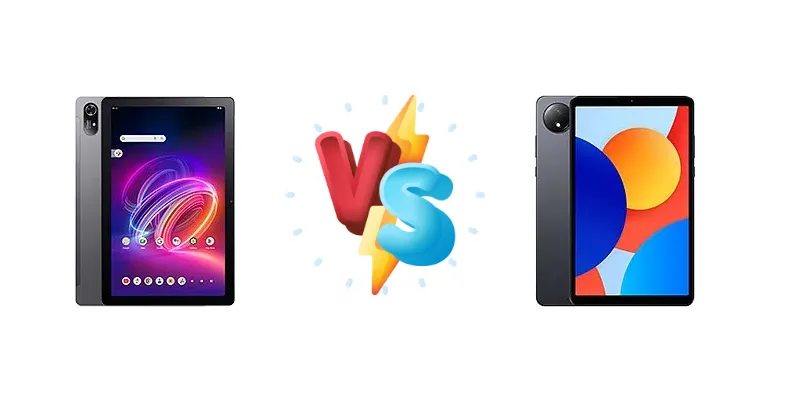
The budget tablet market is heating up, with the Acer Iconia Tab P11 (2025) and Xiaomi Redmi Pad SE 8.7 vying for attention. Both aim to deliver a capable Android experience without breaking the bank, but they take different approaches to achieving this. The key differentiator lies in their chipsets – the Acer sporting the newer, more efficient Mediatek Helio G99, while the Xiaomi relies on the Helio G85. This comparison dives deep into the implications of this core difference and other crucial aspects to determine which tablet offers the best value.
🏆 Quick Verdict
For most users, the Acer Iconia Tab P11 (2025) emerges as the better choice. Its Mediatek Helio G99 chipset, built on a 6nm process, provides a noticeable performance advantage and improved efficiency over the Redmi Pad SE 8.7’s 12nm Helio G85. While the Redmi Pad SE 8.7 offers a competitive price, the Acer’s superior processing power justifies the slight price premium.
| Network |
|---|
| 2G bands | N/A | GSM 850 / 900 / 1800 / 1900 |
| 3G bands | N/A | HSDPA 800 / 850 / 900 / 1700(AWS) / 1900 / 2100 |
| 4G bands | N/A | 1, 2, 3, 4, 5, 7, 8, 13, 18, 19, 20, 26, 28, 38, 40, 41, 66 |
| EDGE | No | - |
| GPRS | No | - |
| Speed | - | HSPA, LTE - cellular model only |
| Technology | No cellular connectivity | GSM / HSPA / LTE |
| Launch |
|---|
| Announced | 2025, Q4 | 2024, July 29 |
| Status | Available. Released 2025, Q4 | Available. Released 2024, August 08 |
| Body |
|---|
| Build | Glass front, aluminum alloy frame | Glass front (Gorilla Glass 3) |
| Dimensions | 265.2 x 169.9 x 8.1 mm (10.44 x 6.69 x 0.32 in) | 211.6 x 125.5 x 8.8 mm (8.33 x 4.94 x 0.35 in) |
| SIM | No | Nano-SIM + Nano-SIM (cellular model only) |
| Weight | 550 g (1.21 lb) | 370 / 373 / 375 g (13.05 oz) |
| Display |
|---|
| Protection | - | Corning Gorilla Glass 3 |
| Resolution | 1200 x 2000 pixels, 5:3 ratio (~212 ppi density) | 800 x 1340 pixels, 5:3 ratio (~179 ppi density) |
| Size | 11.0 inches, 344.4 cm2 (~76.4% screen-to-body ratio) | 8.7 inches, 214.9 cm2 (~80.9% screen-to-body ratio) |
| Type | IPS LCD, 90Hz | IPS LCD, 1B colors, 90Hz, 600 nits (HBM) |
| Platform |
|---|
| CPU | Octa-core (2x2.2 GHz Cortex-A76 & 6x2.0 GHz Cortex-A55) | Octa-core (2x2.0 GHz Cortex-A75 & 6x1.8 GHz Cortex-A55) |
| Chipset | Mediatek Helio G99 (6 nm) | Mediatek Helio G85 (12 nm) |
| GPU | Mali-G57 MC2 | Mali-G52 MC2 |
| OS | Android 14 | Android 14, HyperOS |
| Memory |
|---|
| Card slot | microSDXC (dedicated slot) | microSDXC (dedicated slot) |
| Internal | 256GB 6GB RAM, 256GB 8GB RAM | 64GB 4GB RAM, 128GB 4GB RAM, 128GB 6GB RAM |
| Main Camera |
|---|
| Features | LED flash | LED flash |
| Single | 13 MP, AF | 8 MP, f/2.0, (wide), 1/4.0", 1.12µm |
| Video | 1080p@30fps | 1080p@30fps |
| Selfie camera |
|---|
| Single | 5 MP | 5 MP, f/2.2, (wide), 1/5.0", 1.12µm |
| Video | Yes | 1080p@30fps |
| Sound |
|---|
| 35mm jack | Yes | Yes |
| Loudspeaker | Yes, with stereo speakers (4 speakers) | Yes, with stereo speakers |
| Comms |
|---|
| Bluetooth | Yes | 5.3, A2DP, LE |
| Infrared port | - | Yes |
| NFC | No | No |
| Positioning | Unspecified | GPS, GALILEO, GLONASS, BDS - cellular model only |
| Radio | No | FM radio |
| USB | USB Type-C 2.0 | USB Type-C 2.0 |
| WLAN | Wi-Fi 802.11 a/b/g/n/ac, dual-band | Wi-Fi 802.11 a/b/g/n/ac, dual-band |
| Features |
|---|
| Sensors | Unspecified | Accelerometer, proximity (accessories only), compass |
| Battery |
|---|
| Charging | 20W wired | 18W wired (Int'l)
10W wired (India) |
| Type | 8000 mAh | 6650 mAh |
| Misc |
|---|
| Colors | Iron Gray | Aurora Green (Forest Green), Sky Blue (Ocean Blue), Graphite Gray (Urban Grey) |
| Models | P11-11-8113 | 220233L2G |
| Price | About 260 EUR | About 120 EUR |
| SAR | - | 0.90 W/kg (head) 0.65 W/kg (body) |
| SAR EU | - | 0.40 W/kg (head) 0.99 W/kg (body) |
Acer Iconia Tab P11 (2025)
- More powerful and efficient Mediatek Helio G99 chipset
- Faster 20W wired charging
- Likely better sustained performance for gaming and multitasking
- Potentially higher price point
- Battery capacity not specified, could be smaller than Redmi Pad SE 8.7
Xiaomi Redmi Pad SE 8.7
- Lower price point
- Compact 8.7-inch display
- Decent performance for basic tasks
- Less powerful and efficient Mediatek Helio G85 chipset
- Slower charging speeds (especially the 10W Indian variant)
- May struggle with demanding apps and multitasking
Display Comparison
Neither device’s display specifications are provided, so a direct comparison is limited. However, given the market positioning, we can infer that both likely utilize IPS LCD panels. The Redmi Pad SE 8.7’s smaller 8.7-inch screen may offer a slightly higher pixel density compared to the Acer’s presumed larger display, potentially resulting in a sharper image. Bezels are likely comparable, focusing on cost reduction. Color accuracy is expected to be standard for this price range, prioritizing vibrancy over absolute fidelity.
Camera Comparison
Given the budget nature of these tablets, camera performance is unlikely to be a key differentiator. Details are missing, but it’s safe to assume both feature basic camera setups geared towards video calls and casual snapshots. Expect limited low-light performance and a focus on affordability over image quality. Any differences in sensor size or lens aperture are likely minimal and won’t significantly impact the user experience.
Performance
The core difference lies in the chipsets. The Acer Iconia Tab P11 (2025) features the Mediatek Helio G99, fabricated on a more efficient 6nm process. This translates to better thermal management and sustained performance compared to the Xiaomi Redmi Pad SE 8.7’s Helio G85, which is built on a 12nm process. The G99’s CPU configuration – 2x2.2 GHz Cortex-A76 & 6x2.0 GHz Cortex-A55 – offers a clock speed advantage and utilizes a more modern core architecture than the G85’s 2x2.0 GHz Cortex-A75 & 6x1.8 GHz Cortex-A55. This means the Acer will handle demanding apps and multitasking with greater ease. While both likely pair their chipsets with similar RAM configurations, the G99’s efficiency will allow for smoother operation even under heavy load.
Battery Life
The Acer Iconia Tab P11 (2025) supports 20W wired charging, while the Xiaomi Redmi Pad SE 8.7 offers 18W (International) or 10W (India). This means the Acer will likely charge faster, reducing downtime. However, the actual battery life will depend on the battery capacity of each device, which is not specified. The Helio G99’s improved efficiency in the Acer may partially offset a potentially smaller battery capacity, resulting in comparable real-world usage times. The 10W charging in the Indian variant of the Redmi Pad SE 8.7 is significantly slower and a notable drawback.
Buying Guide
Buy the Acer Iconia Tab P11 (2025) if you prioritize sustained performance for multitasking, light gaming, and future-proofing. It’s ideal for students, professionals needing on-the-go productivity, and users who value a smoother overall experience. Buy the Xiaomi Redmi Pad SE 8.7 if your primary use case is casual media consumption, reading, and basic tasks, and you’re looking for the absolute lowest price point. It’s a solid option for those on a very tight budget who don’t demand high performance.
Frequently Asked Questions
❓ Does the Mediatek Helio G99 in the Acer Iconia Tab P11 (2025) offer a noticeable gaming improvement over the Helio G85?
Yes, the Helio G99’s more modern CPU architecture and higher clock speeds, combined with its 6nm fabrication process, provide a significant performance boost in gaming. You can expect smoother frame rates, reduced stuttering, and better sustained performance during longer gaming sessions compared to the Redmi Pad SE 8.7.
❓ Is the difference in charging speed between 20W and 18W/10W significant in real-world use?
Yes, particularly the difference between 20W and 10W. While 18W is a moderate improvement, the 10W charging on the Indian Redmi Pad SE 8.7 will take considerably longer to fully charge the device. The 20W charging on the Acer Iconia Tab P11 (2025) will provide a much faster top-up, reducing downtime.
❓ Which tablet is better suited for running multiple apps simultaneously?
The Acer Iconia Tab P11 (2025) is better equipped for multitasking. The Helio G99’s superior processing power and efficiency allow it to handle multiple apps running in the background without significant slowdowns, whereas the Redmi Pad SE 8.7’s Helio G85 may struggle with heavier multitasking workloads.
❓ Will the Redmi Pad SE 8.7’s 10W charging be a major inconvenience for daily use in India?
Yes, the 10W charging in the Indian variant of the Redmi Pad SE 8.7 is a significant drawback. It will take a considerably longer time to fully charge the device, potentially requiring overnight charging to ensure it’s ready for use the next day. This is a major compromise for users prioritizing convenience.