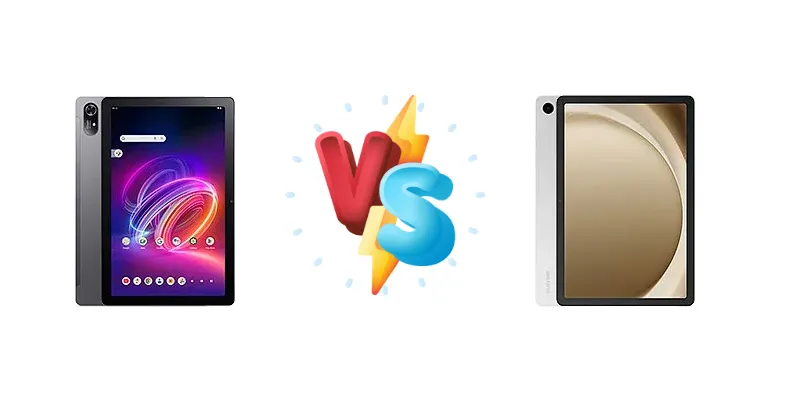
The sub-$300 Android tablet market is heating up. Both the Acer Iconia Tab P11 (2025) and the Samsung Galaxy Tab A9+ aim to deliver a solid experience without breaking the bank. This comparison dives deep into their core components – from chipsets to charging – to determine which tablet offers the best value for your money.
🏆 Quick Verdict
For the average user prioritizing consistent performance and a slightly faster charging experience, the Acer Iconia Tab P11 (2025) emerges as the winner. Its Mediatek Helio G99 chipset, while not a powerhouse, offers a more balanced performance profile than the Snapdragon 695 in the Tab A9+, especially in sustained workloads.
| Network |
|---|
| 2G bands | N/A | GSM 850 / 900 / 1800 / 1900 |
| 3G bands | N/A | HSDPA 850 / 900 / 1700(AWS) / 1900 / 2100 |
| 4G bands | N/A | 1, 2, 3, 4, 5, 7, 8, 12, 13, 17, 20, 26, 28, 38, 40, 41, 66 |
| 5G bands | - | 1, 3, 5, 7, 8, 20, 28, 38, 40, 41, 66, 77, 78 SA/NSA/Sub6 |
| EDGE | No | - |
| GPRS | No | - |
| Speed | - | HSPA, LTE, 5G - cellular model only |
| Technology | No cellular connectivity | GSM / HSPA / LTE / 5G |
| Launch |
|---|
| Announced | 2025, Q4 | 2023, October 05 |
| Status | Available. Released 2025, Q4 | Available. Released 2023, October 17 |
| Body |
|---|
| Build | Glass front, aluminum alloy frame | - |
| Dimensions | 265.2 x 169.9 x 8.1 mm (10.44 x 6.69 x 0.32 in) | 257.1 x 168.7 x 6.9 mm (10.12 x 6.64 x 0.27 in) |
| SIM | No | Nano-SIM + eSIM (cellular model only) |
| Weight | 550 g (1.21 lb) | 480 g or 492 g (1.06 lb) |
| Display |
|---|
| Resolution | 1200 x 2000 pixels, 5:3 ratio (~212 ppi density) | 1200 x 1920 pixels, 16:10 ratio (~206 ppi density) |
| Size | 11.0 inches, 344.4 cm2 (~76.4% screen-to-body ratio) | 11.0 inches, 350.9 cm2 (~80.9% screen-to-body ratio) |
| Type | IPS LCD, 90Hz | TFT LCD, 90Hz |
| Platform |
|---|
| CPU | Octa-core (2x2.2 GHz Cortex-A76 & 6x2.0 GHz Cortex-A55) | Octa-core (2x2.2 GHz Kryo 660 Gold & 6x1.8 GHz Kryo 660 Silver) |
| Chipset | Mediatek Helio G99 (6 nm) | Qualcomm SM6375 Snapdragon 695 5G (6 nm) |
| GPU | Mali-G57 MC2 | Adreno 619 |
| OS | Android 14 | Android 13, upgradable to Android 15, One UI 7 |
| Memory |
|---|
| Card slot | microSDXC (dedicated slot) | microSDXC (dedicated slot) |
| Internal | 256GB 6GB RAM, 256GB 8GB RAM | 64GB 4GB RAM, 128GB 4GB RAM, 128GB 8GB RAM, 256GB 8GB RAM |
| Main Camera |
|---|
| Features | LED flash | - |
| Single | 13 MP, AF | 8 MP, AF |
| Video | 1080p@30fps | 1080p@30fps |
| Selfie camera |
|---|
| Single | 5 MP | 5 MP |
| Video | Yes | 1080p@30fps |
| Sound |
|---|
| 35mm jack | Yes | Yes |
| Loudspeaker | Yes, with stereo speakers (4 speakers) | Yes, with stereo speakers (4 speakers) |
| Comms |
|---|
| Bluetooth | Yes | 5.1, A2DP, LE |
| NFC | No | No |
| Positioning | Unspecified | GPS, GLONASS, GALILEO, BDS, QZSS - cellular model only |
| Radio | No | No |
| USB | USB Type-C 2.0 | USB Type-C 2.0 |
| WLAN | Wi-Fi 802.11 a/b/g/n/ac, dual-band | Wi-Fi 802.11 a/b/g/n/ac, dual-band, Wi-Fi Direct |
| Features |
|---|
| Sensors | Unspecified | Accelerometer, gyro, proximity (accessories only), compass |
| Battery |
|---|
| Charging | 20W wired | 15W wired |
| Type | 8000 mAh | Li-Po 7040 mAh |
| Misc |
|---|
| Colors | Iron Gray | Graphite, Silver, Navy |
| Models | P11-11-8113 | SM-X210, SM-X215, SM-X216B |
| Price | About 260 EUR | $ 199.99 |
| SAR | - | 0.42 W/kg (body) |
| SAR EU | - | 1.19 W/kg (body) |
Acer Iconia Tab P11 (2025)
- Faster 20W charging for quicker top-ups.
- Potentially better CPU performance with the Helio G99.
- Likely more consistent performance under sustained load.
- Lacks 5G connectivity.
- Display specs are unknown, potentially limiting visual experience.
Samsung Galaxy Tab A9+
- Integrated 5G modem for on-the-go connectivity.
- Benefits from the Samsung ecosystem and software support.
- Potentially slightly better battery life in light usage.
- Slower 15W charging.
- Snapdragon 695 may exhibit more throttling under heavy load.
- CPU performance is generally lower than the Helio G99.
Display Comparison
Neither Acer nor Samsung provided display specs beyond the device names. Assuming both utilize IPS LCD panels common in this price bracket, the display experience will likely be similar. However, the Acer's slightly newer release date *could* indicate a marginally improved panel with better color accuracy. Bezels are expected to be substantial on both, typical of budget tablets. Without specific nit brightness data, it's difficult to declare a clear winner; both will likely struggle in direct sunlight.
Camera Comparison
Camera performance is unlikely to be a deciding factor for either tablet. Both are expected to feature basic camera setups geared towards video calls rather than photography. Without specific sensor details, it's safe to assume image quality will be adequate for casual use but not competitive with smartphones. Any mention of a 2MP macro camera on either device should be disregarded as largely ineffective.
Performance
The core difference lies in the chipsets. The Acer Iconia Tab P11 (2025) features the Mediatek Helio G99 (6nm), boasting a CPU configuration of 2x2.2 GHz Cortex-A76 and 6x2.0 GHz Cortex-A55 cores. The Samsung Galaxy Tab A9+ utilizes the Qualcomm SM6375 Snapdragon 695 5G (6nm) with 2x2.2 GHz Kryo 660 Gold and 6x1.8 GHz Kryo 660 Silver cores. While clock speeds are similar, the Cortex-A76 cores in the Helio G99 generally offer a performance edge over the Kryo 660 Gold cores in the Snapdragon 695, particularly in CPU-intensive tasks. The 6nm process node is shared, suggesting comparable efficiency. The Snapdragon 695's integrated 5G modem is a key advantage for users needing mobile data connectivity, but comes at the cost of potentially lower sustained performance due to thermal constraints.
Battery Life
Battery capacity is not specified, but both tablets likely house batteries in the 5000-7000 mAh range, typical for this form factor. The Acer Iconia Tab P11 (2025) supports 20W wired charging, while the Samsung Galaxy Tab A9+ is limited to 15W. This translates to a faster 0-100% charge time for the Acer, potentially shaving off 30-60 minutes. While the Samsung might offer slightly better battery life due to the less power-hungry chipset in certain scenarios, the faster charging of the Acer provides a more convenient user experience.
Buying Guide
Buy the Acer Iconia Tab P11 (2025) if you need a tablet for everyday tasks like browsing, streaming, and light productivity, and value consistent performance over 5G connectivity. Buy the Samsung Galaxy Tab A9+ if you prioritize occasional 5G access for on-the-go connectivity and prefer the Samsung ecosystem, understanding there might be slight performance trade-offs.
Frequently Asked Questions
❓ Will the Snapdragon 695 in the Galaxy Tab A9+ overheat during extended gaming sessions?
The Snapdragon 695 is a relatively efficient chip, but it's not designed for prolonged, demanding gaming. Expect some thermal throttling after 30-45 minutes of intense gaming, leading to reduced frame rates. The Acer Iconia Tab P11 (2025) with the Helio G99 may handle sustained loads slightly better due to its CPU architecture.
❓ Is the 5G connectivity on the Galaxy Tab A9+ worth the trade-off in CPU performance?
That depends on your usage. If you frequently need internet access while traveling or in areas without Wi-Fi, the 5G connectivity is a significant benefit. However, if you primarily use the tablet at home or in the office, the performance advantage of the Acer Iconia Tab P11 (2025) will likely be more noticeable.
❓ Can either tablet handle multitasking with several apps open simultaneously?
Both tablets can handle moderate multitasking, but neither is a powerhouse. The Acer Iconia Tab P11 (2025) with its Helio G99 and potentially more efficient CPU architecture will likely manage multiple apps more smoothly than the Galaxy Tab A9+ with the Snapdragon 695, especially with heavier applications.