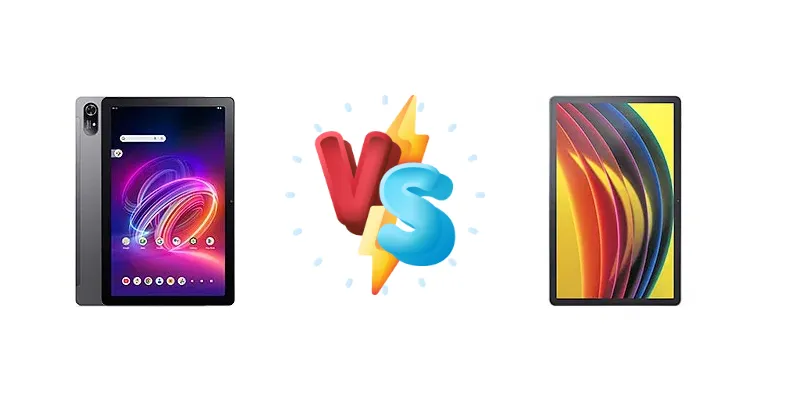
The mid-range Android tablet space is heating up, with both Acer and Lenovo offering compelling options. The Acer Iconia Tab P11 (2025) represents a newer iteration, boasting a more modern chipset, while the Lenovo Tab P11 Plus has established itself as a solid all-rounder. This comparison dissects the key differences between these two tablets, focusing on performance, efficiency, and real-world usability.
🏆 Quick Verdict
For the average user prioritizing sustained performance and future-proofing, the Acer Iconia Tab P11 (2025) is the better choice. Its Mediatek Helio G99, built on a 6nm process, offers a noticeable efficiency advantage over the Lenovo Tab P11 Plus’s 12nm Helio G90T, translating to less throttling during demanding tasks.
| Network |
|---|
| 2G bands | N/A | GSM 850 / 900 / 1800 / 1900 |
| 3G bands | N/A | HSDPA 850 / 900 / 1900 / 2100 |
| 4G bands | N/A | 1, 2, 3, 4, 5, 7, 8, 20, 28, 38, 40, 41 |
| EDGE | No | - |
| GPRS | No | - |
| Speed | - | HSPA, LTE - cellular model only |
| Technology | No cellular connectivity | GSM / HSPA / LTE |
| Launch |
|---|
| Announced | 2025, Q4 | 2021, June 28 |
| Status | Available. Released 2025, Q4 | Available. Released 2021, July 29 |
| Body |
|---|
| Build | Glass front, aluminum alloy frame | - |
| Dimensions | 265.2 x 169.9 x 8.1 mm (10.44 x 6.69 x 0.32 in) | 258.4 x 163 x 7.5 mm (10.17 x 6.42 x 0.30 in) |
| SIM | No | Nano-SIM (cellular model only) |
| Weight | 550 g (1.21 lb) | 490 g (1.08 lb) |
| | - | Stylus support |
| Display |
|---|
| Resolution | 1200 x 2000 pixels, 5:3 ratio (~212 ppi density) | 1200 x 2000 pixels, 5:3 ratio (~212 ppi density) |
| Size | 11.0 inches, 344.4 cm2 (~76.4% screen-to-body ratio) | 11.0 inches, 344.4 cm2 (~81.8% screen-to-body ratio) |
| Type | IPS LCD, 90Hz | IPS LCD, 400 nits (typ) |
| Platform |
|---|
| CPU | Octa-core (2x2.2 GHz Cortex-A76 & 6x2.0 GHz Cortex-A55) | Octa-core (2x2.05 GHz Cortex-A76 & 6x2.0 GHz Cortex-A55) |
| Chipset | Mediatek Helio G99 (6 nm) | Mediatek MT6785 Helio G90T (12 nm) |
| GPU | Mali-G57 MC2 | Mali-G76 MC4 |
| OS | Android 14 | Android 11 |
| Memory |
|---|
| Card slot | microSDXC (dedicated slot) | microSDXC (dedicated slot) |
| Internal | 256GB 6GB RAM, 256GB 8GB RAM | 64GB 4GB RAM, 128GB 4GB RAM, 128GB 6GB RAM |
| Main Camera |
|---|
| Features | LED flash | LED flash |
| Single | 13 MP, AF | 13 MP, (wide), AF |
| Video | 1080p@30fps | 1080p@30fps |
| Selfie camera |
|---|
| Single | 5 MP | 8 MP, (wide) |
| Video | Yes | 1080p@30fps |
| Sound |
|---|
| 3.5mm jack | - | No |
| 35mm jack | Yes | No |
| Loudspeaker | Yes, with stereo speakers (4 speakers) | Yes, with stereo speakers (4 speakers) |
| Comms |
|---|
| Bluetooth | Yes | 5.1, A2DP, LE |
| NFC | No | No |
| Positioning | Unspecified | GPS, GLONASS, BDS - cellular model only |
| Radio | No | FM radio |
| USB | USB Type-C 2.0 | USB Type-C 2.0 |
| WLAN | Wi-Fi 802.11 a/b/g/n/ac, dual-band | Wi-Fi 802.11 a/b/g/n/ac, dual-band, Wi-Fi Direct |
| Features |
|---|
| Sensors | Unspecified | Accelerometer, gyro, proximity |
| Battery |
|---|
| Charging | 20W wired | 20W wired |
| Type | 8000 mAh | Li-Po 7700 mAh |
| Misc |
|---|
| Colors | Iron Gray | Slate Grey, Platinum Grey, Modernist teal |
| Models | P11-11-8113 | ZA940124SE |
| Price | About 260 EUR | About 300 EUR |
Acer Iconia Tab P11 (2025)
- More efficient Mediatek Helio G99 chipset
- Potentially better sustained performance
- Likely longer battery life due to chipset efficiency
- May be slightly more expensive
- Detailed display specs are unknown
Lenovo Tab P11 Plus
- Proven track record and reliability
- Potentially lower price point
- Adequate performance for basic tasks
- Less efficient Mediatek Helio G90T chipset
- More prone to thermal throttling
- Shorter battery life under load
Display Comparison
Both tablets likely feature similar LCD panels, given their market positioning. However, detailed display specs (resolution, brightness, color gamut) are missing. The Acer, being a 2025 model, *may* benefit from slight panel improvements, but without concrete data, it's speculative. Bezels are likely comparable, aiming for a modern aesthetic without premium OLED costs. Color accuracy will likely be standard for this price range, suitable for general use but not professional color work.
Camera Comparison
Given the context data, a detailed camera comparison is limited. Both tablets likely feature similar camera setups focused on basic functionality. Without sensor size or aperture information, it's difficult to assess image quality. The presence of a 2MP macro camera on either device is unlikely to be a significant selling point, as these sensors typically lack detail and dynamic range. The primary camera's performance will be the deciding factor, but data is unavailable.
Performance
The core difference lies in the chipsets. The Acer Iconia Tab P11 (2025) utilizes the Mediatek Helio G99 (6nm), while the Lenovo Tab P11 Plus features the older Helio G90T (12nm). The 6nm process node of the G99 is significantly more efficient, meaning it generates less heat for the same level of performance. While both CPUs share the same core configuration (2x2.2 GHz Cortex-A76 & 6x2.0 GHz Cortex-A55), the G99’s architecture and process node allow it to maintain higher clock speeds for longer periods. This translates to smoother multitasking, faster app loading times, and improved gaming performance on the Acer. The G90T, while capable, is more prone to thermal throttling under sustained load.
Battery Life
Both tablets offer 20W wired charging, suggesting similar charging speeds (approximately 2-3 hours for a full charge). The actual battery capacity is not specified, but the Helio G99’s superior efficiency in the Acer Iconia Tab P11 (2025) will likely result in longer battery life during typical usage scenarios. Even with a similar battery capacity, the G99 will consume less power, extending the time between charges. The G90T, being less efficient, will drain the battery faster under load.
Buying Guide
Buy the Acer Iconia Tab P11 (2025) if you need a tablet capable of handling extended gaming sessions or multitasking without significant performance drops. Its newer chipset provides a more efficient experience. Buy the Lenovo Tab P11 Plus if you prioritize a proven track record and potentially lower pricing, and your usage primarily revolves around media consumption and light productivity tasks where sustained peak performance isn't critical.
Frequently Asked Questions
❓ Will the Acer Iconia Tab P11 (2025) handle demanding games like Genshin Impact at high settings?
While the Helio G99 is a capable chipset, Genshin Impact is a particularly demanding title. Expect playable frame rates at medium settings, but high settings may result in noticeable frame drops due to thermal throttling. The G99's efficiency will mitigate throttling compared to the G90T, but it won't eliminate it entirely.
❓ Is the difference in chipset performance between the Helio G99 and Helio G90T noticeable for everyday tasks like browsing and video streaming?
For basic tasks like web browsing, video streaming, and social media, the difference will be minimal. Both chipsets are more than capable of handling these workloads smoothly. However, the Acer's G99 will feel snappier when switching between multiple apps or loading complex web pages due to its faster processing speed and improved efficiency.
❓ Does the Lenovo Tab P11 Plus get noticeably hot during extended video playback or gaming?
The Helio G90T is known to generate more heat under load. During extended video playback, it may become warm to the touch. During gaming, it's likely to get significantly hotter, potentially leading to performance throttling to prevent overheating. The Acer Iconia Tab P11 (2025) should run cooler due to the more efficient G99 chipset.