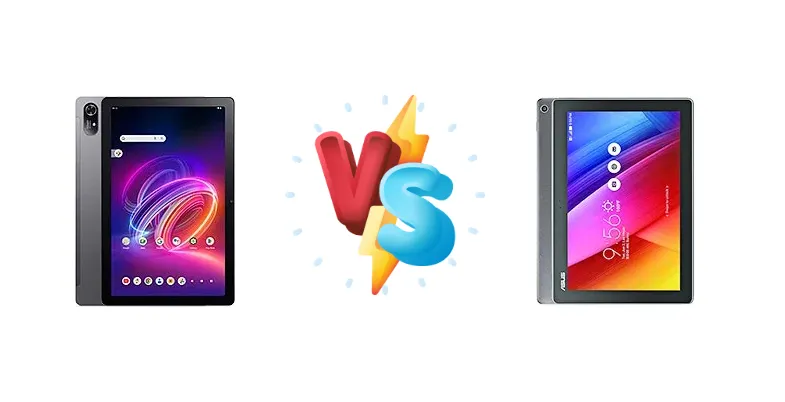
The tablet market offers a wide range of options, but finding the right balance between performance and price can be challenging. We're pitting the Acer Iconia Tab P11 (2025), a more recent release featuring a modern Mediatek Helio G99 chipset, against the Asus Zenpad 10 Z300M, a long-standing budget option powered by the older Mediatek MT8163. This comparison will dissect the key differences to help you determine which tablet best suits your needs.
🏆 Quick Verdict
For the average user, the Acer Iconia Tab P11 (2025) is the clear winner. Its significantly more powerful Mediatek Helio G99 chipset delivers a substantially smoother and more responsive experience, making it better suited for multitasking, gaming, and future-proofing. While the Zenpad 10 Z300M remains a viable ultra-budget option, its dated hardware struggles to keep pace.
| Network |
|---|
| 2G bands | N/A | N/A |
| 3G bands | N/A | - |
| 4G bands | N/A | - |
| EDGE | No | No |
| GPRS | No | No |
| Technology | No cellular connectivity | No cellular connectivity |
| Launch |
|---|
| Announced | 2025, Q4 | 2016, May. Released 2016, May |
| Status | Available. Released 2025, Q4 | Discontinued |
| Body |
|---|
| Build | Glass front, aluminum alloy frame | - |
| Dimensions | 265.2 x 169.9 x 8.1 mm (10.44 x 6.69 x 0.32 in) | 251.6 x 172 x 7.9 mm (9.91 x 6.77 x 0.31 in) |
| SIM | No | No |
| Weight | 550 g (1.21 lb) | 490 g (1.08 lb) |
| Display |
|---|
| Protection | - | Oleophobic coating |
| Resolution | 1200 x 2000 pixels, 5:3 ratio (~212 ppi density) | 800 x 1280 pixels, 16:10 ratio (~149 ppi density) |
| Size | 11.0 inches, 344.4 cm2 (~76.4% screen-to-body ratio) | 10.1 inches, 295.8 cm2 (~68.4% screen-to-body ratio) |
| Type | IPS LCD, 90Hz | IPS LCD |
| Platform |
|---|
| CPU | Octa-core (2x2.2 GHz Cortex-A76 & 6x2.0 GHz Cortex-A55) | Quad-core 1.5 GHz Cortex-A53 |
| Chipset | Mediatek Helio G99 (6 nm) | Mediatek MT8163 (28 nm) |
| GPU | Mali-G57 MC2 | Mali-T720MP2 |
| OS | Android 14 | Android 6.0 (Marshmallow) |
| Memory |
|---|
| Card slot | microSDXC (dedicated slot) | microSDXC (dedicated slot) |
| Internal | 256GB 6GB RAM, 256GB 8GB RAM | 16GB 2GB RAM, 32GB 2GB RAM |
| Main Camera |
|---|
| Features | LED flash | - |
| Single | 13 MP, AF | 5 MP, AF |
| Video | 1080p@30fps | Yes |
| Selfie camera |
|---|
| Single | 5 MP | 2 MP |
| Video | Yes | - |
| Sound |
|---|
| 3.5mm jack | - | Yes |
| 35mm jack | Yes | Yes |
| Loudspeaker | Yes, with stereo speakers (4 speakers) | Yes, with stereo speakers |
| Comms |
|---|
| Bluetooth | Yes | 4.0, aptX |
| NFC | No | No |
| Positioning | Unspecified | GPS, GLONASS |
| Radio | No | No |
| USB | USB Type-C 2.0 | microUSB 2.0 |
| WLAN | Wi-Fi 802.11 a/b/g/n/ac, dual-band | Wi-Fi 802.11 a/b/g/n |
| Features |
|---|
| Sensors | Unspecified | Accelerometer, compass |
| Battery |
|---|
| Charging | 20W wired | - |
| Talk time | - | Up to 11 h (multimedia) |
| Type | 8000 mAh | Li-Po 4890 mAh, non-removable (18 Wh) |
| Misc |
|---|
| Colors | Iron Gray | Dark Gray, Pearl White, Rose Gold |
| Models | P11-11-8113 | - |
| Price | About 260 EUR | - |
Acer Iconia Tab P11 (2025)
- Significantly faster processor (Helio G99)
- More efficient 6nm process for better battery life
- Faster 20W charging
- Likely improved display quality
- Potentially higher price point
- Detailed display specs unavailable
Asus Zenpad 10 Z300M
- Lower price point
- Simple and straightforward Android experience
- Lightweight and portable
- Adequate for basic tasks
- Outdated and slow processor (MT8163)
- Poor performance with multitasking and demanding apps
- Less efficient 28nm process
- Likely lower display quality
Display Comparison
While both tablets likely feature 10.1-inch displays (based on model naming conventions), the comparison stops there. Detailed display specs like resolution, brightness, and panel type are missing. However, given the Zenpad 10 Z300M's age, it likely utilizes an older IPS panel with lower brightness and color accuracy compared to what Acer would offer in a 2025 model. The P11 likely benefits from improved viewing angles and potentially a higher resolution, enhancing media consumption.
Camera Comparison
Given the budget nature of both tablets, camera performance is unlikely to be a key selling point. Detailed camera specs are unavailable, but it's safe to assume both feature basic camera setups. The Acer Iconia Tab P11 (2025) likely benefits from newer image processing algorithms and potentially a slightly better sensor, but don't expect flagship-level image quality from either device. Any 2MP macro or depth sensors on either device are likely to offer minimal practical benefit.
Performance
The performance gap is the most significant differentiator. The Acer Iconia Tab P11 (2025) boasts the Mediatek Helio G99 (6nm), an octa-core processor with 2x2.2 GHz Cortex-A76 and 6x2.0 GHz Cortex-A55 cores. This is a substantial leap over the Asus Zenpad 10 Z300M’s Mediatek MT8163 (28nm) quad-core 1.5 GHz Cortex-A53. The 6nm process node of the Helio G99 translates to significantly improved power efficiency and thermal management, allowing for sustained performance. The Cortex-A76 cores in the P11 are also architecturally superior to the A53 cores in the Zenpad, delivering a noticeable boost in single-core and multi-core performance. This difference will be acutely felt in app loading times, multitasking, and demanding applications.
Battery Life
Battery capacity details are missing for both devices. However, the Mediatek Helio G99’s 6nm process offers a significant advantage in power efficiency. While the Zenpad 10 Z300M might have a slightly larger battery, the P11’s more efficient chipset will likely result in comparable or even better real-world battery life. The Acer Iconia Tab P11 (2025) also supports 20W wired charging, which is faster than what the Zenpad 10 Z300M likely offers, reducing charging times.
Buying Guide
Buy the Acer Iconia Tab P11 (2025) if you need a tablet capable of handling modern apps, light gaming, and multitasking without significant lag. It's ideal for students, casual gamers, and anyone who values a responsive user experience. Buy the Asus Zenpad 10 Z300M if you prioritize absolute affordability and only require basic functionality like web browsing, email, and light media consumption – and are willing to accept noticeable performance limitations.
Frequently Asked Questions
❓ Will the Acer Iconia Tab P11 (2025) be able to handle demanding games like Genshin Impact?
While the Helio G99 is a capable processor, Genshin Impact is a very demanding game. The P11 will likely be able to run it at lower settings and frame rates, but don't expect a smooth, high-fidelity experience. The Zenpad 10 Z300M would struggle significantly, likely being unplayable.
❓ Is the Asus Zenpad 10 Z300M still a good option for reading ebooks and browsing the web?
Yes, the Zenpad 10 Z300M is perfectly adequate for basic tasks like reading ebooks, browsing the web, and checking email. However, you will notice slower loading times and occasional lag compared to more modern tablets. If these tasks are your primary use case and budget is a major concern, it remains a viable option.
❓ What kind of storage options are available for the Acer Iconia Tab P11 (2025)?
Storage options are not specified in the provided data. However, based on Acer's typical offerings, it's likely to come in configurations of 64GB or 128GB, with microSD card support for expansion. This is a significant advantage over the Zenpad, which may have limited storage options.