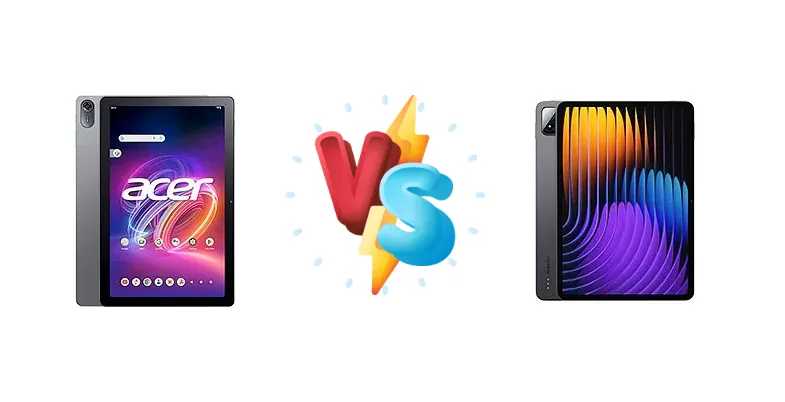
The Android tablet market is heating up, with options ranging from budget-friendly media consumption devices to powerful productivity machines. We're pitting the Acer Iconia Tab P10 (2025), a value-focused offering, against the Xiaomi Pad 7 Pro, a device aiming for a more premium experience with a focus on performance and rapid charging. This comparison will dissect the key differences to help you determine which tablet best suits your needs.
🏆 Quick Verdict
For the average user prioritizing performance and convenience, the Xiaomi Pad 7 Pro is the clear winner. Its Snapdragon 8s Gen 3 chipset offers a substantial leap in processing power, and the 67W charging is a game-changer. However, the Acer Iconia Tab P10 (2025) remains a viable option for those on a tight budget who prioritize basic functionality.
| Network |
|---|
| 2G bands | N/A | N/A |
| 3G bands | N/A | N/A |
| 4G bands | N/A | - |
| EDGE | No | N/A |
| GPRS | No | N/A |
| Technology | No cellular connectivity | No cellular connectivity |
| Launch |
|---|
| Announced | 2025, Q4 | 2024, October 29 |
| Status | Available. Released 2025, Q4 | Available. Released 2024, October 29 |
| Body |
|---|
| Build | Glass front, aluminum alloy frame | Glass front, aluminum frame, aluminum back |
| Dimensions | 8.1 mm thickness | 251.2 x 173.4 x 6.2 mm (9.89 x 6.83 x 0.24 in) |
| SIM | No | No |
| Weight | 495 g (1.09 lb) | 500 g (1.10 lb) |
| Display |
|---|
| Resolution | 1200 x 2000 pixels, 5:3 ratio (~224 ppi density) | 2136 x 3200 pixels, 3:2 ratio (~345 ppi density) |
| Size | 10.4 inches, 307.9 cm2 | 11.2 inches, 371.5 cm2 (~85.3% screen-to-body ratio) |
| Type | IPS LCD, 90Hz | IPS LCD, 68B colors, 144Hz, HDR10, Dolby Vision, 800 nits (peak) |
| Platform |
|---|
| CPU | Octa-core (2x2.2 GHz Cortex-A76 & 6x2.0 GHz Cortex-A55) | Octa-core (1x3.0 GHz Cortex-X4 & 4x2.8 GHz Cortex-A720 & 3x2.0 GHz Cortex-A520) |
| Chipset | Mediatek Helio G99 (6 nm) | Qualcomm SM8635 Snapdragon 8s Gen 3 (4 nm) |
| GPU | Mali-G57 MC2 | Adreno 735 |
| OS | Android 14 | Android 15, HyperOS 2 |
| Memory |
|---|
| Card slot | microSDXC (dedicated slot) | No |
| Internal | 128GB 6GB RAM, 256GB 6GB RAM | 128GB 8GB RAM, 256GB 8GB RAM, 256GB 12GB RAM, 512GB 12GB RAM |
| Main Camera |
|---|
| Dual | - | 50 MP, f/1.8, (wide), 1/2.76", 0.64µm, PDAF
Auxiliary lens |
| Features | - | LED flash, HDR, panorama |
| Single | 13 MP | - |
| Video | 1080p@30fps | 4K@30/60fps, 1080p@30/60fps |
| Selfie camera |
|---|
| Features | - | HDR |
| Single | 5 MP | 32 MP, f/2.2, 19mm (ultrawide), 1/3.6", 0.61µm |
| Video | Yes | 1080p@30fps |
| Sound |
|---|
| 35mm jack | Yes | No |
| Loudspeaker | Yes, with stereo speakers | Yes, with stereo speakers (4 speakers) |
| Comms |
|---|
| Bluetooth | 5.0, A2DP, LE | 5.4, A2DP, LE, LHDC 5 |
| Infrared port | - | Yes |
| NFC | No | No |
| Positioning | GPS | No |
| Radio | No | No |
| USB | USB Type-C 2.0 | USB Type-C 3.2, accessory connector |
| WLAN | Wi-Fi 802.11 a/b/g/n/ac, dual-band | Wi-Fi 802.11 a/b/g/n/ac/6e/7, dual-band, Wi-Fi Direct |
| Features |
|---|
| Sensors | Gyro | Fingerprint (side-mounted), accelerometer, gyro, proximity, compass |
| Battery |
|---|
| Charging | 10W wired | 67W wired, PD3.0, QC3+, 40% in 20 min |
| Type | Li-Ion 8000 mAh | 8850 mAh |
| Misc |
|---|
| Colors | Iron Gray | Gray, Blue, Green |
| Models | P10-21Q-870Q, NT.LHBAA.001 | 24091RPADG |
| Price | About 220 EUR | About 500 EUR |
| SAR EU | - | 0.99 W/kg (body) |
Acer Iconia Tab P10 (2025)
- More affordable price point
- Sufficient for basic tasks
- Likely lighter and more portable
- Significantly slower charging
- Less powerful processor
- Inferior performance for gaming and multitasking
Xiaomi Pad 7 Pro
- Much faster charging (67W)
- Significantly more powerful processor (Snapdragon 8s Gen 3)
- Better performance for demanding applications
- Likely superior camera performance
- Higher price tag
- Potentially heavier than the Acer
Display Comparison
While display specifications are missing for the Acer Iconia Tab P10 (2025), we can infer it targets a more budget-conscious market, likely featuring a standard LCD panel. The Xiaomi Pad 7 Pro, however, benefits from the efficiency of its Snapdragon chipset, potentially allowing for a higher resolution and refresh rate display. The absence of LTPO technology in either device suggests neither will dynamically adjust refresh rates for optimal battery savings. Bezels are likely to be more pronounced on the Acer, contributing to a lower screen-to-body ratio.
Camera Comparison
Given the tablet form factor, camera performance isn't a primary concern for most users. However, the Xiaomi Pad 7 Pro is likely to feature a more sophisticated camera system, benefiting from the image signal processor (ISP) within the Snapdragon 8s Gen 3. Without specific camera specs for the Acer Iconia Tab P10 (2025), it's safe to assume a more basic setup. The Xiaomi’s ISP will likely offer better dynamic range and noise reduction, resulting in more pleasing images in various lighting conditions.
Performance
The core difference lies in the chipsets. The Xiaomi Pad 7 Pro’s Qualcomm SM8635 Snapdragon 8s Gen 3 (4nm) is a significant upgrade over the Acer’s Mediatek Helio G99 (6nm). The Snapdragon 8s Gen 3 features a Cortex-X4 prime core clocked at 3.0 GHz, alongside Cortex-A720 performance cores, offering substantially higher single-core and multi-core performance. The 4nm process node of the Snapdragon also translates to improved thermal efficiency, reducing throttling during sustained workloads. The Helio G99, while capable for everyday tasks, will struggle with demanding games or intensive applications. The Xiaomi Pad 7 Pro is the clear winner for users who need processing power.
Battery Life
The Xiaomi Pad 7 Pro boasts a significant advantage in charging speed with its 67W wired charging, supporting PD3.0 and QC3+, achieving 40% charge in just 20 minutes. The Acer Iconia Tab P10 (2025) is limited to 10W wired charging, resulting in a considerably slower charging experience. While the Xiaomi Pad 7 Pro’s active use score of 10:12h is a good benchmark, the faster charging mitigates concerns about battery life, allowing for quick top-ups throughout the day. The Acer’s slower charging will require significantly more time to replenish the battery.
Buying Guide
Buy the Acer Iconia Tab P10 (2025) if you need a basic, affordable tablet for light tasks like web browsing, email, and occasional video streaming, and aren't concerned with demanding applications or fast charging. Buy the Xiaomi Pad 7 Pro if you prioritize performance for gaming, multitasking, or creative work, and value the convenience of incredibly fast charging and a more responsive user experience.
Frequently Asked Questions
❓ How much faster is the Xiaomi Pad 7 Pro's charging compared to the Acer Iconia Tab P10 (2025)?
The Xiaomi Pad 7 Pro's 67W charging is dramatically faster. It can achieve 40% charge in 20 minutes, while the Acer Iconia Tab P10 (2025) with its 10W charging will take several hours to reach a similar charge level. This difference is crucial for users who need to quickly top up their tablet during short breaks.
❓ Will the Mediatek Helio G99 in the Acer Iconia Tab P10 (2025) be sufficient for playing modern Android games?
While the Helio G99 can handle some less demanding games, it will likely struggle with graphically intensive titles at higher settings. Expect lower frame rates and potential stuttering. The Snapdragon 8s Gen 3 in the Xiaomi Pad 7 Pro offers a significantly smoother gaming experience.
❓ Is the Xiaomi Pad 7 Pro likely to overheat during prolonged gaming sessions?
The Snapdragon 8s Gen 3's 4nm process node is designed for improved thermal efficiency. While some heat generation is inevitable during intense gaming, the Xiaomi Pad 7 Pro is less likely to experience significant throttling compared to devices with less efficient chipsets. However, sustained heavy use will still generate heat.