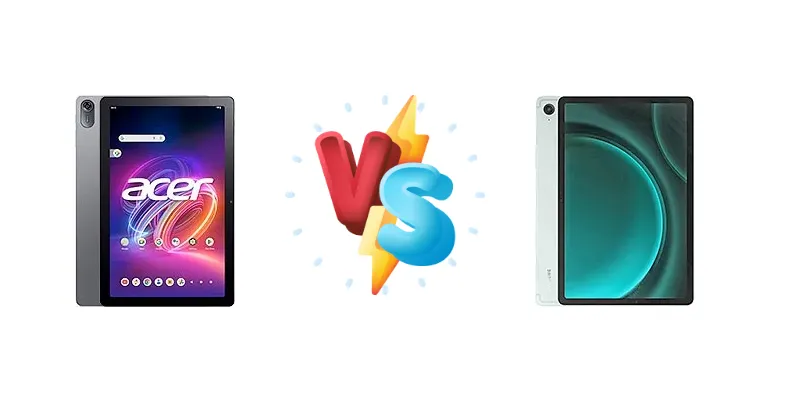
The mid-range tablet market is heating up, with the Acer Iconia Tab P10 (2025) and Samsung Galaxy Tab S9 FE vying for attention. Both aim to deliver a solid Android experience without breaking the bank, but they take different approaches to performance and features. This comparison dives deep into the specifications to determine which tablet offers the best value for your money.
🏆 Quick Verdict
For the average user prioritizing fast charging and a more powerful processor, the Samsung Galaxy Tab S9 FE is the better choice. Its Exynos 1380 chipset and 45W charging significantly outperform the Acer Iconia Tab P10 (2025)'s Helio G99 and 10W charging, justifying the potential price difference.
| Network |
|---|
| 2G bands | N/A | GSM 850 / 900 / 1800 / 1900 |
| 3G bands | N/A | HSDPA 850 / 900 / 1700(AWS) / 1900 / 2100 |
| 4G bands | N/A | 1, 2, 3, 4, 5, 7, 8, 12, 13, 17, 20, 26, 28, 32, 38, 40, 41, 66 |
| 5G bands | - | 1, 3, 5, 7, 8, 20, 28, 38, 40, 41, 66, 77, 78 SA/NSA/Sub6 |
| EDGE | No | - |
| GPRS | No | - |
| Speed | - | HSPA, LTE, 5G - cellular model only |
| Technology | No cellular connectivity | GSM / HSPA / LTE / 5G |
| Launch |
|---|
| Announced | 2025, Q4 | 2023, October 04 |
| Status | Available. Released 2025, Q4 | Available. Released 2023, October 16 |
| Body |
|---|
| Build | Glass front, aluminum alloy frame | Glass front, aluminum back, aluminum frame |
| Dimensions | 8.1 mm thickness | 254.3 x 165.8 x 6.5 mm (10.01 x 6.53 x 0.26 in) |
| SIM | No | Nano-SIM + eSIM (cellular model only) |
| Weight | 495 g (1.09 lb) | 523 g or 524 g (1.15 lb) |
| Display |
|---|
| Resolution | 1200 x 2000 pixels, 5:3 ratio (~224 ppi density) | 1440 x 2304 pixels, 16:10 ratio (~249 ppi density) |
| Size | 10.4 inches, 307.9 cm2 | 10.9 inches, 344.5 cm2 (~81.7% screen-to-body ratio) |
| Type | IPS LCD, 90Hz | IPS LCD, 90Hz |
| Platform |
|---|
| CPU | Octa-core (2x2.2 GHz Cortex-A76 & 6x2.0 GHz Cortex-A55) | Octa-core (4x2.4 GHz Cortex-A78 & 4x2.0 GHz Cortex-A55) |
| Chipset | Mediatek Helio G99 (6 nm) | Exynos 1380 (5 nm) |
| GPU | Mali-G57 MC2 | Mali-G68 MP5 |
| OS | Android 14 | Android 13, up to 4 major Android upgrades, One UI 6 |
| Memory |
|---|
| Card slot | microSDXC (dedicated slot) | microSDXC (dedicated slot) |
| Internal | 128GB 6GB RAM, 256GB 6GB RAM | 128GB 6GB RAM, 128GB 8GB RAM, 256GB 8GB RAM |
| Main Camera |
|---|
| Single | 13 MP | 8 MP, (wide) |
| Video | 1080p@30fps | 4K@30fps, 1080p@30fps |
| Selfie camera |
|---|
| Single | 5 MP | 12 MP, (ultrawide) |
| Video | Yes | Yes |
| Sound |
|---|
| 35mm jack | Yes | No |
| Loudspeaker | Yes, with stereo speakers | Yes, with stereo speakers |
| Comms |
|---|
| Bluetooth | 5.0, A2DP, LE | 5.3, A2DP, LE |
| NFC | No | No |
| Positioning | GPS | GPS, GALILEO, GLONASS, BDS, QZSS - cellular model only |
| Radio | No | No |
| USB | USB Type-C 2.0 | USB Type-C 2.0, magnetic connector |
| WLAN | Wi-Fi 802.11 a/b/g/n/ac, dual-band | Wi-Fi 802.11 a/b/g/n/ac/6, dual-band, Wi-Fi Direct |
| Features |
|---|
| Sensors | Gyro | Fingerprint (side-mounted), accelerometer, gyro, compass, proximity (accessories only) |
| Battery |
|---|
| Charging | 10W wired | 45W wired, QC2.0 |
| Type | Li-Ion 8000 mAh | Li-Po 8000 mAh |
| Misc |
|---|
| Colors | Iron Gray | Mint, Silver, Gray, Lavender |
| Models | P10-21Q-870Q, NT.LHBAA.001 | SM-X510, SM-X516B |
| Price | About 220 EUR | About 300 EUR |
| SAR | - | 1.55 W/kg (body) |
| SAR EU | - | 0.59 W/kg (body) |
Acer Iconia Tab P10 (2025)
- Potentially lower price point
- Sufficient for basic tasks
- Mediatek Helio G99 is a proven performer for its class
- Slow 10W charging
- Less powerful processor compared to the Exynos 1380
- Likely less efficient chipset
Samsung Galaxy Tab S9 FE
- Faster Exynos 1380 processor
- 45W fast charging with QC2.0
- More efficient 5nm process
- Potentially higher price
- May not be a significant upgrade for very basic users
- Samsung's software can be resource intensive
Display Comparison
While display specifications are not provided, it's reasonable to assume both tablets utilize IPS LCD panels given their price points. However, the Samsung Galaxy Tab S9 FE likely benefits from Samsung’s display expertise, potentially offering slightly better color accuracy and viewing angles. The lack of information on refresh rates suggests both are likely capped at 60Hz. Bezels are expected to be comparable, focusing on cost optimization rather than premium aesthetics.
Camera Comparison
Given the context, camera performance is unlikely to be a deciding factor for either tablet. Both will likely feature basic camera setups suitable for casual snapshots and video calls. Without specific sensor details, it’s safe to assume image quality will be comparable, leaning towards acceptable in good lighting conditions. The absence of information suggests neither tablet prioritizes camera capabilities.
Performance
The core difference lies in the chipsets. The Samsung Galaxy Tab S9 FE’s Exynos 1380, fabricated on a 5nm process, offers a clear advantage over the Acer Iconia Tab P10 (2025)’s Mediatek Helio G99 (6nm). The Exynos 1380’s Cortex-A78 cores (2.4 GHz) are architecturally superior to the Helio G99’s Cortex-A76 cores (2.2 GHz), translating to faster application loading and smoother multitasking. The 5nm process also contributes to better power efficiency, potentially leading to longer battery life under load. While both use Cortex-A55 cores for efficiency, the Exynos 1380’s four cores versus the Helio G99’s six provide a balanced approach to performance and power consumption.
Battery Life
Battery capacity is not specified, but the charging capabilities highlight a significant difference. The Samsung Galaxy Tab S9 FE’s 45W wired charging with QC2.0 support allows for a much faster 0-100% charge compared to the Acer Iconia Tab P10 (2025)’s slow 10W charging. This means less downtime and more usability, especially for users who rely on their tablets throughout the day. While a larger battery capacity on the Acer could partially offset the charging disadvantage, the Exynos 1380’s improved power efficiency on the Samsung likely provides a net benefit in real-world usage.
Buying Guide
Buy the Acer Iconia Tab P10 (2025) if you need a basic tablet for light tasks like reading, web browsing, and occasional video streaming, and are on a very tight budget. Its Helio G99 is sufficient for these workloads. Buy the Samsung Galaxy Tab S9 FE if you prefer a more responsive experience for multitasking, gaming, and content creation, and value the convenience of significantly faster charging speeds and a more modern chipset.
Frequently Asked Questions
❓ Does the Exynos 1380 in the Galaxy Tab S9 FE tend to overheat during prolonged gaming sessions?
The Exynos 1380, built on a 5nm process, is generally efficient and well-managed in terms of thermal performance. While it may get warm during extended gaming, it's unlikely to experience significant throttling compared to the Helio G99, which has a less efficient 6nm process. Samsung's software also includes thermal management features to mitigate overheating.
❓ How long will it realistically take to fully charge the Acer Iconia Tab P10 (2025) from 0% with its 10W charging?
With 10W charging, a full charge from 0% on the Acer Iconia Tab P10 (2025) will likely take between 3-5 hours, depending on battery capacity. This is significantly slower than the Samsung Galaxy Tab S9 FE, which can achieve a full charge in well under 2 hours with its 45W fast charging.
❓ Is the performance difference between the Helio G99 and Exynos 1380 noticeable for everyday tasks like browsing and video streaming?
For basic tasks like web browsing and video streaming, the difference may not be immediately apparent. However, the Exynos 1380’s superior processing power will result in snappier app launches, smoother multitasking, and a more responsive overall experience, especially when switching between applications.