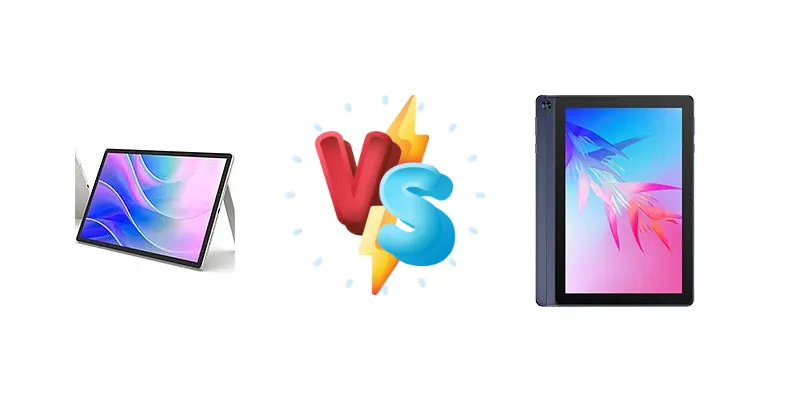
The Acer Iconia A14 and Huawei MatePad T 10 represent the entry-level segment of the Android tablet market. Both aim to deliver a functional tablet experience without breaking the bank, but they achieve this with different approaches to silicon. This comparison focuses on the core performance differences stemming from their respective chipsets – the Allwinner A733 in the Iconia A14 and the Kirin 710A in the MatePad T 10 – and how those differences translate to real-world usage.
🏆 Quick Verdict
For the average user prioritizing sustained performance and a slightly more modern CPU architecture, the Acer Iconia A14 emerges as the better choice. Its Allwinner A733 chipset, built on a 12nm process, offers a performance edge over the older 14nm Kirin 710A, particularly in multi-threaded tasks. However, the MatePad T 10 remains a viable option for basic media consumption and light tasks.
| Network |
|---|
| 2G bands | N/A | GSM 850 / 900 / 1800 / 1900 |
| 3G bands | N/A | HSDPA 800 / 850 / 900 / 1900 / 2100 |
| 4G bands | N/A | 1, 3, 5, 7, 8, 18, 19, 20, 26, 28, 38, 40, 41 |
| EDGE | No | - |
| GPRS | No | - |
| Speed | - | HSPA, LTE - cellular model only |
| Technology | No cellular connectivity | GSM / HSPA / LTE |
| Launch |
|---|
| Announced | 2025, September 03 | 2021, April 20 |
| Status | Available. Released 2025, November | Available. Released 2021, April 23 |
| Body |
|---|
| Build | Glass front, aluminum frame | - |
| Dimensions | 324.6 x 211 x 8 mm (12.78 x 8.31 x 0.31 in) | 240.2 x 159 x 7.9 mm (9.46 x 6.26 x 0.31 in) |
| SIM | No | Nano-SIM (cellular model only) |
| Weight | 910 g (2.01 lb) | 450 g (0.99 lb) |
| Display |
|---|
| Resolution | 1200 x 1920 pixels, 16:10 ratio (~162 ppi density) | 800 x 1280 pixels, 16:10 ratio (~156 ppi density) |
| Size | 14.0 inches, 568.3 cm2 (~83.0% screen-to-body ratio) | 9.7 inches, 272.8 cm2 (~71.4% screen-to-body ratio) |
| Type | IPS LCD | IPS LCD |
| Platform |
|---|
| CPU | Octa-core (2x2.0 GHz Cortex-A76 & 6x1.8 GHz Cortex-A55) | Octa-core (4x2.0 GHz Cortex-A73 & 4x1.7 GHz Cortex-A53) |
| Chipset | Allwinner A733 (12 nm) | Kirin 710A (14 nm) |
| GPU | IMG BXM-4-64 MC01 | Mali-G51 MP4 |
| OS | Android 15 | Android 10, EMUI 10.1, no Google Play Services |
| Memory |
|---|
| Card slot | microSDXC (dedicated slot) | microSDXC |
| Internal | 256GB 8GB RAM | 16GB 2GB RAM, 32GB 2GB RAM, 32GB 4GB RAM, 64GB 2GB RAM, 64GB 4GB RAM |
| Main Camera |
|---|
| Features | LED flash | HDR, panorama |
| Single | 8 MP, AF | 5 MP, f/2.2, PDAF |
| Video | 1080p@30fps | 1080p@30fps |
| Selfie camera |
|---|
| Single | 5 MP | 2 MP, f/2.4 |
| Video | Yes | 720p@30fps |
| Sound |
|---|
| 35mm jack | Yes | Yes |
| Loudspeaker | Yes, with stereo speakers (4 speakers) | Yes, with stereo speakers |
| Comms |
|---|
| Bluetooth | 5.4, A2DP, LE | 4.2, A2DP, LE |
| NFC | No | No |
| Positioning | No | GPS, GLONASS, BDS - cellular model only |
| Radio | No | No |
| USB | USB Type-C 2.0 | USB Type-C 2.0, OTG |
| WLAN | Wi-Fi 802.11 a/b/g/n/ac/6, dual-band | Wi-Fi 802.11 a/b/g/n/ac, dual-band, Wi-Fi Direct |
| Features |
|---|
| Sensors | Accelerometer | Accelerometer |
| Battery |
|---|
| Type | 8000 mAh | Li-Po 5100 mAh |
| Misc |
|---|
| Colors | Vapor Silver | Deepsea Blue |
| Models | A14-M1N | AGRK-L09, AGRK-W09, AGR-L09 |
| Price | About 260 EUR | About 150 EUR |
Acer Iconia A14
- More modern CPU architecture (Cortex-A76)
- Potentially better thermal management due to 12nm process
- Likely smoother performance in demanding apps
- Brand recognition may be lower than Huawei
- Camera specifications unknown, potentially average
Huawei MatePad T 10
- Established brand reputation (Huawei)
- Potentially wider software support and updates
- May integrate well with other Huawei devices
- Older CPU architecture (Cortex-A73)
- Less efficient 14nm manufacturing process
- Likely lower sustained performance
Display Comparison
Neither Acer nor Huawei provide detailed display specifications in the provided data. However, given the price point, both tablets likely utilize IPS LCD panels. The absence of information regarding refresh rates suggests both are limited to standard 60Hz. The real-world impact of display quality will likely be minimal for typical use cases, but the lack of higher resolution or advanced features like LTPO limits their appeal for media professionals or users prioritizing visual fidelity.
Camera Comparison
Unfortunately, the provided data doesn't offer any camera specifications for either device. Given their positioning in the budget tablet market, it's safe to assume both tablets feature basic camera setups geared towards video calls and casual snapshots rather than photography enthusiasts. Expect limited low-light performance and average image quality. Without specific sensor details, a meaningful comparison is impossible.
Performance
The core of the difference lies in the chipsets. The Acer Iconia A14’s Allwinner A733 features a combination of 2x 2.0 GHz Cortex-A76 cores and 6x 1.8 GHz Cortex-A55 cores. This architecture is demonstrably more efficient and powerful than the Huawei MatePad T 10’s Kirin 710A, which utilizes 4x 2.0 GHz Cortex-A73 cores and 4x 1.7 GHz Cortex-A53 cores. The Cortex-A76 offers a significant IPC (Instructions Per Clock) improvement over the A73, meaning the Iconia A14 can process more data per clock cycle. Furthermore, the A733’s 12nm manufacturing process is more efficient than the Kirin 710A’s 14nm process, potentially leading to better thermal management and sustained performance. While both are octa-core CPUs, the architectural advantages of the Allwinner A733 translate to a noticeable performance boost in CPU-intensive tasks.
Battery Life
Again, battery capacity and charging wattage are not provided. However, considering the chipsets, the Allwinner A733’s improved efficiency in the Iconia A14 could translate to slightly better battery life despite potentially having a similar capacity battery to the MatePad T 10. The 12nm process allows for lower power consumption at similar performance levels. Without concrete numbers, this remains speculative, but the A733’s efficiency is a key factor.
Buying Guide
Buy the Acer Iconia A14 if you need a tablet capable of handling moderate multitasking, streaming video, and light gaming without significant slowdowns. Its newer CPU architecture provides a smoother experience for demanding applications. Buy the Huawei MatePad T 10 if you prioritize a well-established brand ecosystem and primarily intend to use the tablet for basic tasks like reading, web browsing, and occasional video playback, and are less concerned with demanding performance.
Frequently Asked Questions
❓ Will the Allwinner A733 in the Acer Iconia A14 struggle with graphically intensive games?
While the A733 isn't a gaming powerhouse, it should handle most casual Android games at medium settings. However, demanding titles like Genshin Impact may require significant compromises in graphics settings to maintain playable frame rates. The Kirin 710A in the MatePad T 10 will likely perform even worse in these scenarios.
❓ Does the Huawei MatePad T 10 support Google Mobile Services (GMS)?
Huawei's situation with GMS is complex. The MatePad T 10 typically ships with Huawei Mobile Services (HMS) instead of GMS. This means you'll be relying on Huawei's AppGallery and potentially workarounds to access popular Google apps like YouTube and Gmail. The Acer Iconia A14 comes with full GMS support.
❓ Which tablet is better for multitasking – running multiple apps simultaneously?
The Acer Iconia A14, with its newer Cortex-A76 cores and more efficient chipset, is better equipped for multitasking. It will handle switching between apps and running them in the background with less lag and slowdown compared to the Huawei MatePad T 10.